In praise of Candle Power

candle 1

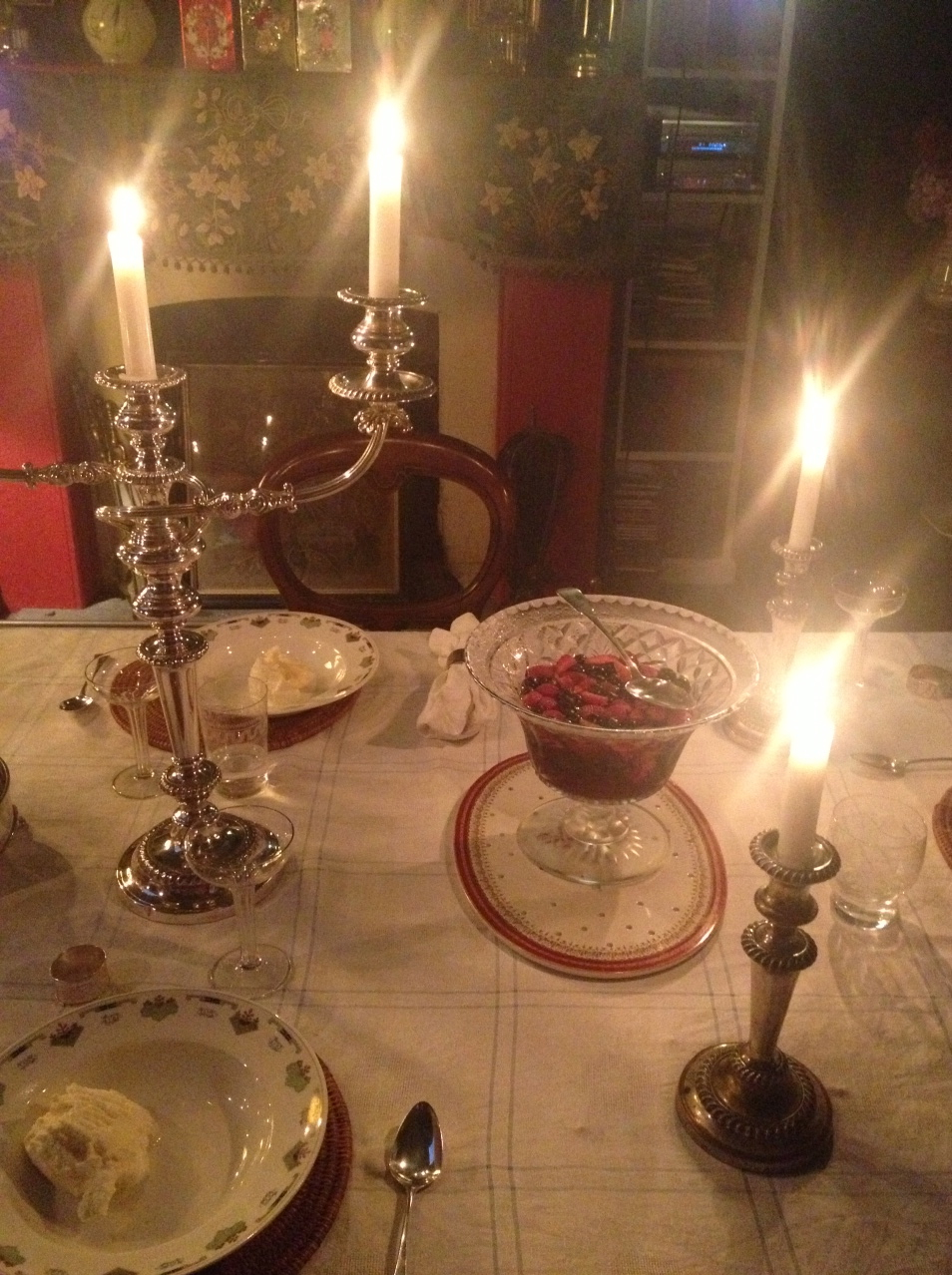
A candle-lit dinner. Photograph by regular guest Claire Regnault.

A good friend of mine, married to a professional fireman, lives without candlelight. Indeed she lives in a house from which all forms of naked flame are exiled.

Her husband has, somewhat sadly, seen too much melancholy evidence of what happens when it all turns to custard. I, no particular extreme risk taker, could not imagine a house in which candles were never lit, they seem so much a part of making a room work.

Candle-lit dinners are not reserved for visitors (or romantic events). Most nights there are candles on the table. Except at the height of summer – but even then there tends to be a stick with an unlit candle somewhere.

On other occasions candles get lit in the studio or library to add a little ambiance to the lighting of the room in which the overhead lights are dimmed and the other lights pooled.

So many of the items that we collect here were designed if not for candle-lit then gas-lit rooms that had a much lower level of light than the all-penetrating light of modern fittings. Therefore objects were designed to reflect light – in order to bounce it around a bit more and make the room more sparkling. Most obvious are the mirrored overmantles and chunky gilt frames, but cut crystal and china with a gilded stripe or the spine of a book splashed with gold, were all part of the same attempt at a symphonic reflection of light.

Candle light is of course wonderfully flattering. The warm sparkle of a candle, or group of candles, placed between you and the person across a dinner table almost always bathes both in a kinder light.

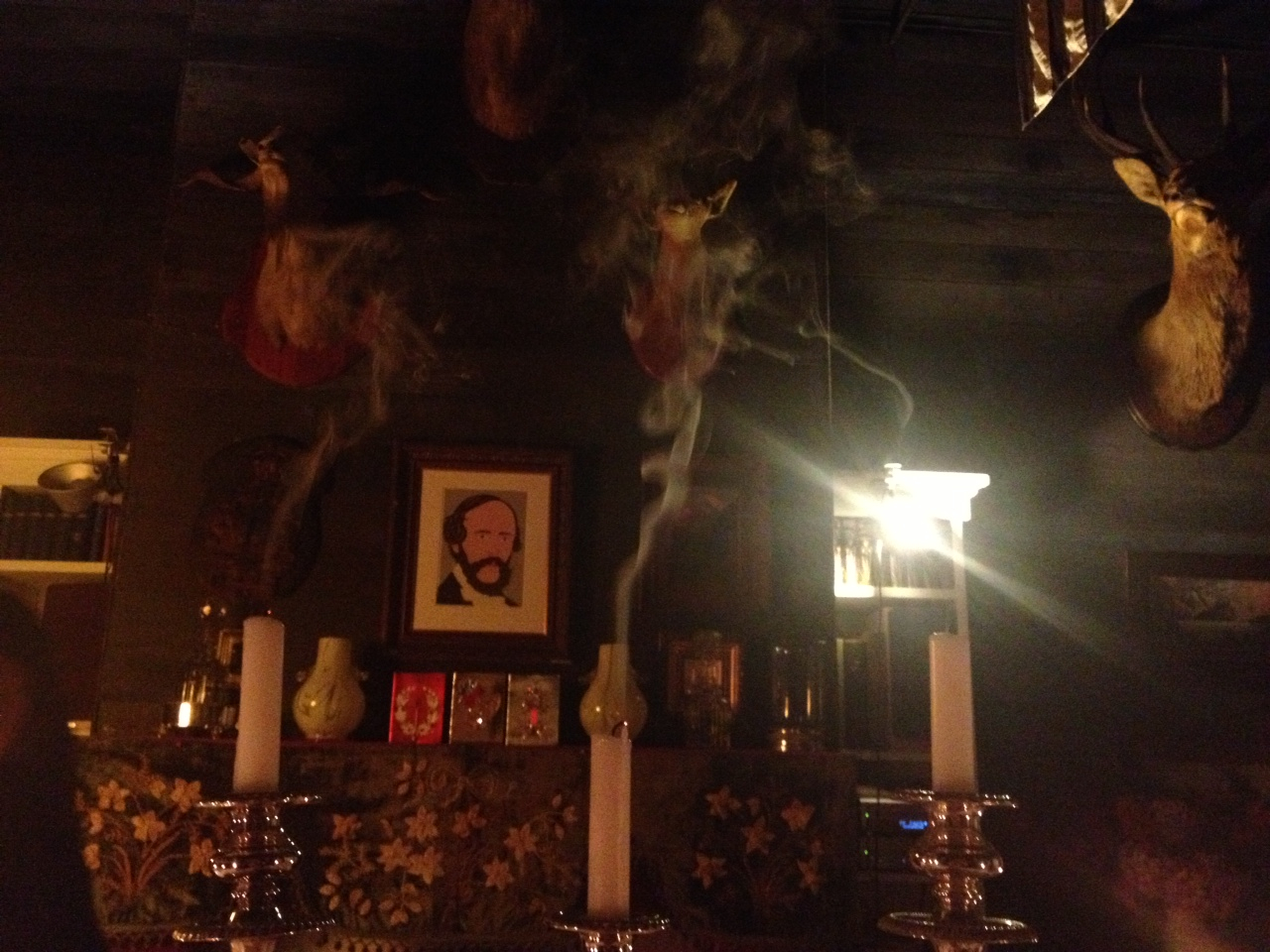
However one of the nicest moments in a candle-lit dinner is when it’s all over and you put out the candles. We have a little brass candlesnuffer and once it’s done its job it sends enormous curling plumes of white smoke high into the dark blue painted ceiling of the Studio. For a moment the room is cast in darkness with only the smoke still providing plumes of light as it billows up into the ceiling.  For me this makes the risk worthwhile.

candle 2

The best moment of all – again captured by Claire.

DLJ

Posted in inspiration, original surfaces, practical matters, Uncategorized | Tagged , , | Leave a comment

taking care of tapa cloth

good tapa 2

Tapa cloth has always played a big role in New Zealand decorating due to its ready availability. Go back thirty years and there was barely a student flat in which someone didn’t have a large tapa (or at least a scrap) pinned to the wall. These were often tourist items, acquired by parents and grandparents on Pacific Island holidays or latterly from second-hand shops (where they were deposited by other people’s grandparents).  Auckland’s burgeoning Pacific Island population also became a source.

However our fascination goes back way longer than that to the Victorian collectors of Pacific material who used tapa to decorate their houses or as a background to other ethnographic displays such as clubs and spears. (There is a fascinating book of Tapa collected by Captain Cook in the Sir George Grey Collection, Auckland Public Library.)

thumbnail

Major Alexander’s office, Government House, Wellington (1903)
Ranfurly family :Photographs. Ref: PA1-f-194-45-1. Alexander Turnbull Library, Wellington, New Zealand. http://natlib.govt.nz/records/22878649

Even now there is a lot of tapa cloth around and it’s a mix between the serious collectible, the tourist oriented mid-century productions and those pieces brought in by  migrant families. Between Peter and myself we’ve collected a fair bit of tapa individually over the years. This now hangs in the back hall, one of the spaces we have yet to decorate in any official way. There they have other items on top of them in a Victorian manner. We like tapa, but we haven’t bought new ones for years. The fact that we are thinking of getting on with the back hall had us recently thinking about tapa gain.

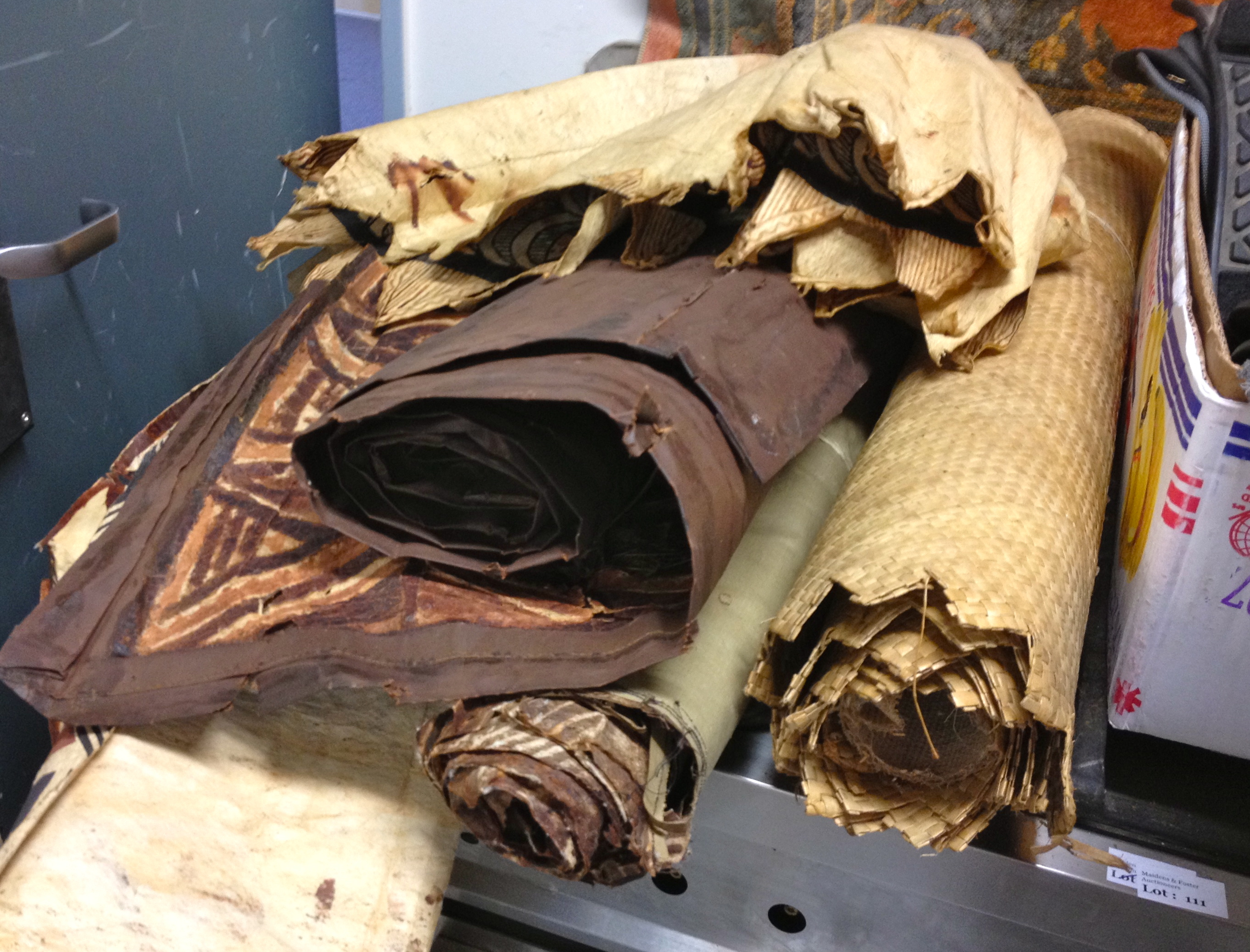
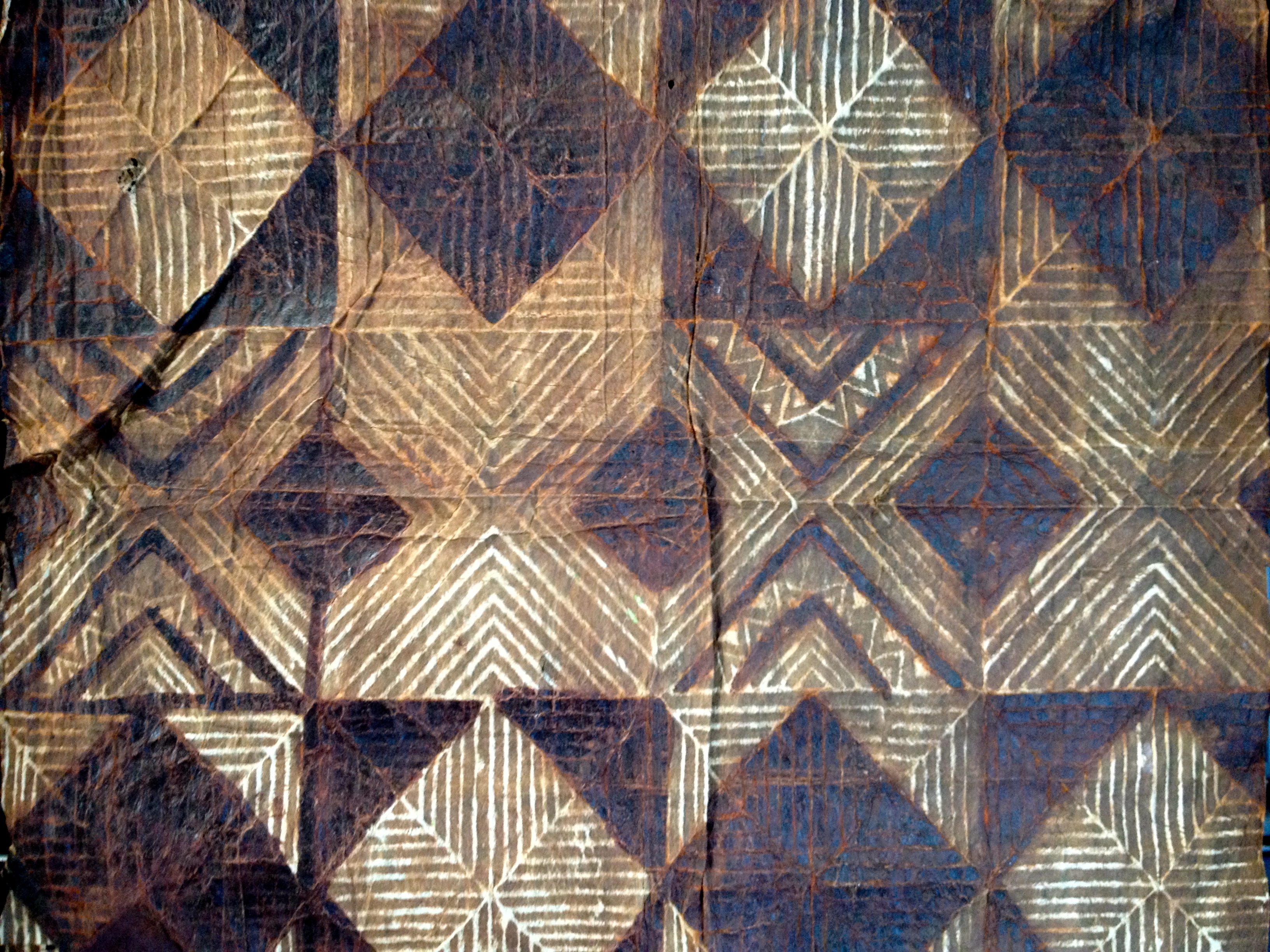
Then last week tucked in a corner at M&F were a group of rolled up tapa all of different origin, shape and condition. They came with an allusion to a local estate of good provenance and clearly had some age to them. They were also somewhat worn and neglected. Some of them had been sewn down to what seemed to be old roller blinds. Others had hessian attached suggesting they might once have been pasted directly on to scrim-lined walls. Some had been used as drop cloths during interior painting projects. We didn’t mind much because we wanted some pieces that we might cut up to deal with difficult to cover areas of hall wall.This seemed a good idea, because there’s plenty of tapa around and these were shagged or so it seemed.

at MF

An unassuming bundle at Maidens and Foster

On getting them home and unrolling them it seemed that some of the pieces were a little more than touristic and that in some cases they appeared rather older than first thought. Change of approach required.  It seemed that the likelihood of these being chopped up and pasted to the wall any time soon had changed. We had to take these a little more seriously and progress with a little caution.

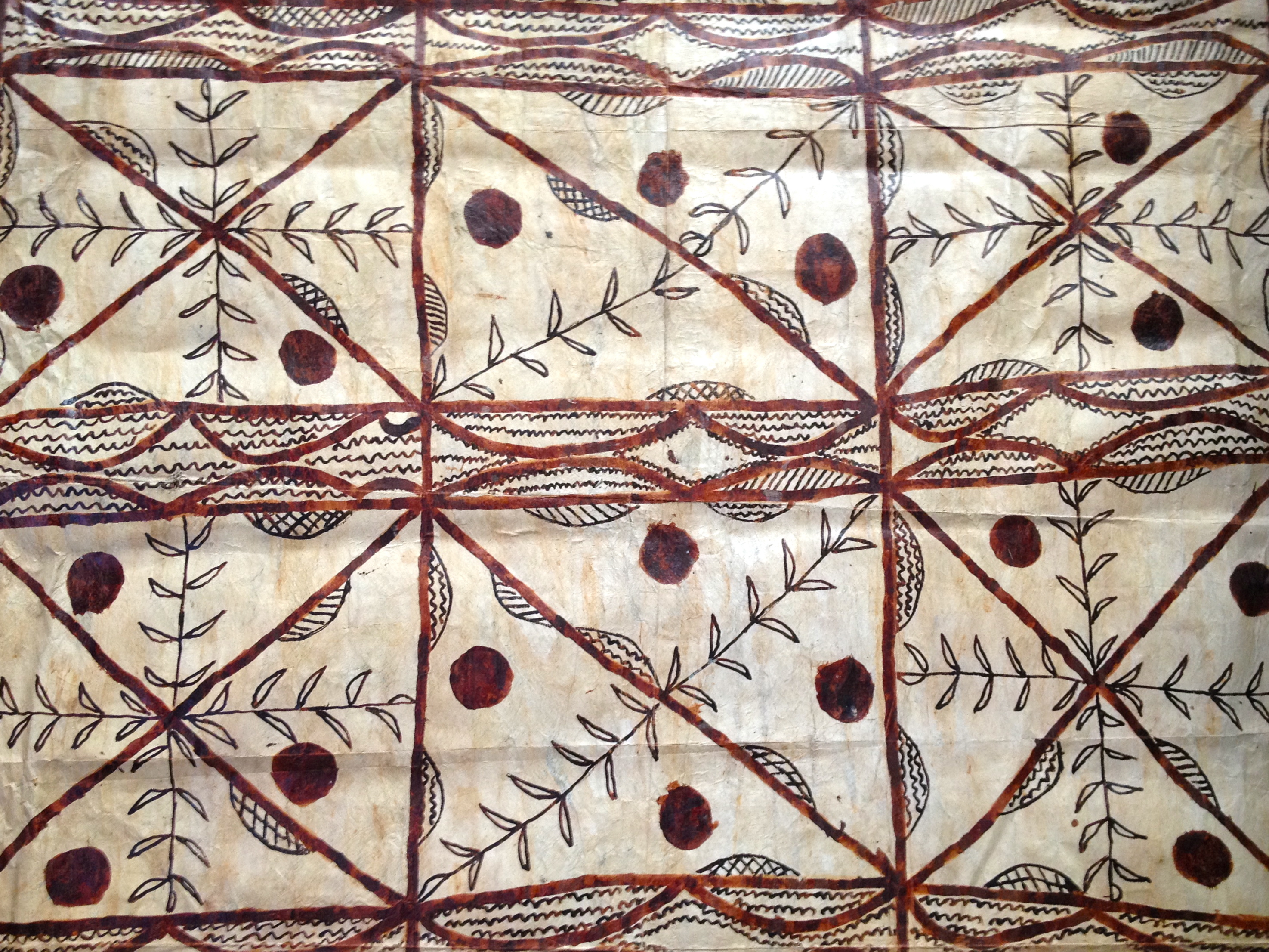
detail: the standout piece, not large, but with great pattern and depth of colour.

detail: the standout piece, not large, but with great pattern and depth of colour.

There is still a little research to be done on one or two of the pieces. Some simply need flattening and some clearly are minor fill, probably destined for the original purpose for which they were acquired. One item stands out. It was protected in a roll of other pieces and its deep colour and good condition has already singled it out for potential framing.

2.

So how does one care for tapa – the good tapa that so many New Zealanders have?  First of all to be upfront, what follows is not professional museum advice, for that go to the handy sheet produced by the Bishop Museum in Hawaii: www.bishopmuseum.org/research/pdf/cnsv-tapa.pdf‎

The big thing to remember is that this is an organic material, the bark of a tree and that it is susceptible to insects. Some of those we’ve acquired have nice big holes where insects have chomped through – look out for them before they get to your holdings. They just aren’t eating the bark sometimes they’re eating the paste that holds thing together – so be doubly vigilant.

moths

insects make a lasting but unwelcome impression on tapa

Keep tapa out of direct light which is the general (but oh so hard to live by) rule for almost anything of interest in life, books, furniture, watercolours and textiles

Humidity always plays havoc with organic things and low humidity is a problem, one that is not going to happen in sweltering North Island New Zealand, but the rest of the world keep this in mind. Low humidity makes fibres brittle, high humidity can cause molds to grow.

taped tapa

Historically fascinating but acid bearing paper and tapa are not a good mix.

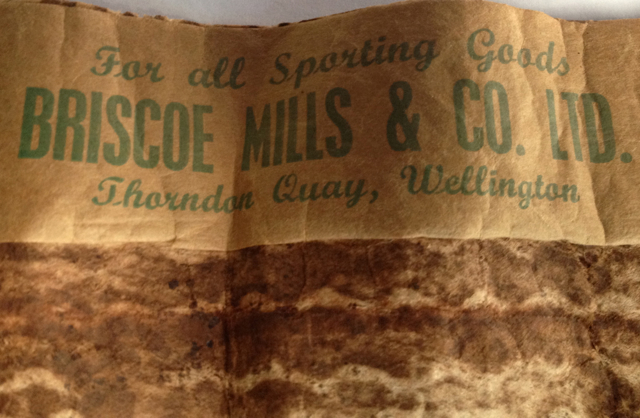
Avoid acid bearing materials like card and paper in close proximity to your tapa. One of our examples has a paper tape glued to the edges as reinforcing – not a good idea.

Most New Zealanders pin tapa to the wall with drawing pins. Of course this is not good – more a result of familiarity breeding contempt. Framing is best for key pieces but the float method required is generally costly and tapa are usually on the big side for artworks. You can try draping over a rod – covered in acid free padding or you can clamp and hang from the top edge – if they are of good weight and in good condition.

All that said tapa remain good value from a decorative point of view. They are really quite tough and do make a strong statement. Some lesser examples remain sacrificial.

At the moment ours are lying around the studio. Peter calls this process ‘Robert Louis Stephenson-ing up’ the Studio. A woven mat has taken up residence on the dining table with one of the tapa (currently glued to an old blind on top of it). Another is weighted down with tins of tomatoes and Sheffield plate candlesticks in order to get the creases out it. Others are draped over pictures hanging on the wall. The rejects are bundled up awaiting their fate. The last, a round one is placed on a stool, under the care of one of the cats who has taken to it – not a practice recommended by the Bishop Museum I am sure.

cat tapa

DLJ

Posted in auction finds etc., collecting, practical matters, Uncategorized | Tagged , , , , , , , , , | 5 Comments

an oft-heard tale of silveriness

glasses on tray

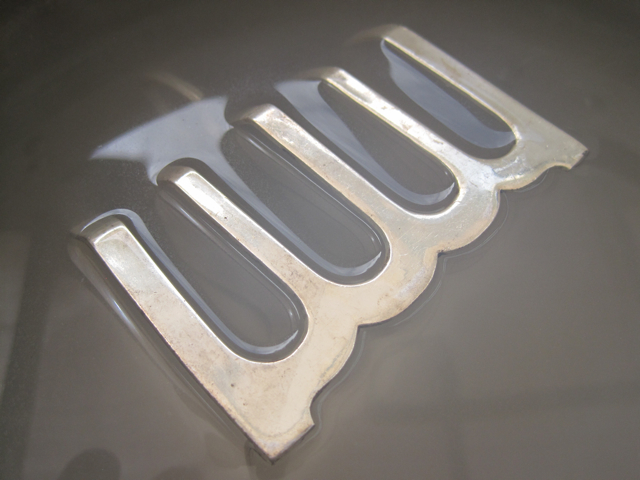
Our collection of small glasses glisten way reflected in the glow of the new silver tray

I keep telling myself that is it is time to move on and stop posting about items made of silver – their neglect, ridiculous cheapness and how to clean them.  The problem with this all-together sensible thinking, is that I keep finding beautiful neglected items of silver at ridiculously low prices. This is not an inherently bad thing but I somehow am unable to stop telling people about how great little neglected bits of silver turn out to be. It is only  by way of encouragement for blog readers to get in on a good thing. So here I go again

IMG_2330

The tray perched momentarily on top of the box at the auction for a photo – then put back at the bottom – it’s an old trick but worthwhile.

It was a better than usual M&F general sale. In part this was because of the presence of items from the estate of an elderly woman from a well know local family. However I don’t think this particular box was hers. It was made up of a selection of small items mostly electroplated silver but including some old Victorian tiles and a bashed up but decor extremus acceptable vase in black basalt Wedgewood.

The key item in the box lot was a largish tray that took up the length of the apple box the items were packed into. Although it was clearly silver plate on copper, there were no marks and the silver had turned an unattractive yellow patina – which suggested the presence of nickel silver. In my books solid silver plate goes black but exposed nickel plating goes yellow. This means you can tell the quality of neglected plate even in a distressed state before you purchase.

Therefore I suspected this tray would not polish up.  It did however have a rather nice border of aesthetic movement floral design. So the bid I left reflected a certain  ‘don’t really care whether I get it or not’ attitude.

I got it and when it came home the box was divided up into keep (the tray, the tiles, the basaltware and a little brass strainer) and the send immediately to the local charity shop (this was done). Of course the tray was the star keeper, the rest a nice bonus as is the way with a good box lot.

IMG_2341

polishing complete – a lovely tray revealed under the muck

The tray refused to respond to my instant cleaning (Rinso method) so I sat down with traditional metal polish. What I soon found was that the yellow stain was not an indication of the presence of worn electroplated nickel silver but some other mishap, a spill of some substance. What it was, was unclear but it came off  revealing the rippled surface and lovely silvery coppery-ness of a superior Sheffield plate tray. The banding around the tray has lost a lot of its silver but this added to the tray’s special charms and it took its place on the sideboard holding our adopted family of small glasses.

A good thing is that were other non-silvery treasures at the same sale which will make a good subject for the next posting.

Until then.

DLJ

Posted in auction finds etc., practical matters | Tagged , , , , , , , , , | Leave a comment

The Balloon-back chair (1830-1850)

No other piece of furniture has had quite the same fall from grace among collectors as has the balloon back dining chair. Once the most highly sought after piece of colonial furniture – a set of ballon-backs, however pert, not longer attracts much attention in the sale rooms which is sad.

This is a little history piece – again written for another purpose – I hope readers might enjoy.

It is often supposed that because King William IV was, unlike his brother George IV, not a high-profile patron of the arts, nor a private collector, that little design development occurred during his reign. The appearance of Prince Albert, Consort to Queen Victoria on the design scene after 1840 threw a further shadow across William’s reign. Generally it is considered that under the influence of William and his consort, Queen Adelaide, there was little more than a general coarsening of proportion and a darkening of colour represented by the popularity of mahogany.

Yet the period 1830-1850 does deliver one interesting progression in design – the development of the balloon-back dining chair. Although the end result – the Victorian balloon-back chair – might not be as acclaimed as it once was, the transitional points in its development parallel the early colonial period in New Zealand and therefore remain instructional to scholars of New Zealand furniture.

In 1830, when William succeeded to the throne, all chairs, dining and otherwise, were what might be deemed sub-classical in pattern. This meant that a broad horizontal yoke rail extended well beyond the plain back uprights, these were in themselves extensions of plain rear legs. Below the yoke rail appeared a much narrower, horizontal splat. This was accompanied by a padded seat (often dropped-in) and straight (often turned) front legs. Should such chairs be destined for the more prestige setting of the drawing-room or a parlor, then they might be enhanced by the addition of volutes to the yoke-end, decorated uprights, a carved splat, or other similar embellishments.

It is possible that we now forget, the role of the upright chair in the drawing-room situation, as opposed to that of the dining room. Today’s ‘lounge’ is by definition dominated by fully upholstered furniture. This was not the case of the William & Adelaide period, or that of the early Victorians, in which a number of  wood-framed upright chairs were a necessity for any formal room and their ease of transport essential to the use of such rooms.

By 1835, the yoke-back dining room chair and the scroll-back drawing-room chair are evolving together, but on separate paths towards a new form.  Although the balloon-back is a distinctly British furniture type, the potential remains that the link between the sub-classical type and this next phase – might have been the growing influence of the French Louis XIV style – which provided a degree of sinuousness, not native to the British imagination. Regardless of origin, by 1835 the yoke end has been rounded off – no longer extending beyond the rail and it is now integrated into the upright. At the same time the parlour chair had moved to a point where the scroll top carving has near been eliminated leaving a plain curved top.

The balloon-back was established by 1845 and within five years all trace of the yoke-back had disappeared. This remained the pattern for dining room chairs into the 1860s. Dining room chairs were almost always more austere than their parlour equivalents. Similarly library chairs remained simple and not decorated, befitting the perceived masculinity of such spaces. In the drawing-room however a balloon back might feature a carved splat – or other decoration – within the round of the upright.

Cabriolet legs began appearing after 1850 on chairs destined or the parlour. This fashion was encouraged by the Great Exhibition of 1851 at which Rococo features were a distinctive feature – and ensured that the fashion for the curvilinear held say for some decades to come.

It is worth noting the development of particularly delicate variations on the baloon-chair form intended for the boudoir. These fancy chairs were lighter in build. The newer, more delicate, frame required the addition of one, and often two, sets of side stretchers running between back and front legs. Similarly lighter coloured woods (birch or maple) required japanning or another painted surface. These chairs were designed entirely for us within the space of the lady’s bedroom and not for the public rooms.

DLJ

Posted in furniture, Uncategorized | Tagged , , , , , , , , , | 1 Comment

On Lustreware Teapots

This is a piece called ‘English Silver Lustreware Teapots’ of the late 18th and early 19th centuries, I wrote it for another blog but thought Decor Extremus readers might also like it. 

Lusterware is one of those materials desirable for its ability to deceive. The entire point of silver lusterware was to allow earthenware to simulate old English pewter or plate. Thus an earthenware body carrying fluted or beaded design with a coat of silver lustre might transform a brown earthenware teapot – suitable only for the kitchen – into an object worthy of the drawing room.

The method of judging a work of early nineteenth century luster therefore becomes it nearness to the silverware it tries to imitate. The best examples of these teapots being those that appear to be silver until a visitor picks them up.

In his seminal work Chats on English China (1904) Arthur Hayden attributes the manufacture of such pieces to –

“Brislington by R. Frank about 1770: at Eturia, by Wedgewood, in 1780: and by Wilson in Staffordshire, in 1785, also by Moore & Co. and Dixon & Co. at Sunderland, about 1820.”

Yet it was almost certainly Wedgewood who popularized the plainer lustreware designs that came about in the earlier part of the Nineteenth century. To these Hayden attributes a deep colour that simply could not be achieved in silver itself – ‘the lustre is of a deeper and richer quality.’

In such works it was not silver that was used, but an oxide of platinum. The first coat made up of platinum dissolved in nitric acid and treated with a spirit obtained from tar. This was then painted with a large brush over the earthenware and fired. The oldest silver lustre is on a black or brown body. Later on it was made on a creamy body, but one gets the extreme brilliance of the silver lustre only on the brown or brownish-black body.

These pieces were intended for an evolving middle class to whom silver plated items had not yet come down sufficiently in price. Yet there were two essential problems with the material. If your ‘wondrous lustre tea pot slips to the ground, it lies in a heap of brown earthenware fragments.’ Secondly the silver manufacturers were keen to capture the same market and were soon designing silver plate for the same market. Thus silver plate tea services meant lustre fell from fashion and a high degree of breakage made it rare and collectable.

One last word from Arthur Hayden – ‘to collectors of this ware – do not wash your specimens any more than you can help, as warm water has a deleterious effect on the lusted and tends to make it less brilliant; we recommend our readers to polish their luster ware with a soft cloth, and we wish them absolute and entire freedom from all mishaps.

DLJ

Posted in collecting | Tagged , , , , , , , , , , , , , , | Leave a comment

Shine on Hester Bateman

Because I’m lucky enough to have birthday and Christmas close but not so close that the presents are combined, I have recently been on the receiving end of a few small silvery items gifted by thoughtful friends. Together they tell an interesting story of what you can (and can’t) learn from your own silver.

spoons

H Rodbertus’ silver spoons made for him by F Schultz and engraved 12 February 1869

1.

A few weeks ago I was lucky enough to be given three lovely silver teaspoons for my birthday. They are elegant spoons, long in the handle and narrow in the bowl. They are continental silver, quite probably German. I know they date from 1869 because a date 12 February 1869 is engraved on the back. The date seems to have no great significance in history, so I assume it is probably associated with the owner H Rodbertus whose name is likewise engraved on the back of the handle. They were made by a man (or woman) called F. Schultz whose name is stamped into the reverse of the spoon neck, as is the number 12.

Do you think I can find anything out about F. Schultz?  I suppose Europe’s nineteenth and twentieth century history has been a little too turbulent to assist me much here. The continental silversmiths are always much harder to track than their British counterparts. Indeed both H. Rodbertus and F. Schultz have thus far evaded my research skills but at the moment I refer to the spoons as the émigré spoons – imagining that an émigré family escaping Germany in the 1930s brought them to NZ – the path by which most items of this type end up here.

2.

For Christmas I received a little Edwardian folding knife, intended originally as a fruit knife. It is a sweetie. It has a mother of pearl handle, a little engraved folate guard and an inset shield ready for a monogram. The blade in silver is hallmarked. In this case I know exactly who made it and when.

knife

Fruit knife by Thomas Marples 1912

It was made by Thomas Marples in Sheffield in 1912. Thomas came from a family of tool makers (Marples tools are still much admired and collected). He was born in Sheffield around 1833 and in 1851 the census listed him as a fruit knife cutler.

That Thomas could specialize in such an arcane specialist trade is a real testament to the Victorian need for finely wrought objects. There are many surviving examples of lovely fruit knives by Thomas and as he died in 1912, mine is one of his last knives.

This is the wonder of the British systems of hallmarking and probably why collectors have always been so keen on sterling, aka British, silver. A little knife carries with it such a solid history recorded in tiny marks, all of which make the object more resonant. I’ll think of Thomas and his devotion to his craft whenever I use the knife.

handle

Thomas Marples was a specialist fruit knife cutler. His TM mark is the final right hand mark on the blade.

There may be specialist Thomas Marples’ collectors out there (even as I write that sentence I’m tempted to become one) but I suspect he’s fairly obscure, in part because the folding fruit knife has both fallen from attention and was never a high-profile an item in the first place.

3.

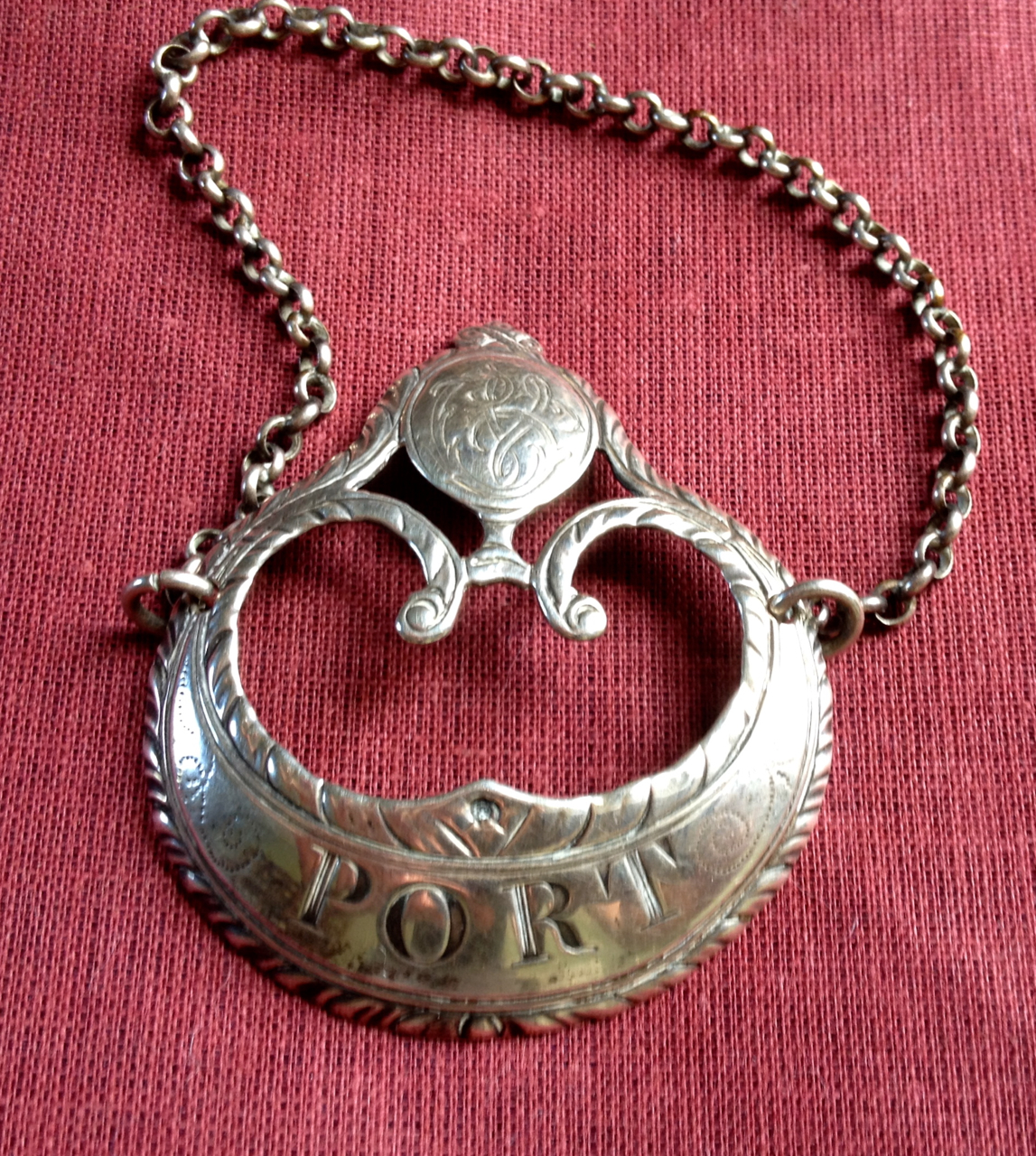
My new decanter label is an all-together different situation.  Another Christmas present it is of the ‘suggested variety.’ That is I dropped enough hints about it that the message got through. Indeed so strongly was it heard that two were brought at auction as the lot numbers meant that the more desirous one came up later. Peter wisely hedged his bets. It is the work of an English silversmith called Hester Bateman (1708 – 1794).

Hester Bateman 'Port' decanter label

Hester Bateman ‘Port’ decanter label

Hester is the closest thing there is to a celebrity Georgian silversmith – probably only rivaled in the fame stakes by the American Paul Revere (1734-1818) who really isn’t famous for being a silversmith but for other things. They are not too far off being contemporaries Hester having had a later start in the industry. Hester inherited the tools of her deceased husband John in 1760. When he died they had already been married for more than 20 years and she had borne him six children.  Which is probably why she needed to work and soon picked up his tools – registering her own mark in 1761.

Women Georgian silversmiths weren’t uncommon, as Philippa Granville and Jennifer Goldsborough’s excellent book Women Silversmiths (1685-1945) illustrates. Although I’m happy to have a Hester Bateman piece (Peter has a little inherited collection of Bateman silver) it wasn’t only the celebrity designer appeal of the item that attracted me to this piece but the qualities of the work itself. Decanter labels are slightly strange objects.

After their initial period in vogue (much of the Nineteenth century) they had an enormous revival in the 1980s when, like vesta boxes and watch chains, they were much sought after.  Today that fashion has once again subsided but then the preference then was for bulky square labels that suited big square whisky decanters in heavily cut crystal that used to figure in adverts on the back of expensive men’s magazines. My interest really began in my recent return to being a regular port drinker, partially in order to justify some nice Georgian port glasses – found in thrift shops.  So I thought I could take the plunge on a decanter label.

Washington_1772

Colonel George Washington (1772) by Charles Willson Peale. Washington wears a gorget.

This one is a lovely delicate piece that seem to be to connect in form to the gorgets worn by soldiers in the eighteenth century – perhaps a nice connect for a port label given soldier’s propensity for port – at least in novels.

Gorgets started out as part of a larger suit of armor – a throat guard above the breastplate but lingered as a sign of rank for decades after armor disappeared.

I like the idea that the decanter label, in the form of a throat protector, hangs around the throat of a decanter in order to depict its rank  – port, madeira, sherry etc. This is to my mind an illustration of conceptual thinking amongst our eighteenth century design counterparts a sort of fitness for purpose.
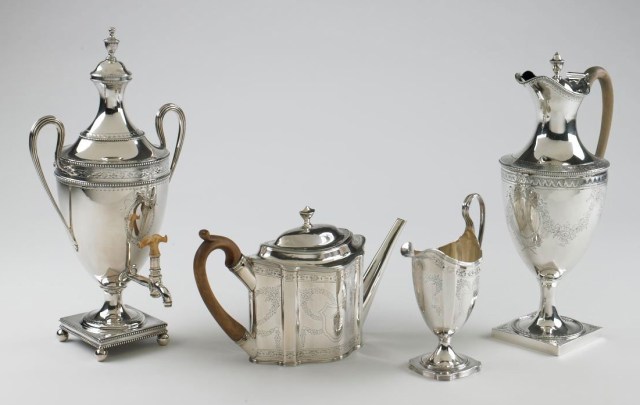
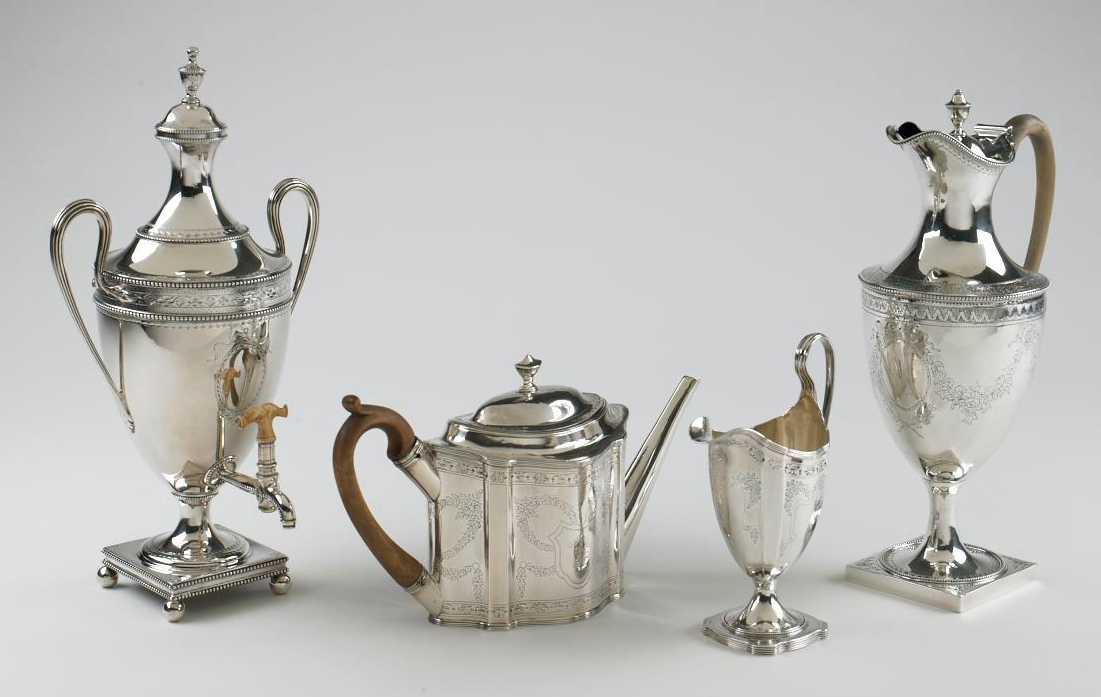
Hester Bateman silver , a hot water urn, teapot, milk jug and coffee pot (dates unknown)

Hester Bateman silver , a hot water urn, teapot, milk jug and coffee pot (dates unknown)

Hester Bateman was something of a thinker – and beyond the need to pick up the tools and support the kids. She realized that silversmiths were facing real completion from the emerging Sheffield plate arena and that she needed to innovate to stay ahead. She perfected a finely cut-out silver style on thinner gauge metal than that previously used and mastered fine engraving on the same. This was therefore cheaper to the customer but very stylish.The little port label is an example, cut from thin silver beautifully lettered and nicely engraved. This worked and established not only Hester’s reputation but also that of the rest of the family, most of whom took up the tools. Hester had at least five children who grew to adulthood – Jonathan, Peter, John, Letitia and Ann. Only Peter, Letitia, and Ann were still living at the time of Hester’s death. 
 Her sons Peter and John Bateman registered their mark in 1790 but John died a year later. Peter then went into business with John’s widow Anne and they registered their mark in 1791. In 1800 they registered the mark of Peter, Ann and William Bateman, a nephew. From 1839 to 1843 another William Bateman, son of the first one registered his own mark.
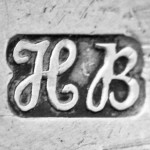
Hester Bateman's mark.

Hester Bateman’s mark.

All of this, confusing as it might seem, illustrates how the Bateman name stayed active in silver from George III to Victorian times.  This was no mean feat in competitive time and in the face of constantly changing fashions.

So I love my little label and my other recent acquisitions in the silver line. Yet what I like most of all is that now I get to search out the perfect port decanter – with just the right throat against which to best display my new label.

An Auction House Epilogue

The morning after I’d written this blog I was checking out our favorite local auction house – which had an Antique sale viewing that day.  As I wandered out through the general sale rooms I spied a little decanter sitting on a shelf. I had not spotted it on the two trips I’d made to view the general sale. Really I hadn’t spotted much at all in this week’s sale. decanter
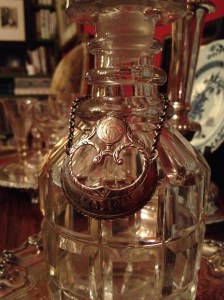
On examination it proved to be a sweet, small-sized decanter, neither marked or stained and with its original stopper.  The glass was heavy and deeply cut. I left a bid – it was in a lot with 2 glass cake plates and a glass food cover. By 5.00pm I got the call. It was mine.

I didn’t really think it was the one for my label. It has wide ribs around the neck and a flange top of considerable diameter. However to my surprise the little chain fitted nicely over the rim and holds the label nicely in position. Now to fill it with Port.

DLJ

Posted in auction finds etc., collecting, Uncategorized | Tagged , , , , , , , , , , | 2 Comments

Interesting things with lamps

IMG_5774

The Library at night: the lighting effect is achieved with two mantlepiece lamps

When I first moved into this house I really only occupied one room – now the Studio – which was then somewhat exposed to the street. This more so once we took out the aluminum joinery and put in enormous wooden sash windows. We attracted a lot of attention from people out walking in the summer dusk, in part because things were suddenly happening to a house that had remained unchanged for so very long.

Once while attending an after work function a woman I did not know said, “I know you, you’re doing interesting things with lamps.” This struck me as unusual as did her follow-up line “I must pop in some time and have a look.” Although she never did ‘pop-in,’ I spent a long time asking myself – what was it I was doing with lamps that the neighborhood found so unusual?

1.

The pendent lights that occupy the centre of each ceiling here, are seldom used to light the rooms. I tend to think of these as house lights – the lights you bring up to get people out of a cinema – or that you turn on in order to vacuum a restaurant in which a single group of diners are lingering. Every room here has a lamp and in some cases five or six. It is the sort of arrangement that my parents would have objected to – why pay for five light bulbs when one very bright one, centrally placed, will do?

The answer of course the preservation of some sort of control over the mood of a space. The in-ceiling recessed down-lighting now universally favored in most homes (even when renovating old houses) is unflattering to both the room and the occupants. Do we want every aspect of our lives thrown into merciless high relief?

What’s more, there are more subtle ways of changing mood than via a dimmer switch and the use of a well-chosen lamp is one of them. Despite this, most people prefer to sit (or worse expect guests to sit) in the harsh glare of overhead lighting.

lamp 3

My new friends Helen and John Gloag have opinions on the general effects of lighting but even more opinions regarding lamps – specifically what might be turned into a lamp. It seems that the Gloags had difficulty finding good contemporary lighting. They were big on fossicking in shops to find light fittings that predated electricity (aka candle-powered) and having them wired for electricity. Something that it has only just occurred to me, you couldn’t do in the days of gas lighting in the generation before theirs. So for the Gloags there were lots of old candle-powered wall sconces and chandeliers cluttering antique shops – which they cunningly wired up.

Fast forward to today and in the right second-hand shop or auction you can find all sorts of wired up object lamps made from a whole range of things including vases, jars, and figurines – now discarded in favor of wired-in down-lights.  Such is the cyclical nature of decorating.  These aren’t always sought after. Contemporary lamps are often thought of as a portable spotlight – a task light that can be moved to any point in the house to illuminate a chosen crevice. Whereas what you’re often looking to achieve is a soft pool of light in a discreet corner of a room for which old lamps can be perfect.

2.

What always concerned the Gloags most about a lamps was not the base but the shade and their problem is, as it turns out, generally still our problem.

In New Zealand, the standard of lampshades available is generally abysmal. Anyone out there of a craft/skill bent could do worse than pursing a career as a bespoke lampshade maker. Even better still become a dedicated lampshade restorer, as it’s not uncommon to find a lampshade once glorious now tattered attached to an old lamp.

Vintage silk shades if they can be found at all usually look something like this

Vintage silk shades if they can be found at all usually look something like this

The Gloags talk a lot about silk shades. The notion is an intoxicating one – but you can almost forget finding anything close to that unless of course it is attached to a lamp that has neither been turned on nor placed in a sunny room for any period of time. Most of us are going to have to settle for a modern alternative available through a chain store.

But we’ve lost something more than simply access to well-made shades. The Gloag’s had a whole raft knowledge of lampshade types and variation that is generally now lost.  They write with authority:

Shades can be designed to give the greatest variety in the tone of a room: it is a matter of colour and material. For example a red shade lined with white gives cheerful warmth, while purple and blues tend to produce a brilliant circle of illumination immediately beneath them and to diffuse a rather subdued light.

For light to be distributed evenly pale tints are necessary: cream, pale yellows, and pinks and light blues achieve evenness, though almost any effect may be contrived by the skillful use of the varied materials from which shades can be made.

It is possible to make very pretty little shades from pieces of old silk Paisley shawl, and trimmed with a soft fringe and line with white they can be used for small standards or candlesticks.

Their lighting chapter ends rather nicely with

 There should never be any great difficulty in making a room look attractive after the blinds are down and the curtains drawn. It is a matter chiefly for our colour sense where we need not allow obstacles to perplex us in the achievement of beauty and distinction.   

With a little imagination you can easily do “interesting things with lamps.” Here there are rescued wooden standard lamps and brass reading lamps (which the Gloags tell me should have green shades). There’s a 1950s task light given to me by an old architect friend. There are two lamps in turned wood painted to look like they were designed by Keith Murray and made at Wedgwood. There are alabaster urns that light up. There are even lamps awaiting shades and at least one old shredded silk shade.

The Alabaster mantle lamps used in the library. The effect is subtle but effective

The Alabaster mantle lamps used in the library. The effect is subtle but effective

These days heavy blue drapes curtain the Studio windows and a hedge has grown up between road and us. The locals still perambulate in the dusk, dogs in tow but the house no longer attracts quite the same attention – well it is at least a while since any stranger encountered in the cocktail hour has expressed their intension to pop in and check out the lighting.

DLJ

Posted in furniture, practical matters, Uncategorized | Tagged , , | 3 Comments

The secret power of RINSO

silver 2

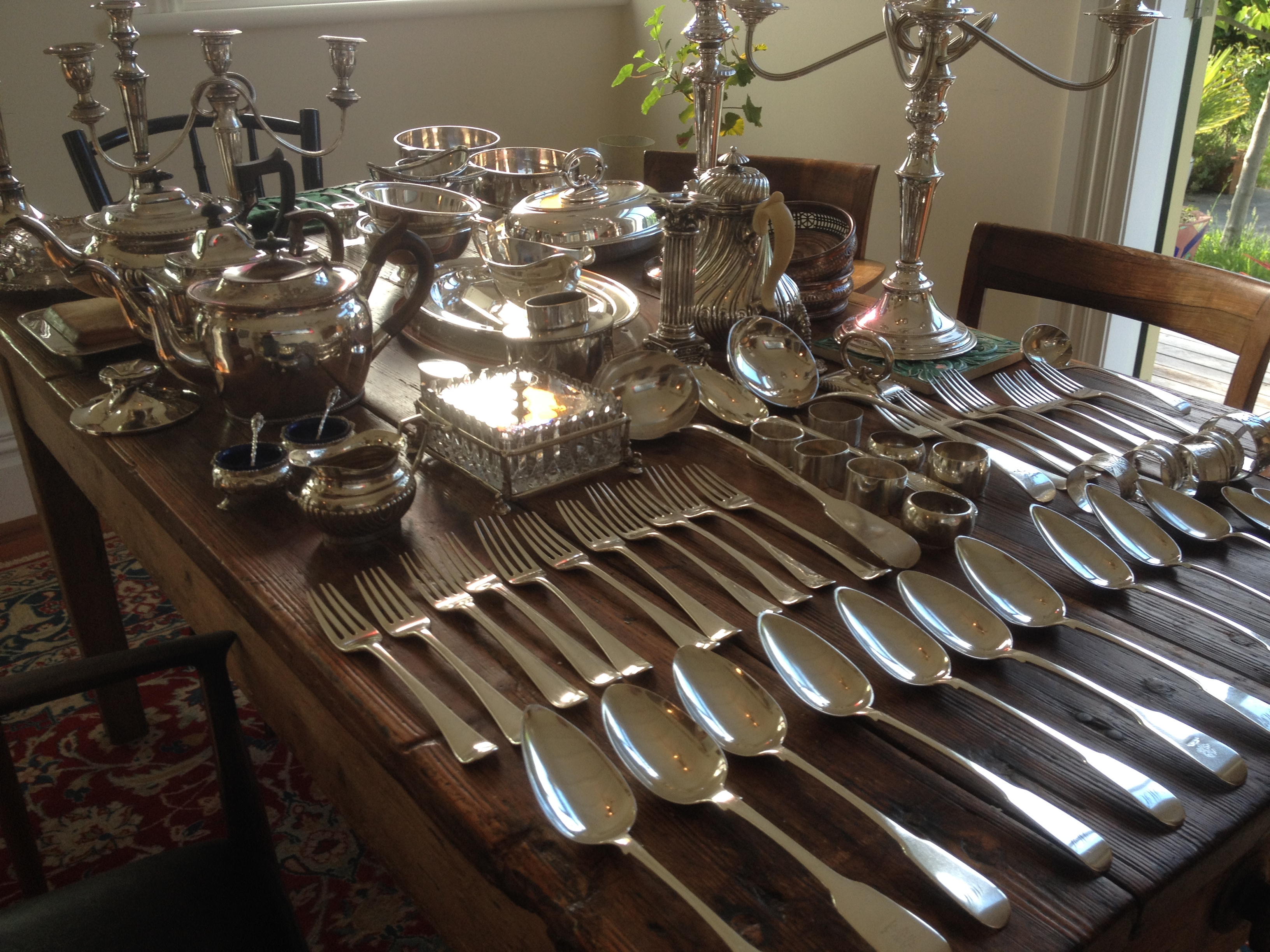
An army of household silver awaits polishing

As the season of entertaining approached, it was becoming increasingly obvious that the family silver was getting itself into something of a state. Without an army of footmen to keep the silver clean, pieces were slowly descending into a certain unattractive blackness. What’s more my mother, moving house, had sent a few unwanted (read not recently cleaned) entrée dishes and other items our way. That both our mother’s would be there for Christmas dinner provided another motivation to attack the silver.

I started in the traditional manner with my silver polish and cloth but soon realized as more and more pieces gathered on the table awaiting cleaning that the task was almost certainly going to overwhelm my enthusiasm. Some things such as bon-bon dishes and pickle forks might just have been ignored but when other than Christmas will you need clean and shiny bon-bon dishes and pickle forks? So with a sigh I realized it was all or nothing.

If only there was another way?

Even then I knew there was – we call it ‘the Secret Bess Wells Method’ named after Peter’s mother Bess Wells.  Bess has a secret ingredient, a long ago discontinued washing powder called RINSO that, when employed properly, polishes silver without effort.  So rare was this magic silver cleaning powder now that a box of it, probably the last in ‘the Western world’, lives high on our laundry shelf protected in part from me – who might in a rash moment use it to clean the silver.

So precious was the RINSO that it is now rationed, used only to clean the two Sheffield candlesticks that sit in the library. They have been in Peter’s family for generations and so only they got the special treatment. Rightly so as it was his mother’s box of RINSO.

Some year back Peter made a film called Pansy and he included a scene in which his mother and he used the magic method to clean the same candlesticks. It caused a minor sensation in its own small way and for a moment propelled Bess into television stardom of a sort. This is it here.

1.

Because the RINSO is off-limits to me, I began to think about what it might be that RINSO had contained – cocaine, heroin, concentrated sulphuric acid? Having not done chemistry at all in school, all I could figure was the likely ingredient was soda. After all products like RINSO were once called washing sodas. That, by the way, is how you use a history degree to solve a chemistry problem.

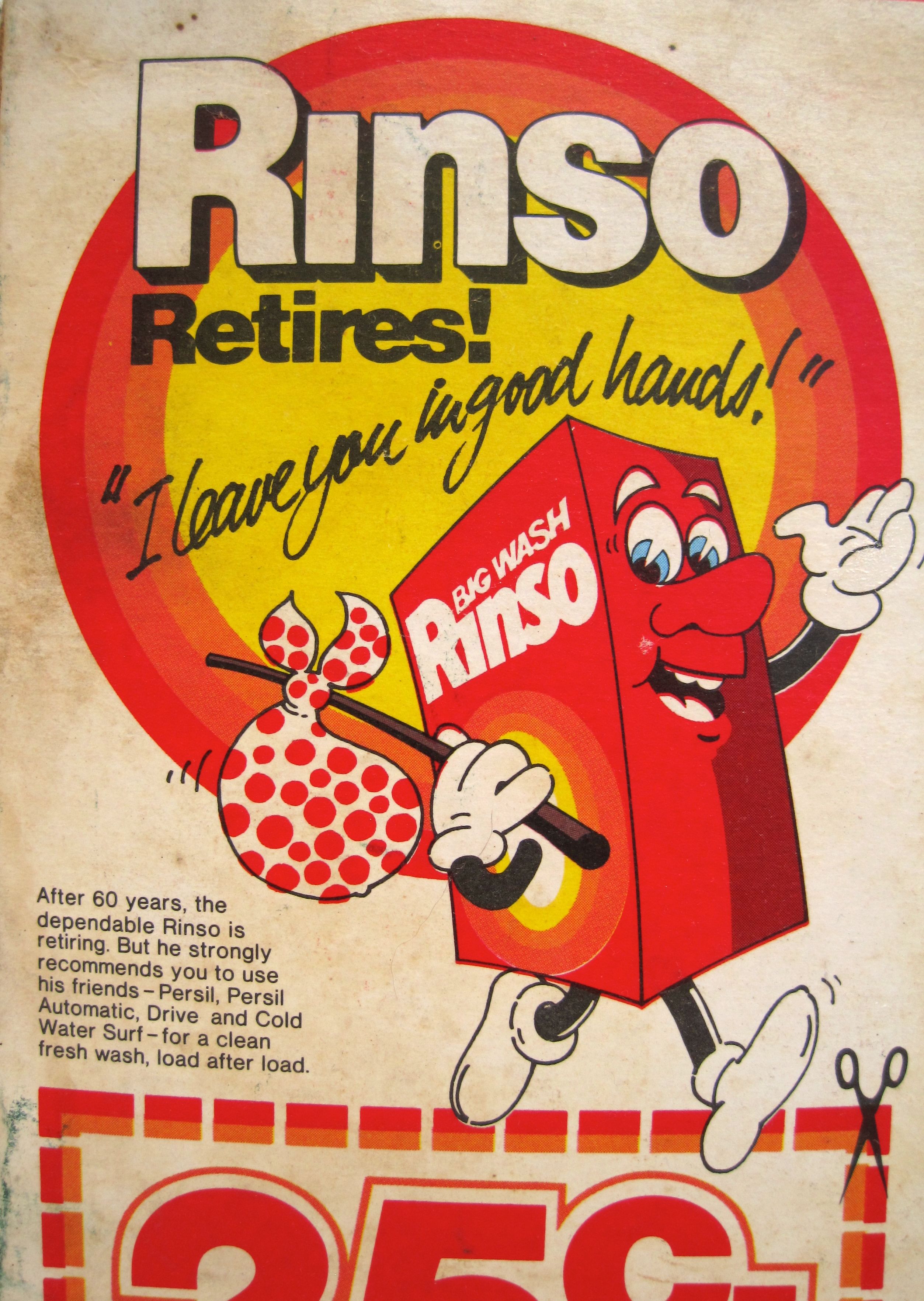
I got the box down hoping that there would be a list of components – but alas the RINSO predated the requirement to tell consumers what they were consuming. However I did notice that on closer inspection this was a special box of RINSO.

rinso

It proclaimed that ‘after 60 years the dependable RINSO is retiring – but he strongly recommends you use his friends ‘Persil, Drive and Cold Water Surf.’ The thing is, by legend these products were duds in the silver-cleaning department. This last ever box of RINSO had probably been bought in a silver cleaning panic once they announced its demise and had been eked out spoonful by spoonful since. The same thing happened some years back when Lever Brothers announced the demise of Sunlight Soap. It survived the big buy up to live another day.

Still I remained skeptical about the uniqueness of RINSO, so I did a little on-line research and found that as suspected the secret ingredient was a very large dose of soda  – or to our minds Baking Soda.

2.

So here it is the best method of cleaning domestic silver when confronted with any bulk.

cleaning 1

cleaning 2

First of all find yourself an aluminum pan. I use and old preserving pan but a pot will do – it has to be big enough to take your silver but not so wide as so you need to provide great amounts of water to fill it. What matters is that it be aluminum, it is in the combination of soda and aluminum that the magic resides.

Place you silver item in the pan. It needs to be in direct contact with the aluminum. Pour over enough boiling water to cover and to this add a tablespoon of Baking Soda.

Or as show here add the soda first it doesn’t seem to matter.

cleaning 3

Wait a few minutes and the tarnish will disappear and your silver will emerge gleaming.

Be careful as the silver conducts heat rather well, so your silver will be very hot to the touch.

cleaning 4

Give the item a good rinse under clear running water and a quick buffing with a clean soft cloth to get off any water droplets.

There is no danger of dried polish getting into crevices and it works wonders on hard to clean items like candlesticks.

3.

What would have been a week’s work took the better part of a Saturday but it was worth it to see the table covered in gleaming silver.  Silver has fallen from fashion in large but because of people’s resistance to cleaning. It’s sad because not only has silver work been one of the mainstays of the decorative arts for centuries but also polished up, nothing suits a white linen table top better than gleaming silver. However best of all the mother’s were well impressed at how clean the silver was. We didn’t tell Bess about having usurped the secret powers of RINSO.

silver 3

DLJ

Posted in practical matters, Uncategorized | Tagged , , , , , , , , , | 2 Comments

Merry Christmas from Normie

I have always had an ambiguous relationship to Christmas cards. This may date from the competition I had with my best childhood friend about whose parents were most popular and she effortlessly won. Or it may have been those weird strings of cards looped round pelmets and even interwoven with venetian blinds. Or was it the cheery Santa Claus vision replete with snow and reindeer that fell out of favour with my radical sourness as a teenager? Whatever, I still find Christmas cards a little scary, like a loud knock on the door or the shrill call of a telephone during slumber.

But Douglas, with characteristic flair, may have worked out a solution.

Auction catalogues in our house are awaited with the avid interest usually kept for the next Booker Prize winner. Douglas normally rips off the cellophane skin and a long and almost lurid silence falls as he meticulously works his way through each entry.

card 3

Norman Hartnell, Christmas card (1969)

One of these entries was enigmatic but full of possibilities: Christmas cards sent by Norman Hartnell to one of his models resident in New Zealand. Alas, we were Hawke’s Bay bound so we asked our intrepid reporter, Shonagh Koea, to go and inspect the cards. The report back was excellent. If we were not buying them she would bid herself. (What better recommendation could there be?)

‘So it was’ that a while later twelve cards were posted down to us in a bundle.

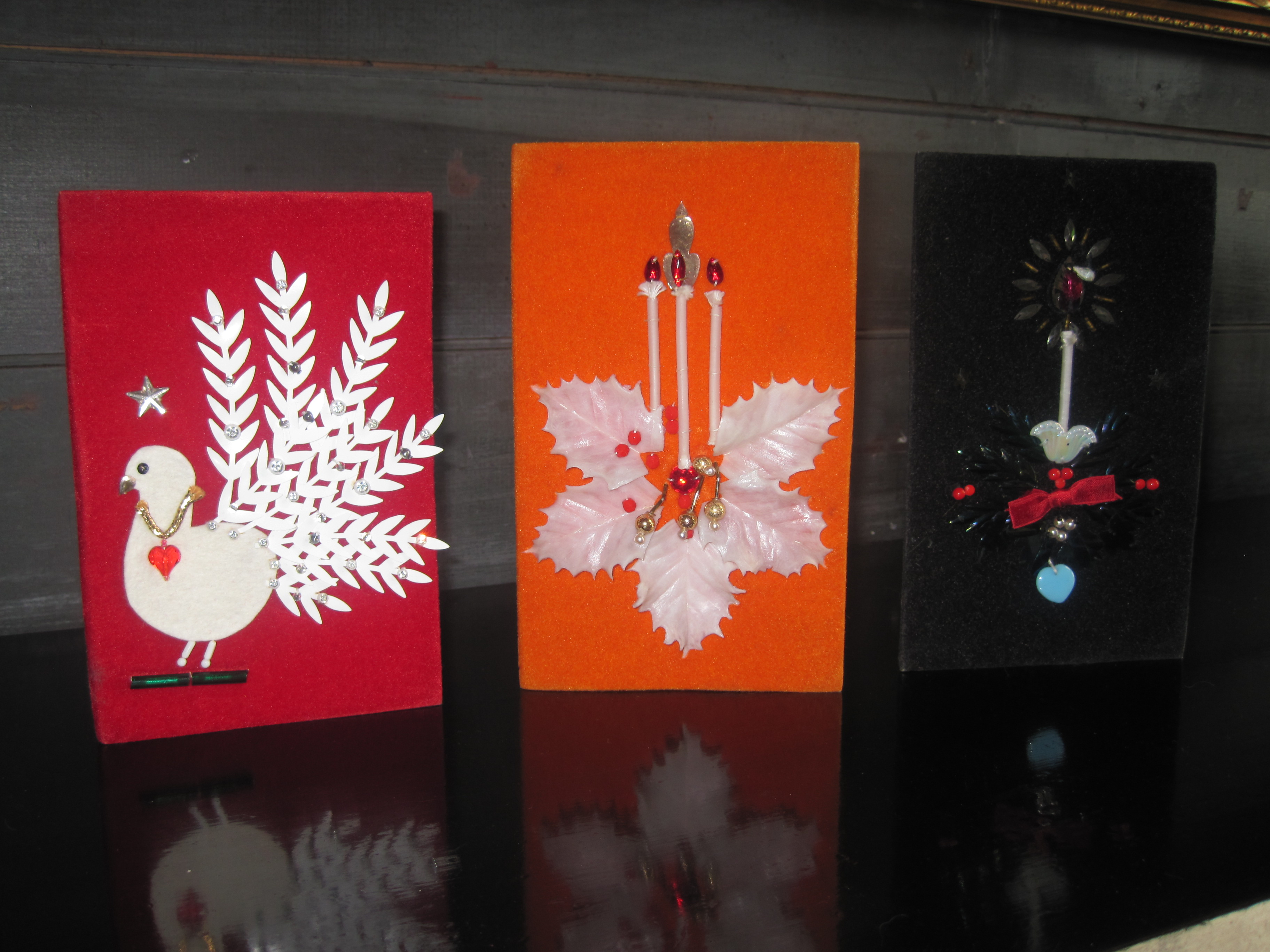
These are some of them.

cards 1

Left to Right: Norman Hartnell, Christmas cards, (undated, 1962 and 1960)

2574633

Queen Elizabeth at the opening of Parliament New Zealand 1954.


They are really very beautiful. Most have a very strong colour background and nearly all of them are heavily bedizened. (The card is actually quite stiff.)

For anyone interested in fashion and history, Norman Hartnell was the Queen’s couturier for a long time. He it was who designed her historic Coronation gown (which can be seen here, in Wellington, minus the cumbersome horse-hair padding that made the gown so beautifully full on Coronation Day.) Is it too much to say that there are correspondences between the heavily embroidered style he favoured and the cards he sent?

IMG_5777

detail: Norman Hartnell Christmas card (undated)

But both Douglas and I are very grateful for the entirely false squadron of Christmas cards that now bedeck our studio. It seems to intimate that we have a whole flock of Christmas-card sending friends, all of them summoning up the ghost of Norman Hartnell.

PW.

On Normie.

Norman_Hartnell_Allan_Warren

Norman Hartnell (1973) by Allen Warren

Norman Hartnell once said “I despise simplicity. It is a negation of all that is beautiful.” So he seems the right designer to be making Christmas cards.

The problem is Christmas is seldom either beautiful or simple, except that is if you get your hands on a dozen bespoke Hartnell Christmas cards!

Norman Hartnell sent to Cambridge University in the 1920s, strayed from his degree into designing for the theatre. He left university and set up the Hartnell salon in Burton Street Mayfair in 1923.

He designed for the smart, theatrical set and eventually for royalty. His most famous designs for Queen Elizabeth’s wedding dress in 1947, for which British women sent in their clothing ration coupons and her highly celebrated 1953 Coronation gown.

Queen-Mother-1939-by-Cecil-Beaton

Queen Elizabeth (1939) by Cecil Beaton

Earlier Hartnell had  done much to establish the Queen Mother’s sense of style. While she was still Queen Elizabeth in the 1930s her Hartnell wardrobe had ushered in a new romanticism to women’s clothes and was much admired on her Paris visit of 1938.

Like all fashion houses the Hartnell salon’s work was seasonal. This meant an annual spell through August in which the embroidery workshops had little to do. So as to keep the girl’s busy he set them to executing embroidered Christmas cards which he sent to friends and favoured clients.

DLJ

Posted in Uncategorized | Tagged , , | 1 Comment

The Gloags – twenty five forever

IMG_1983

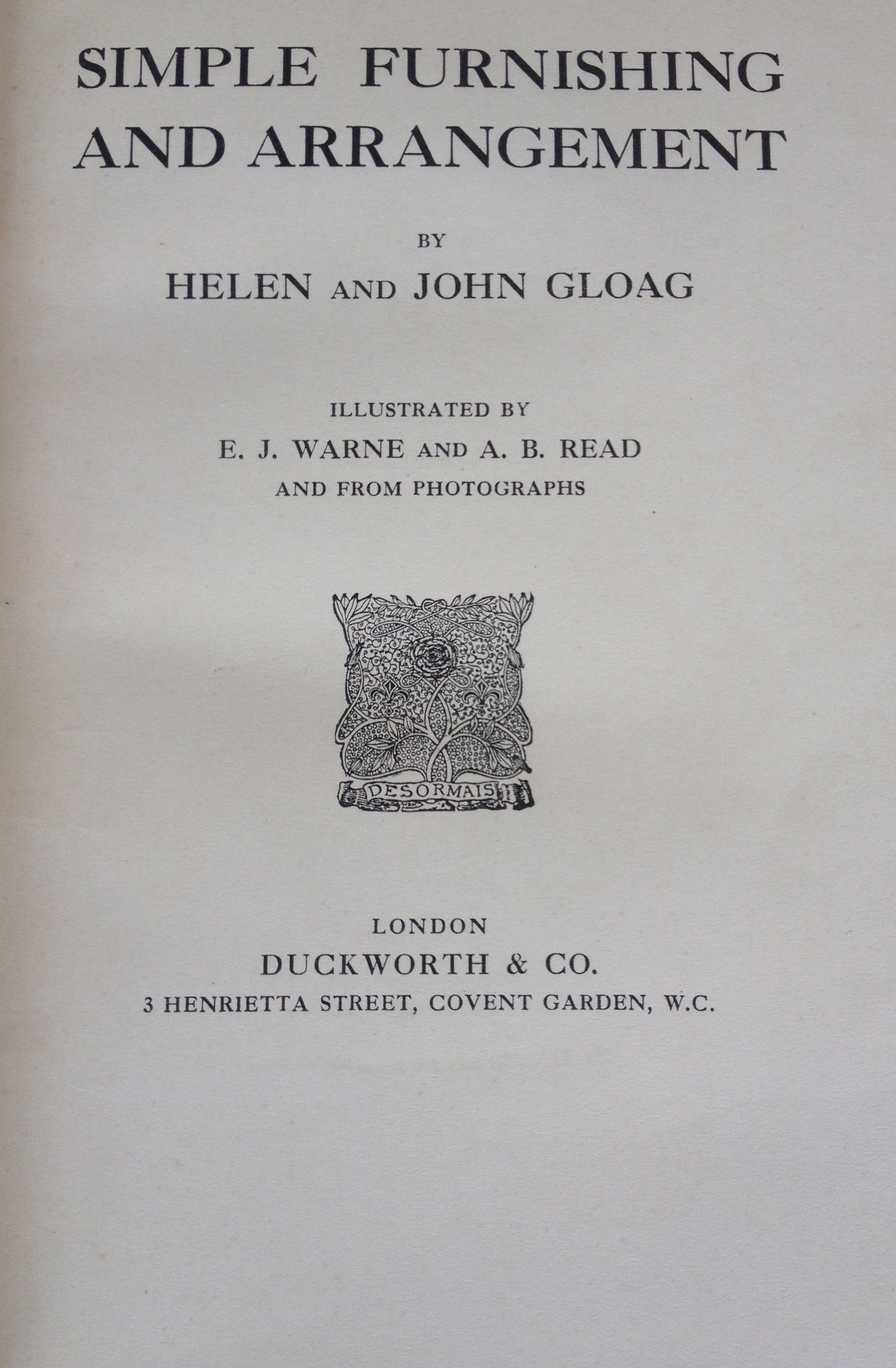
I recently acquired a small book called Simple Furnishing and Arrangement (1921) by Helen & John Gloag. I’ve seen the Gloags’ books in second-hand bookshops over the years but I’ve never really bought them because they seemed a bit fusty. I purchased this one only because it has its original owner’s name inscribed in the front cover.

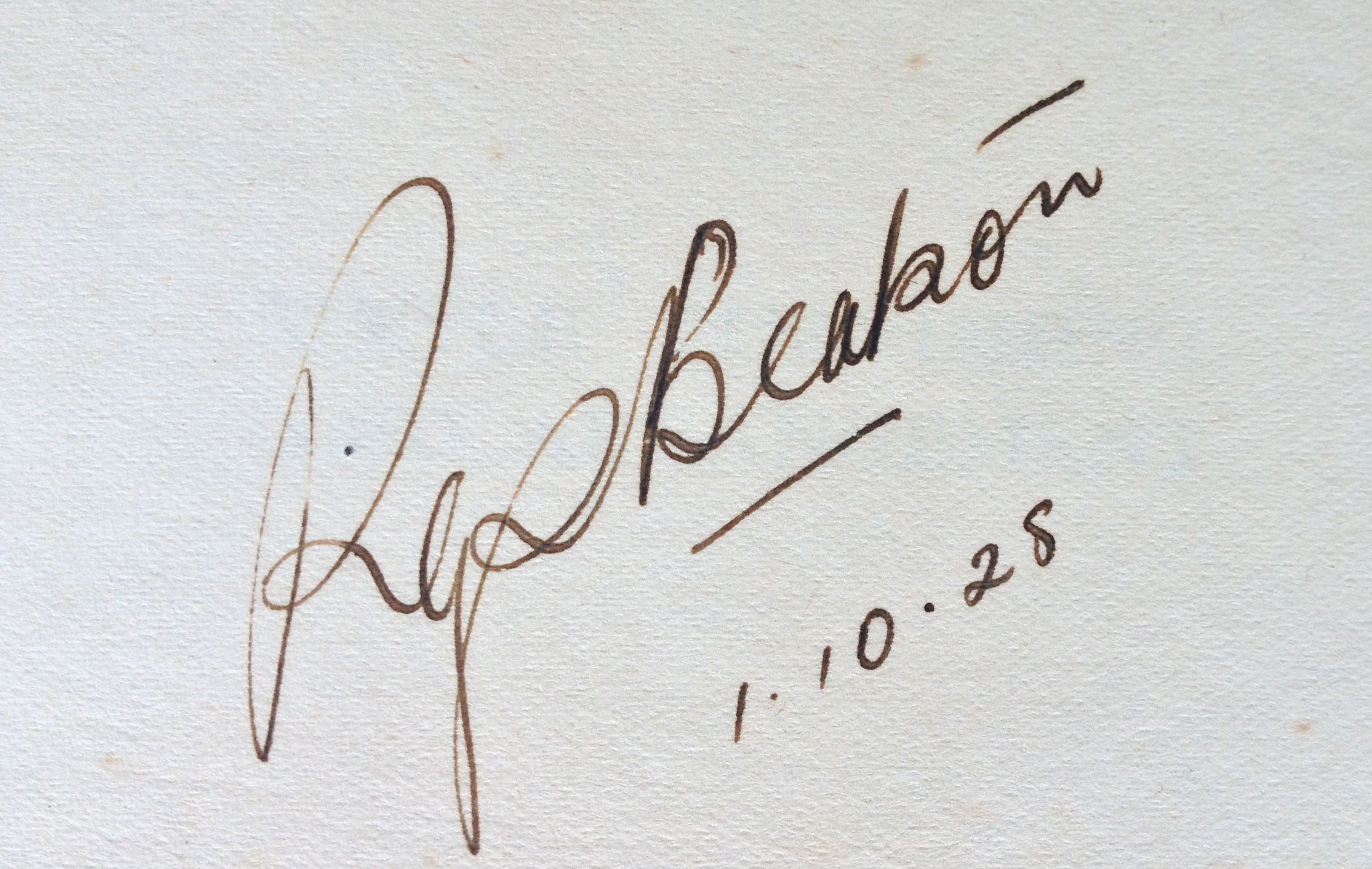
That owner was R. G. S. (Ronald Guthrie Senior) Beatson, the first editor of Home & Building (now Home New Zealand), New Zealand’s pioneering and longest surviving home decorating magazine. Ron purchased this book in Hamilton on 1 October 1928 – just over 85 years ago. At first I felt a little sorry for Ron – is this all you could buy in Hamilton in 1928 – after all it is hardly Le Corbusier?

Then I got to wondering. How old was John Gloag when he (and his wife) wrote this particular book? The answer is 25. RGS Beatson was also twenty-five years old when he bought this copy in 1928, seven years after it had been published. Had this first edition lingered on the shelves unwanted in Hamilton? Did he buy it marked down (as most young architects do) or had it just arrived and he snapped it up and carried it home with great excitement?IMG_1987

We’ll never know the details of that purchase but I now took a different view of the book. This was a book through which two young men, really only just starting out on very different careers, had communicated over ideas about style, at a tricky point in the Twentieth century.

Once this little book, inscribed as it is, would have seemed to young writer me as damming evidence of the avoidance of modernism by both author and owner. However fascinated by the ages of the two men I delved into its pages in order to find what I could that might have reflected their combined youth. What enticed R G S to this book, besides a smart brown linen cover? Why would Duckworth & Co, a respectable London publisher, have wanted to publish a work on decorating by a twenty-five year old – there must have been plenty of other older more authoritative experts about?

IMG_1986

The Gloags start their book: ‘the furnishing of a small house or flat is an interesting and delightful task.’ I smiled at this. Because in the first line they’re saying ‘we’re young, we’re interested in style but we have no real money or resources – so what are our options?’ So the Gloags weren’t fusty, they were young people and young people who were in fact surprisingly modern.

As with most young people they didn’t think much of the generation just before theirs. They wrote:

“New Art was a disaster, and might have established a strong prejudice against fresh effort in design, thereby retarding the development of decoration and furniture.” Originality should not mean sacrifice of all established designs. To favor the abolition of the perfect proportion and grace of the classical orders of architecture would be architectural bolshevism. “

Young authors, myself once included, usually can’t resist slagging off the generation immediately before theirs. It’s a right of passage that becomes a little embarrassing as you get older but in the first flush of writing it’s hard to avoid.  There it is, the Gloags, all of twenty-five, loathed Art Nouveau. I suspect they were in mixed minds about a lot of Arts Craft work too.

The Gloags do what any young couple might do – reach back a generation or two find something they admire, adapt it and then promote it. Dipping into Simple Furnishing and Arrangement  the Gloags seem to have a lot of sensible things to say on the subject of decorating – I’ll now sit down to the rest of the book aware that I’m reading the thoughts of twenty-five year olds dissatisfied with their decorating lot.

DLJ


Posted in Uncategorized | Tagged | Leave a comment