More Beaton than butch


1.

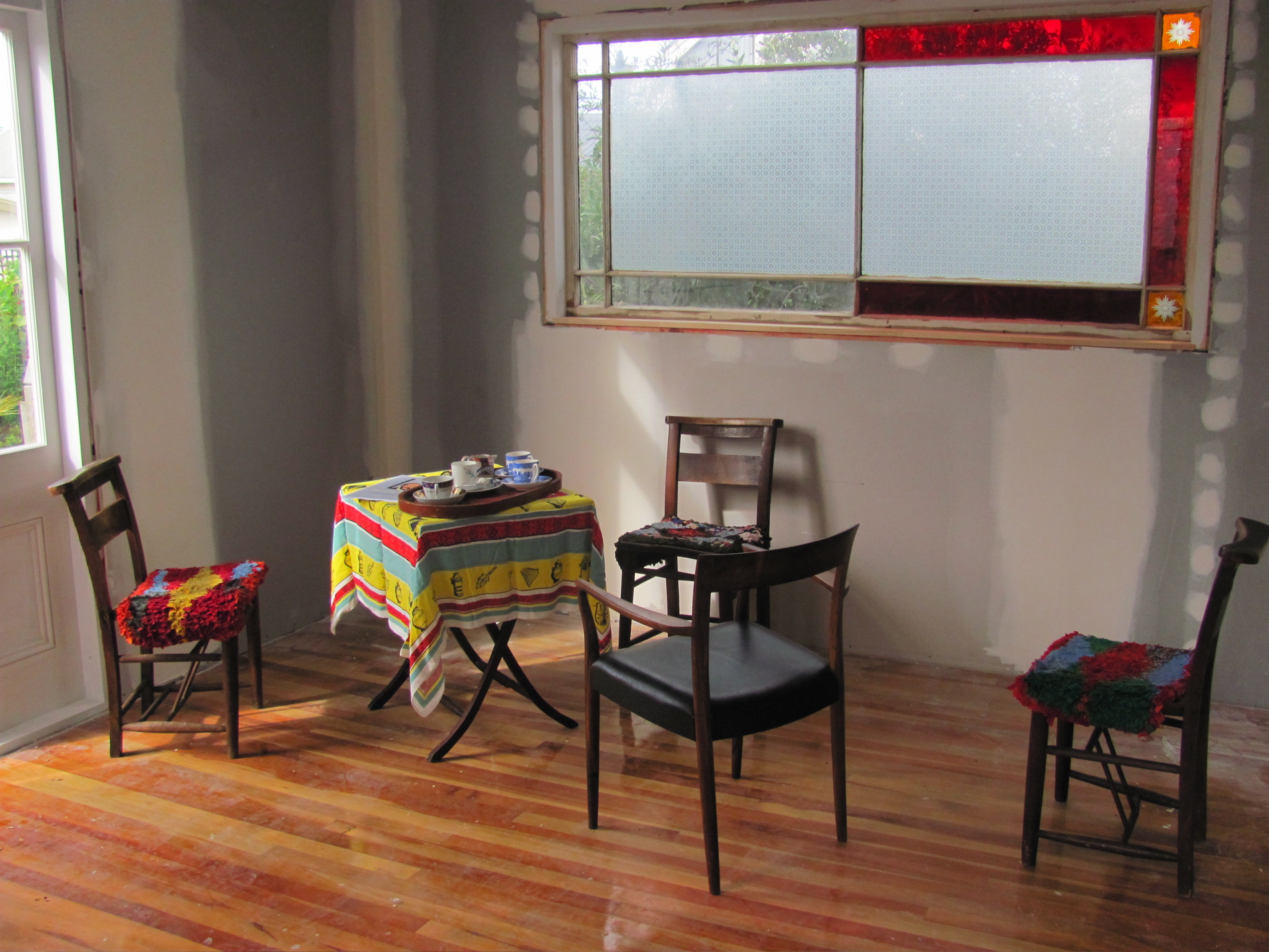
Somehow we decided the sun room aka back dining room would have coloured glass windows. This was partly because we had haphazardly collected old Victorian windows and now had to justify these fevered purchases. But the idea of a kind of conservatory seemed pleasing. There were neighbours on one side we could tactfully edit out – and the fact is Victorian glass is pretty glorious.

I think we’ve written here before on the way old glass ripples, distorts light and refracts. Coloured glass adds another dimension. (Who can remember Kezia in Katherine Mansfield’s Prelude looking out at the garden through red blue and yellow light and seeing an entirely different landscape each time?)
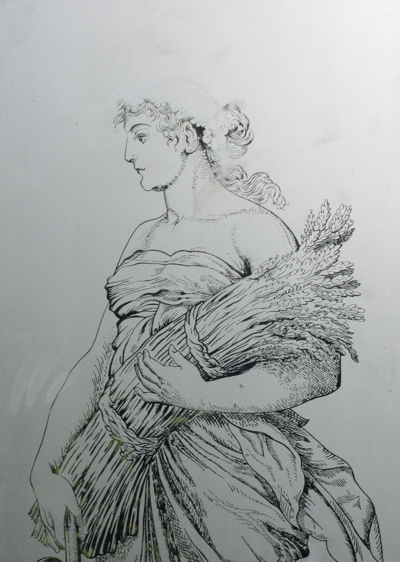
Summer

Glass  seems intimately connected with memory.

However the glass we had, was a mixture. There were the double doors, with their softer hues in a complex, almost Puginesque period pattern. In the middle of one of these doors was a fantastic etching of a woman representing Summer. The other pane was broken. The unbroken pane was removed and inserted into a new frame, has become a rather rude shock for Douglas: as he stands at the toilet he has a lady with a scythe gazing down on him speculatively.

I thought I’d try and find replacement glass for the surrounding coloured panels.

Naively I went to a local glass merchant.

Surrounded by current-vogue glass, with its minimalist colour range running the gamut from bird-dirt to mouth-gargle blue, I had no idea I was at the beginning of a journey.

from bird-dirt to mouth-gargle blue

‘That’s more than a hundred years old,’ the glass man said to me accusingly.

He took me out the back, left me with some shards while he went off to the important business of morning tea.There was a definite sense of reprimand in the air. Eventually an older model came out and conversationally said he used to always make sure he collected any old glass and kept it for just such an occasion. But when his business was absorbed – I felt the business might have ended badly – all the old glass was trashed. Their idea of ‘old’ was1970s dimple glass and there was no match there.

 2.

Puginesque

It was the morning after the All Blacks won over the Australians. The newspapers had said a vast proportion of the population would have celebratory sex if the All Blacks won. (It didn’t say that when the All Blacks lost assaults on women also rose.) Anyway, happy occasion, the All Blacks won and I found myself in what is often called ‘the heartland’ – rural Waikato.

I was in a strange little place called Ohaupo  and I was calling in at ‘Leadlight Products (NZ) Ltd.  I thought there might be enforced chat about the Mighty ABs, or even some specific discussion about the underwear model’s groin injury and how it had plunged every one of us into an angst this side of Munch. However the young man who worked there was conscientious, modest and blissfully quiet. There was something about him of the seriousness of a medieval apprentice.

I obtained two pieces of ruby glass and a replacement side pane for the double doors. But I was also looking for some barley sugar coloured glass to add to the other coloured windows, (two of the other windows teamed red with this peculiar shade. We liked the eccentricity.) But the range of barley sugar orange glass was disappointing. It was either palest citrine or turgid hallucinatory go-girl orange.

3.

I was now in Kingsland, at Sauvarins. Kingsland, long into its existence as a ‘cup venue’ stunk like a urinal and looked a little depressing. The once characterful village was all pimped out and slack as a tart after an epic night with the troops.

Anyway the lady behind the counter in Sauvarins (happily surrounded by more bird-dirt and mouth gargle colours) told me they no longer ‘did colour glass’. She kindly wrote the directions down for Sauvarins colour glass which, she told me emphatically, was a stand alone business no longer connected to the old Sauvarins.  I reflected how businesses in NZ had no longevity or even bothered to keep old stock in the sure knowledge that fashion revolves and everything is needed in the end.I also noticed how everywhere I went there was no business happening and the whole country, like countries all around the world, seemed to be slowing right down.

I found the coloured glass Sauvarins out at Onehunga – I was the only customer – but the very pleasant woman who worked there couldn’t help me either. All the colours seemed electric, unsympathetic and unambiguous. It was no go.

I don’t know. Sometimes I fear a conservatory made up of old Victorian glass windows is a 70s cliché. It may well be. But perhaps clichés have to be reinvented – reoccupied – changed so that they take on a whole new life.

We might have avoided it by the use of cream painted wood. In the old days there was a lot of native wood usually left untreated so it had a kind of orange look to it. There might even be a smell of linseed oil. There was a heaviness to the conception, even a masculinity. Often in my mind’s eye I see these rooms as dark. (Possibly even dirty, if I am frank.)

We’ve gone – surprise – for the more Cecil Beaton-end of things – the light white conservatory much featured in his retro-Edwardian My Fair Lady. The idea is a kind of creamy whiteness and lightness offset by dazzling colour – with light coming in through different coloured glass.

In the end we decided not to go for the eccentricity of barley-sugar orange – especially as it was unprocurable. We’re getting another lot of ruby-red flat glass. I emailed the quiet young man at Ohaupo and already the ‘ruby red flat’ is winging its way to us.

PW

Posted in Uncategorized | 1 Comment

Courtyard Envy

Last weekend we ventured into the hills behind Napier. This is a zone that during all the time we’ve lived here we’ve never explored. We were lured by an open home – more than that – an open stately home of the sort only Hawke’s Bay can provide. We were of course NOT rubbernecking, as this is exactly the sort of house I would buy should $1.5 million suddenly attach itself to my bank balance.

The house had been built in 1906, the same year as this house but instead of being designed for a semi prosperous farmer to retire to, the house in question had been designed by the architect C. T. Natusch for the young wife of an Edwardian run-holder who, finding the station homestead too rural, had asked for and got a town house.

Called Silverford the house is a lovely mock Tudor number, with a low sprawling u-shaped plan. It is set in large gardens and comes with a small vineyard. The house is approached via a long oak tree-lined driveway and has any number of additional charms not least of all the remnants of an Edwardian garden, including a large, almost silted up, ornamental lake and a crochet lawn.

However the great surprise of the house is a beautiful courtyard that sits in the shelter of the u-shaped plan. It can be viewed from inside the house by a glass-lined hall that runs behind the formal rooms of the house. Doors open into the courtyard and it can also be accessed from the open end between the two bedroom wings.

Above the courtyard an ornamental grape and a second climber have been growing contentedly for some years along a network of wires. As this was early spring – it wasn’t hard to imagine how delightful that space was going to be in high summer.

Back at home – after lunch at the local pub – our brand new pergola seems rather bare. It is, as yet, unfinished, as is the carport that will turn our L-shaped house into a U-shaped one and provide the sheltered privacy of Silverford. The sun here is already getting intense and the sheltering leaves of a grape seems a very attractive proposition indeed. It’s an idea we’ll pinch. Where to fit the crochet lawn is however an altogether more difficult proposition.

DLJ

Posted in gardening, inspiration | 2 Comments

Pressed between pages


1.

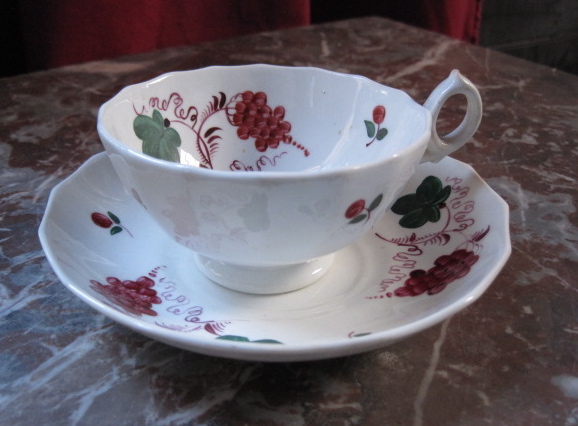
This tea set, a lovely lively little early nineteenth century production, decorated with grape vines and fruit, came to us from our favourite source, Maidens & Foster, the local auctioneer. I had spotted this a week or so back but it had disappeared by sale day. I suspected that Todd had moved it to the antique sale, upgraded it so to speak, but no it had simply gone into the overflow and turned up in the estate sale the following Wednesday.

In the same sale there was a box of about sixty auction catalogues from Sotheby’s and Christie’s sales dating from the 1970s and 1980s.  Nicely illustrated these were a treasure trove of images and heart breaking low prices – oh for a time machine.

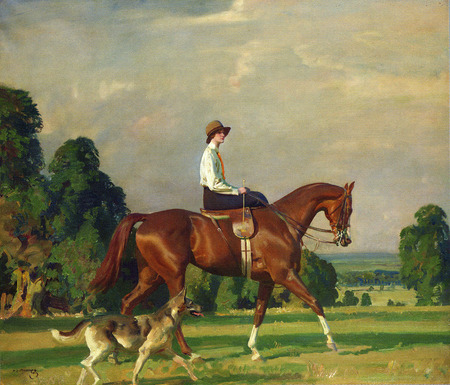
Once I got them home what struck me about these catalogues was the intensity with which someone had studied the international art and design markets. Who was this person who so carefully recorded the prices received for equestrian works by Sir Alfred Munnings’ at Christie’s Important British and American Sporting Paintings on June 4 1983 in New York .

Sir Alfred Munnings. Miss Ruth Brady on Bugle Call (c1920)

Who was this person who had purchased relatively obscure works by Albert Friedreich Schrode, and Christian Friedrich Mali from Important British Paintings a South Kensington sale in 1982? Did he also buy from the decorative arts catalogues? Was he scooping up Art & Crafts and Art Deco furniture and ceramics at good prices while others looked askance.

Was he obsessed with decor?

None of this is quite explained in the catalogues, however closely I read them but I am left with the impression of the sort of person I’d love to sit down with and have a chat about his auction adventures.

A box of books and a tea set is a pretty common weekly haul around here (just part of the decor torrent we live under)  but this week proved to be an exception to the rule once the weekend rolled around.

2.

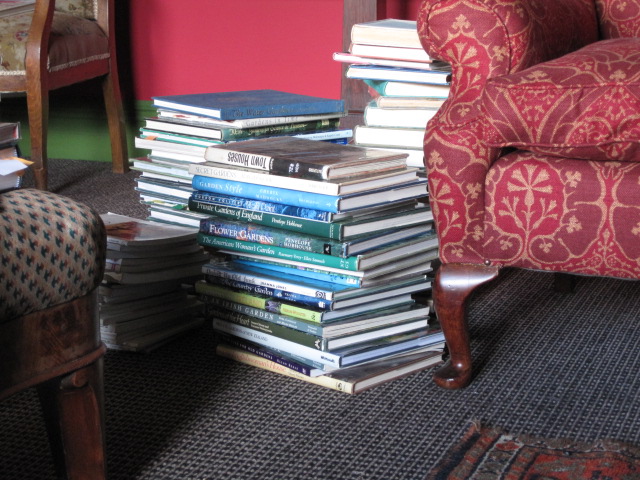
Napier has an annual calendar populated by four book sales in the name of charity – one each by the Napier and Hastings Lions and two by local high schools. Acknowledging that we have far more books than we can reasonably accommodate, we decided to give the notion of queuing for the opening of this weekend’s Lions Book Fair a miss but instead wandered in at 11.30 not expecting to find anything much left.

Chancing upon a lovely copy of Cecil Beaton’s The Face of the World (1957) and a rare copy of Looking Back (1934) Norman Douglas’ autobiography, led us to suspect that, as usual, our taste was not that of the locals and that there might be more to find and Peter headed off into fiction.  My approach is generally to head first for Architecture, proceed to Art, then on to Gardening, Decorating, Cooking, Biography, History, and then finally the New Zealand books. Unable to detect the first two in the sprawling hall – I went straight to the Gardening table.

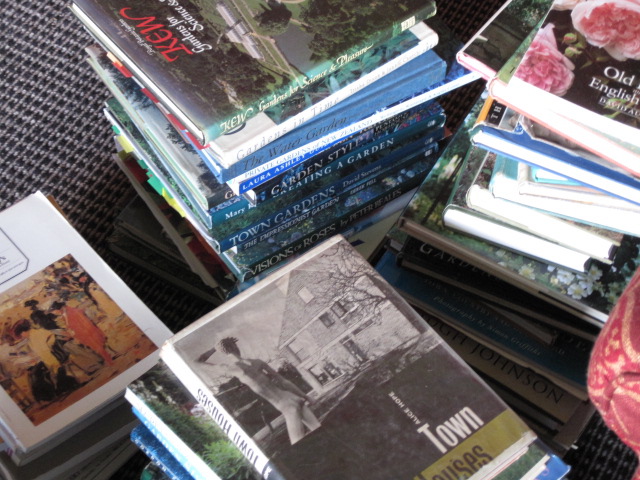
Starting a one end of the table I noticed something strange. I had picked up the first half-dozen books in the line-up and put them under my arm. They were all better than usual (one time expensive) gardening books in lovely condition. Looking along the table it dawned on me that someone had donated a very large and very serious collection of gardening books – from early classics, Gertrude Jekyll’s Wood and Garden, Beverly Nichols Garden Open Today, Russell Page’s Education of a Gardener, and Christopher Lloyd’s The Well-Tempered Garden, through to some great works of garden history – including Jane Brown’s Gardens of a Golden Afternoon about the relationship between Jekyll and Lutyens, and books by and about Edna Walling.

To follow came the ‘simply lovely to look at’ style of garden books Edith Wharton’s Italian Gardens, French Garden Style and Gardening at Sisinghurst and then intensely practical books by Hugh Johnson and Penelope Hobhouse and others.

If it had stopped there I might have come away with a carton full – but I didn’t – the same person’s interests covered decor and so I came home with an additional carton this one full of luscious books on how to decorate New York Town Houses, French Chateaus and Irish Castles.

Even this lot – which gave us a most pleasant evening in front to of the fire (including green tea from our new cups) would have been quite manageable,  if it wasn’t for my inability to resist the temptation to return the next day for the clearance sale – in which books are parcelled off a $6 a carton load. Two more cartons came home – many of the best gardening books had still been unable to attract the attention of local bargain hunters in the space between my visits.

I now know a little about the owner of the auction catalogues through the occasional note or invoice left tucked in a catalogue – something I do myself.  Yet I know even more about the owner of the garden books – through her habit of leaving all sorts of things tucked inside her books. The fact that they’re still there suggest an estate sale or a hasty exit from a home but they tell me a lot about the woman whose library I now (partially) own.

Firstly Betty (not her real name) has the habit of carefully recording where and when she purchased each book with a small printed card inserted into the front of each volume. I am delighted to discover that she didn’t buy these books new – but at the same four charity book sales we visit, over the last ten years (I probably stood next to her at the garden table once or twice). She read each book, marking the pages with small adhesive tags where she though the advice good or the effect pleasing.

Betty’s husband died from the effects of asbestos and she still felt the pain of his loss years later. She wrote, but never posted, a letter to the authorities on the subject. She found solace in the Anglican church. She cut articles from the paper about events and television programmes with pinking shears.

Princes Irene

She borrowed those garden and decor books she didn’t own from the Taradale library. She planted the tulip Princes Irene on Easter Monday 1992 and bought a ‘Barn Owl’ from Palmers for $24.95 on the last day of 1998. She like Rhododendrons and went on garden tours and to antique fairs. She collected antique silver or at least browsed specialist silver sale catalogues. She liked to sit down of an evening a read about stately homes and decorating. In fact the one thing I know nothing about is her garden – although she left me with a layout sketch for a planned herbaceous border.

Betty seems a sweetie.  Again it would have been nice to chat over a cup of tea and perhaps wander through her garden. Wherever Betty’s gone now one just hopes she has a view of a herbacious border or two.

3.

Back at the other end story – the guilt ridden confession of having more books that I can reasonably deal with – I was heartened by one of Betty’s books – The World of Interiors: A Decoration Book by Min Hogg and Wendy Harrop. It is a lavishly compiled book drawing on the magazine of the same name.  In it I found this interior – the home of English decorator Keith Irvine – as the text says – ‘The room looks as though someone is in the throes of moving house, but that is just the way the family likes to live.

DLJ

Posted in gardening | 1 Comment

How to make one room from two.

In wooden frame houses the blending of two rooms into one should be a very simple process. Why then do so many get it so wrong?

Often when visiting a house, a proud owner will explain that ‘these used to be two rooms but we made them into one’ – an architectural operation the scars of which are all too obvious. There is nothing uglier than a clunky join between two rooms.

So here are some things to think about:

First of all you have to ask yourself is this really an option? Can these two particular rooms be made into one room satisfactorily? To understand you need to look first at the proportions of the eventual room. Are the two original rooms of similar scale are their ceiling heights the same? Examine the position of the doors and windows. Will the finished room look like it was supposed to be, or will it resemble a stitched together Fanken-room?

If the rooms are unlikely to work as a whole, then you need to think about how you might retain the wall between then but reshape the opening. The classic way of doing this is by an arch, but proceed with caution.  There was a fashion some years back for Spanish Mission style interior (inspired by TV westerns like Bonanza and Zorro) inserted into older houses. The result was usually/always disastrous and left any sort of semi-circular arched opening with a bad rep.

In most cases a strong square opening is the better option.  To do this you need to start with the proportions of the top section, i.e. the space between the top of the proposed opening and the ceiling. Once decided, this will determine the scale of the protruding sidewalls, those that will support the overhead structure. Where mistakes are made is in eliminating the sidewalls to maximise the width of the opening. This makes it appear as if someone has placed a large beam through the room.

Note: if your wall is a structural one ­– and requires a large beam through it – this is a really good indication that these should not be made into one room but retained as two. In this scenario you need to turn to decor solutions rather than structural ones.

Back to the goal – two rooms blended into one. First step is to demolish the walls that separate the two rooms. The framing needs to be removed entirely so that you can see what needs to be done.

It’s important that you start from the top. Usually, and mistakenly, we don’t pay much attention to ceilings. However we spend more time looking at them than we think – particularly in bedrooms or living rooms. In New Zealand, where 90 % of ceilings are painted white (one 1930s decor writer hoped this was a short-lived fad), ceilings often catch the eye and particularly if there is some sort of glitch in their otherwise smooth surfaces.

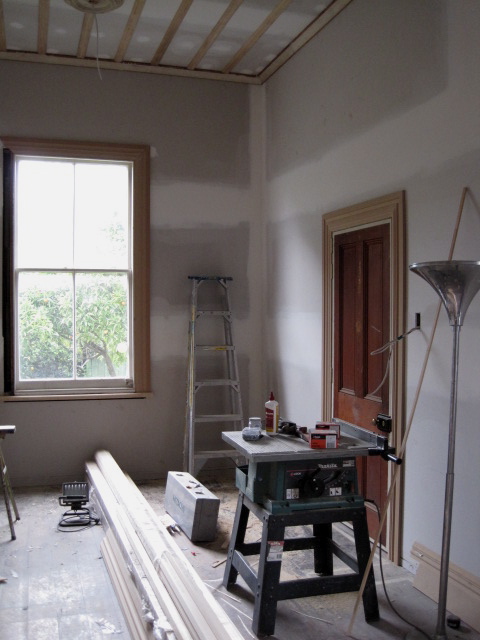
When we demolished the wall between onetime kitchen and maid’s room we discovered that the ceiling planks were not continuous (and the battens long removed). This put an end to the idea of a board and batten ceiling of any authentic type.

Instead the old cornices were removed (to be put back up later), new gib-board was put up over the old boards to make a new continuous ceiling. Then with the cornice put back, new battens were laid over. Because the room is long and slender what was two rooms look very much like it always was.

Similarly the wall finishes of the two room – both different – were covered with new wallboard. A quick assessment of doors and windows – led to a slight shift of one door to the left by a few feet, this was more to accommodate the layout of the room that leads off the new room. Now the only suggestion that there were ever two rooms are remnant lines on the old wooden floor – and these will be covered by carpet.

DLJ

Posted in practical matters | Leave a comment

Decor Extremus goes to the tip

When I was a kid the tip, the dump, was a source of never-ending wonder. Since I am such an ancient, I should make it clear I am speaking of the 1950s and especially the 1960s. By this time everyone had made a communal decision that we all lived in the rocket age, Kennedy was the president and the past was really behind us all. We had no further use for it.

So the tips of my childhood were full of abandoned Victorian and depression-period objects on a truly enormous scale. (Think the store room of Citizen Kane at the end of the film…deposited over rotting matter) Of course kids are always rag pickers so it was an educational goldmine.

Well, yesterday, Douglas and I took some vegetation out to the tip. There is always a woman who takes the money who bides her time by being fresh. I am always ‘young man’ (a winning strategy) and she makes the point that it is ‘just for me’ that she is giving me the tip ticket. (How do you handle this plunge into intimacy. When I buy bread the woman always calls me – and every other customer – darling. I sort of like it and I sort of cringe. Imagine if one replied – that’s alright sweetheart.)

Anyway long story short, Douglas had also put in bag of rubbish. Whether this was a ploy I do not know, since I know he was also a tip scavenger in his childhood. I backed the car up to the pit. It was a windy day and great clouds of brown dust whipped around. Tips to me always evoke Italian neo-realist films. They seem to me to be heavily atmospheric – both wasteland and goldmine.

Douglas tipped out his bag and then called me over. I could tell he was excited. I got out and looked down. I became excited too.

Down below us, about two metres down, were two pictures in elaborate Victorian golden frames. Inside were family photographs. One had shattered glass and both were dirty. But one frame looked magnificent.

The huge machine, which scoops up the rubbish into one vast tidy pile, was at work. Douglas tried to get the man’s attention: it was no small business getting down into the pit of rubbish to ‘save’ the pictures.

But this became our burning obsession.

Somehow the man noticed our predicament. He halted the machine and got out. He was unusually pleasant: mostly men who work at the tip have a high suspicion of mere mortals who merely come to deposit rubbish: they sit, as it were, atop the rubbish heap as lords and masters.

Douglas explained we wanted to look at the picture down there.

Amazingly, the man picked it up, looked at it and instead of saying – you can’t have it, it’s council property, he handed it up to Douglas saying, ‘It looks pretty old.’

Whether this meant – a negative or a positive – I couldn’t tell.

Once it was in Douglas’s hands, he smiled and said to the man, ‘There’s another picture down there, could I see it too?’

We got its companion, a woman. Then Douglas saw yet another, smaller picture. This was of a young man.

We got all three.

They were filthy but clearly all belonged together as a family. Given Maori sensitivities to ancestral images, it seemed amazing that these poor Pakeha – who obviously had money in their past – had ended up so abandoned.

The tip man cheerily winked to me when I turned to wave a thank you goodbye. Tips are great places, I thought.

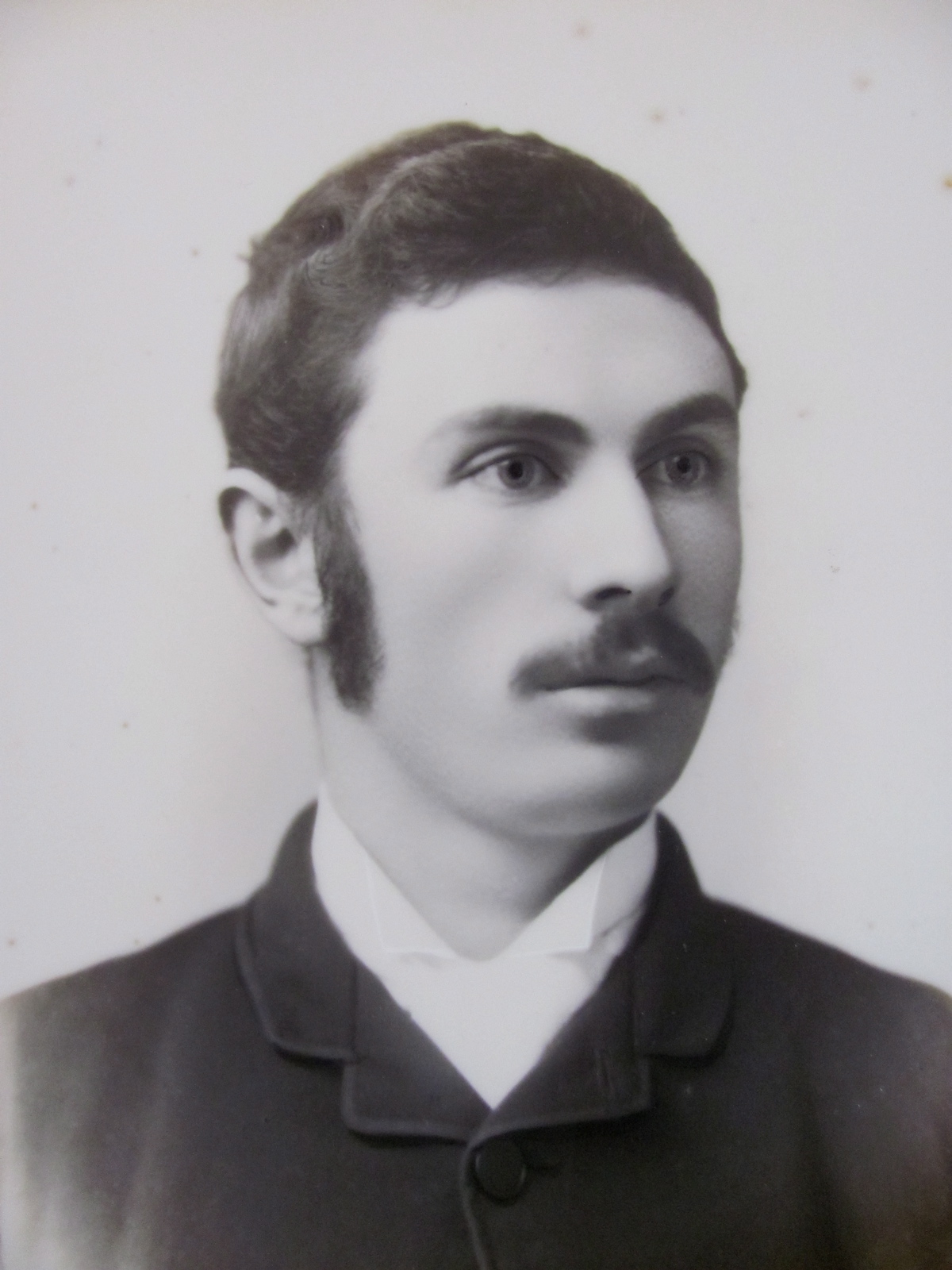
Back home Douglas took the images out of the frames. They turned out to be Opalotypes, a Victorian production method of photographing onto thin sheets of white glass – the effect of which was closer to a pencil drawing than a photograph (and which seems to evoke the graveyard and memorializing). It was expensive too and it’s not surprising that the subject family were clearly prosperous – a plump father, an ugly mother and a not-too-bad looking son.

Inside there were pencil markings and an actual date – 20/10/1892.

But it was the frame, which caught our attention.

We have a ‘frame bank’, buying up frames at auctions in the knowledge (or hope) that in future we’ll have some use for them.

The local picture framer is used to us now – we are the odd couple who come in and ask, not merely to put things in old dirty frames (which they clean) but even more weird, we insist on keeping the old woggly glass.

This (right) is one of the frames we have bought – we live with (aka tolerate) its current incumbent. Now we have another frame awaiting an image…

Does this way lie decorative madness?

Are we creating the tip of the future?

PW

Posted in auction finds etc. | Leave a comment

The Hero of our Home

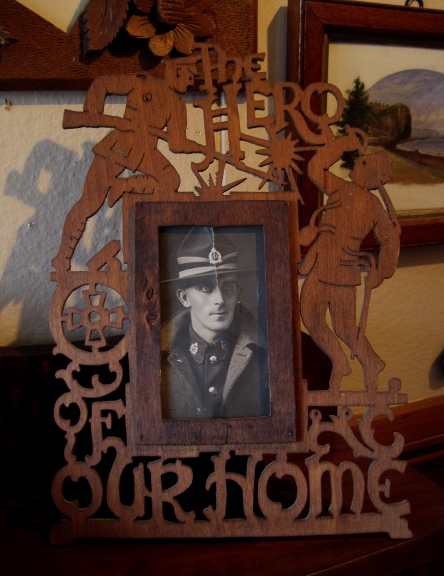
This is William John Gempton. He came into our home via the convergence of two collecting paths – (1) my policy of rescuing handsome men from a ghastly eternity spent forgotten in a box in some secondhand shop and – (2) the very fine fretwork frame in which he lives. William (complete with frame) was found in an antique shop that used to be in Market Road, Auckland (run by the remarkable Finella now resident at Cordy’s).

William gets more attention than do most individual objects in the house by dint of the fact that he tends to slip from the frame in which his photograph is lodged and therefore requires putting back together on a pretty regular basis. Last time this happened I was reminded of his name. ‘Bill Gempton (1890-1979)’, is written in pen on the back.  I decided to Google him.

Google was sure I really meant Bill Compton – the lead vampire in True Blood. So I took the image down to work, where there are people much better than most at tracking this sort of information. It took only a couple of minutes and we now have Bill’s back story.

To my total surprise Bill turned out to be a Napier boy – a saddler, whose parents lived in Hastings Street. He shipped out to World War 1 aged 28, with the 42nd Reinforcements D Company but did so relatively late in the piece in August 1918 – when the war had only a couple of months to go. This means that Bill probably saw little in the way of active service.

Bill came home to Napier and returned to the business of making saddles. His handsome good looks never seemed to find a wife – yes some people find the intensity of his eyes [a little vampire there after all] a little troubling. Bill lived on and off with a sister. Was it her that had made the frame? Was it her that labelled the back of the photograph? Did the photograph live with his sister all those years before somehow ending up in an antique shop? There seems a certain irony that Bill’s frame – so graphically illustrates  a Tommy ‘sticking it to the Hun,’ when Bill arrived too late to do anything of the sort. Was he vaguely embarrassed by it as the years rolled on – or did it sit forgotten on a table in a spare bedroom.

Later in his life, when the saddler business sort of petered out, Bill became a caretaker and property manager for some of the larger houses on Napier Hill, moving residence with some frequency. So the question kind of remains of whose home was Bill the hero? I once removed Bill from his frame and replaced it with a lovely image – of much the same period – of a sweet grey Tom-cat but it just didn’t work. I returned  bachelor Bill to his frame and there he remains – saddler, soldier, groundsman and the Hero of our Home.

DLJ

Posted in auction finds etc. | 2 Comments

Men about the house.

I have managed to persist in writing and editing a book while the house has been undergoing that curious species of madness known as renovation. I did this through the purchase of some earplugs costing less than $7. They’re not particularly good but somehow they provide just enough blankness to convert the builder’s radio to a background rumble. I was so desperate to complete my book that I just kept on working.

It helped that the renovations – an outside verandah, a new sunroom – were largely taking place outside the skin of the house. They were outside and I was inside. The three cats all came into my room and like people suffering bombardment we huddled together, occasionally exchanging a long questioning look when a hit seemed closer than usual.

But now the skin of the house has been breached. An internal room is being made into a bedroom, with the additional luxury of a dressing room and a bathroom off that. A fireplace has been demolished.

Then a few days ago the house was suddenly occupied by a small army of men. There was the electrician who is a jolly small man with a very loud voice. He is friendly and only too soon that fatal mistake had been made. My name was abbreviated to ‘Pete’. This is the rare gift of friendship awarded for a lifetime service, or in the case of my mother, having done the hard yards of giving birth to me. The friendly electrician invaded my space completely by ‘popping’ into my study to see what lights were working, to inform me about electricity going on and off. I was thrilled.

He also had retainers, young lads slim enough to slither under floorboards with cables. They all looked startled on seeing me, which I put down to their sudden awe at seeing an award-winning author at close proximity.

In addition there were suddenly two plumbers on site.

Now things really looked up. One of the plumbers was a handsome lad dressed informally in Hawke’s Bay rugby colours. He sported some fetching shorts. He was modest and polite.

I am wised up enough to be wary of good-looking tradesmen. Charm is no substitute for capable work. But the plumber showed no such mercenary dash. He worked away quietly in the hall right outside my office – distractingly so –  while the ever-cheerful electrician ‘popped’ in and out of my personal space to keep me up to date with his electrical adventures.

In defence I had put up a lace curtain over my study windows. My cats naturally disliked the way it cut out the sun. Usually one of them managed to claw the curtain away, since the curtain was pinned up with drawing pins. This added to my completely admirable absence of stress.

My book is now on its way to China. I say this because I like its romantic image, which conjures up slow boats, sunsets and Singapore Slings. Realistically I know the book went electronically.

Just as I know now the skin of the house has been breached, having ‘men about the house’ will be increasingly invasive. There is another month or so of renovation madness to go. There is dirt and mess everywhere. When someone at a recent event referred to ‘your beautiful house’ I had to do a double-take. Really the house resembles nothing so much as one of those country houses made over to an army barracks during a war. It isn’t beautiful at the moment. All is mess, all is chaos – but you feel sure in time – or you hope – some kind of magic will return.

PW

Posted in Uncategorized | Leave a comment

Beverly Nichols and the Christmas rose

I am a big fan of the, now sadly obscure, writer Beverly Nichols, who if you can get in the groove of his somewhat arch queeny tone – is one of those fab interwar English poufs with an obsession with both house and garden. This obsession,  in a pre-blog era, was something Beverly was able to parlay into an incredible number of garden and decorating books – along with almost every other conceivable type of other publication;  essays, novels, plays, political and theological works, biographies, auto-biographies (published aged 25) and highest of all highest literary achievement – three books on cats.

The profits from these he spent on a string of ever larger houses and more impressive gardens. In this he was my kind of guy – less so his predilection for luring uniformed Guardsmen from duty – but that’s another story.

One of Beverly Nichol’s best books is called Down The Garden Path, first published in 1932 and illustrated by the equally fabulous Rex Whistler.  In this, Beverly spends some time on his mad scheme to create a mid winter garden. I find people often misunderstand my [essentially complimentary] use of the term ‘mad,’ so perhaps it’s worth noting this is Beverly’s own choice of words

We are now in the depths of winter … my first winter in the cottage … and the first winter when I went mad…. for I suddenly said to myself  ‘I WILL HAVE FLOWERS IN MY GARDEN IN WINTER.’ 

What unfolds is a charm-laden story in which Beverly’s attempts to get anything to flower in the permafrost – ‘and by flowers [he] meant real flowers, not merely a few sprays of frozen periwinkle and an occasional blackened Christmas rose.’  

Rex Whistler, Winter (1932), from 'Down the Garden Path.'

Yet what struck me from the beginning was that very thing Beverly rejected – what was a Christmas rose? This was something I’d never encountered before. I like roses and so surely I’d like Christmas roses.

It  turns out that a Christmas rose (aka Winter roses aka Lentin roses) were the same Helleborus that Peter had been growing for years in his Auckland garden. I however had never paid much attention to the little low-growers – I needed that personal invite from Bev.

The thing is, right through his chapter – Winter Madness – Beverly keep returning again and again to the Winter rose. So it weaves its way through his  search for anything other than a winter rose – like a recurrent motif.  So in the end, out of curiosity as much as anything,  I committed to being a supporter of the Winter rose.

All this essentially came to nought – a passing fad – until, that is, this winter when mine have for the first time started to produce enough in the way of booms to fill a copious number of vases.

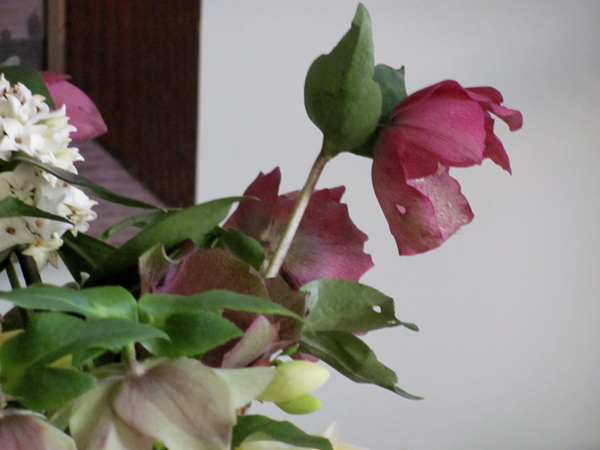
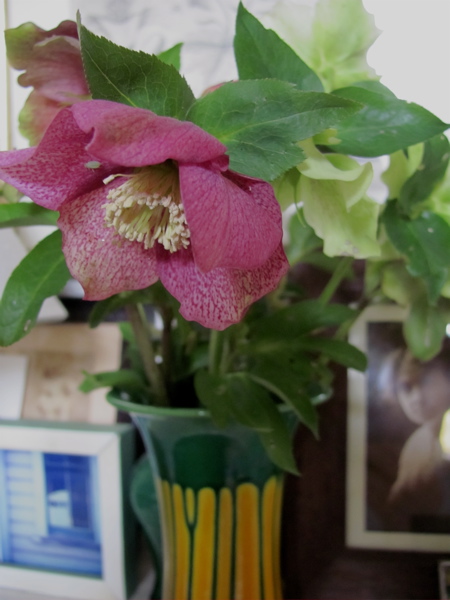
As mentioned Winter roses are in the Helleborus group. Their pretty, open, cup-shaped flowers do look a bit like single roses (hence the name) in shades of pink, maroon and cream that age to a fascinating green. This weird, limited but linked, colour range is one of the nice things about this plant – it’s not like a flouro-yellow one is suddenly going to pop up – which seems to happen with some other plants (Antirrhinum) I could mention.

Helleborus are ideal for use as ground covers under trees and don’t seem to need much attention – and any attention they do need can be gleaned from any good garden book – after all Beverly wanted FLOWERS and it’s those we’re talking about here.

One of those things you need to know – is that you need to pick Helleborus in the morning as the young flowers are inclined to wilt and to split the stems and plunge into hot water. After that they’ll last quite well but it’s any easy step to overlook. Because the don’t smell they make a great companion for Daphne which does. In Beverly’s book he talks about winter jasmines that flower at the same time (as they do) and I could see that might work too.

What Beverly would have thought about that particular combination is a guess. I’ve just grabbed his 1967 work The Art of Flower Arrangement (more commonly referred to in this house as Mad Bev Does the Flowers) off the library shelf,  only to find that Christmas roses get no mention. This  is a pity because by about the late 1960s Bev’s prose style is entering a period of near intergalactic mannerism and I’m sure it would be worth quoting.

Back on the ground – I’m fond of my Winter roses, and their ability to bridge the last flowers of summer and the space before spring bulbs are up. Of course in Hawke’s Bay there are other flowers in the garden and certainly no sign of Beverly’s blanket of snow – but every time I see my Helleborus, I think of Bev’s imagining of his first mid-winter walk in his new garden …

In an instant, I seem to see the garden bare … the crimsons and purples are wiped out, the sky is drained of its blue, and the trees stand stark and melancholy against a sky that is the colour of ashes. It is then that I see, in some distant corner, the faint sad glimmer of the winter jasmine … like a match that flickers in the dark … and at my feet a pale and lonely Christmas rose. And I kneel down quickly, as though I would shelter this brave young flower from the keen wind.

DLJ

Posted in gardening | Leave a comment

How to approach a dressing room

There is something robust and purposeful about this room that I admire. It is more than the architectural severity of the gloss-finished tongue and groove, the emphatic placement of the bank of windows, or the view through to the unquestionably functional bathroom. It is, I think, to do with the masculine nature of the space.

This room states very clearly that, in order for a man to dress appropriately for his day, the essential starting point is a thermometer and a good range of robust boots.

This image is one I found while browsing on the Alexander Turnbull library site (www.natlib.govt.nz/collections/digital-collections/timeframes) years ago and it has always stuck in my mind because of the simplicity of the space. A reminder perhaps that dressing rooms, as they were first conceived, were working spaces and not décor experiences.

I cannot help but think there is no longer much mention made of those domestic spaces that were once called dressing rooms. Different from the en-suite bathrooms and the walk-in wardrobes which have tended to replace them, a dressing room occupies a very specific place on the architectural plan. It sits between bedroom and bathroom. It is the archetypical ‘space between’ in which the view through, and therefore an immediate connection, is made between washing and dressing. This is a space where a man dressed and presented himself to the world. Remembering that women usually used a dressing table, placed within the bedroom space.

It is perhaps appropriate then, that our new dressing room is being carved out of what was once the washhouse. It will sit between the new master bedroom (the original kitchen and servant’s bedroom) and a new bathroom (borrowed from the old wash-house) in what was once the scullery. Because it was once one of the house’s utilitarian spaces it was lined with rimu tongue and groove – which we have recycled and used to line the walls.

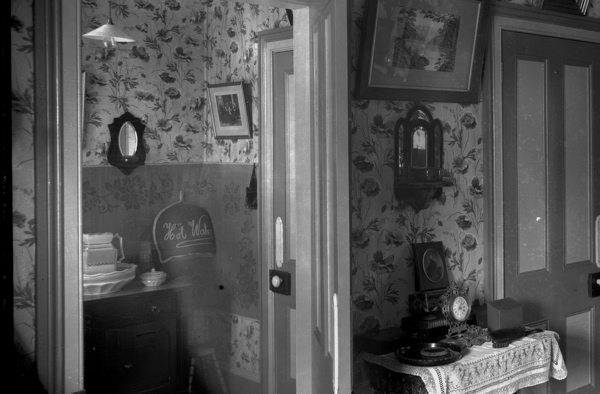
Somehow I suspect my favorite  dressing room belongs to a farmer, or other rural gentleman and not to Alexander Turnbull as my misleading title suggests. The more urban  dressing room (above) I also found browsing in the Turnbull. This is clearly an earlier room (pre hot water bathrooms) but even then I suspect his wife has had more of a hand in this room, coordinating wallpapers to match the bedroom and providing a velvet cozy in order to provide hot water.  It still has that lovely sense of a subsidiary space off the master bedroom.

At the moment our dressing room is little more than that view from a one match-lined shell into another which gives you some idea why it is I’m gazing at Turnbull images. The builders are back on Monday and the room should progress quickly after that. Then I’ll be on to thinking how to fill the room up – however – the lesson to be learned from the anonymous country dweller is that the more you leave out the stronger and more complete a dressing room will be.

DLJ

Posted in inspiration | Leave a comment

The co-ordinated trans-Tasman plaster ceiling project

A while back I blogged about the dilemmas of a Moroccan-style bathroom in a post YSL world. Well the concept for that bathroom is developing but as intimated a little more along the lines of Lord Leighton’s Victorian oriental fantasies than anything authentically Moroccan – beyond of course the little brass basin that set the whole project in motion.

Starting at the top – I’m taking the opportunity to create a second plaster ceiling. In part because the success of the one in the ‘boys’ bathroom,’ has given me the confidence to try something a little more complex although, ironically, a great deal smaller.

The ceiling pattern that has evolved for the girls’ bathroom is a bringing together of three different plaster suppliers each with their own stories, each giving give rare in site into the potential of a fascinating trade.

Atlas - every thing imaginable

The cornice (after much consideration I went for something restrained) will come from the Atlas Fibrous Plaster Co of Hastings (who will be assembling the ceiling itself). Atlas had its origins in an Australian plasterer lured to New Zealand in the 1920s to work on the now famous – Civic cinema in Auckland.

The Civic is a masterpiece of Moorish fantasy, populated with plaster lions, elephants, and much, much more. Like so many associated with the Civic, (including its owner Thomas O’Brien), Atlas came pretty close to going broke when the Great Depression hit and were on the point of closing up and going home to Melbourne, when along came the 1931 Hawke’s Bay Earthquake. They relocated to Hastings in order to supply Hawke’s Bay with the very plasterwork that now underpins the Art Deco heritage status of the twin cities.

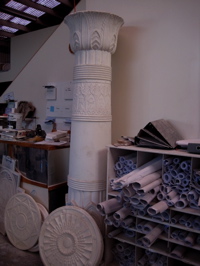
Now run by Bryce, Atlas is a veritable treasure trove of plaster casts of all sorts of objects – from to Art Deco cornice to a stash of plaques (reading Advance Hastings) left over from a forgotten city-development campaign of the 1940s. Atlas’ range even includes enormous Egyptian style plaster columns (designed for Masonic temples) that one-day I’ll find to use for – although perhaps not in a petite, girl’s bathroom, project.

The bathroom ceiling will feature small panels each with a stylised rose, designed to project down from the cornice at each corner. These come from Carrara Ceilings in Johnsonville, Wellington. Carrara was established in 1903 by another trans-Tasman import, Robert Wardrop from Victoria who joined up with an Austrian named Ernest Schaefer to begin The Carrara Ceiling Company – that in a cross cultural moment they named for the Carrara marble quarries of Italy.

Now run by the endlessly patient Trevor, Carrara’s real specialty is their vast range of amazing Edwardian period moldings – spectacular cornices, impressive domes and even giant plaster cherubs. Trevor’s got a fairly comprehensive website (www.carraraceilings.co.nz) but there is a lot more to be revealed from a visit to the Johnsonville factory ­which is where Trevor’s natural patience pays off,  as he unveils sample after sample, to eager renovators.

At Carrara

The final component of the ceiling will be a small grill – designed to disguise the intrusion of modern technology (an extractor fan). For this I reversed the flow of plaster skills and went Trans-Tasman.

Although devoted to décor magazines – I can’t recall a situation where I’ve gone out and bought exactly the same object I’ve spied in the magazine. Sometimes one might pursue a web site or a shop that one reads about but to come away with the object on Page 9 – never seems to quite pan out.

However while sitting in the café at the National Portrait Gallery while on a trip to Canberra, I spied an article in Belle or Vogue Living illustrated with an aesthetic movement plaster grill. I took a digital photograph – I did this without my glasses and later it proved to be so out of focus that it took a bit of work to figure out where the grill could be obtained.

The answer was Sydney Plasterworks (www.sydneyplasterworks.com.au.) Although not as old as the local firms – founded in 1960s – I assume Sydney Plaster inherited some earlier firms molds as they too have a spectacular range of Victorian and Edwardian product.

Although their manager, Bryan ,was willing to give me a trans-Tasman postage quote for my grill – it wasn’t something he recommended. So instead, I took his advice and co-ordinated with Peter to bring the grill home when on one of his recent trips to Sydney. Bryan quasi-coordinated a courier pick-up and delivery to Peter’s hotel and he bought it home in a hard shell suitcase (one wonder’s how he answered the did you pack your own luggage question?  Within days the grill was here – intact and fabulous – yes I ended up paying about four times more for it than would a Sydneysider – but plaster is cheap ­ and so such multiplications are bearable.

Both Trevor and Bryce are passionate about the material in which they work and together they have a communal – we can make anything for you attitude. They quote and ship anywhere and make sure you leave with an armful of samples. However there is also awareness that theirs is something of a dying trade. (My heart breaks when Bryce explains they dumped 3 tons of molds when they moved factory a few years back). The fashion for minimal interiors – and I must say some awful plastered rooms in the 1970s and 1980s – have put plaster out of the collective mindset.

Watching recent series of the Australian decorating series – The Block made me realise how plaster clings to the Australian decorating imagination. Contestants clutched illustrated catalogues of plaster components and installed elaborate ceiling roses in their renovations. Here no one thinks much of plaster which is a pity, because so often in New Zealand nothing is authentically period – for example when you buy wooden mouldings they’ve been adapted to metric rather than imperial measurements – the result of which is always something somehow meaner than the original.  With plaster you buy a product that comes from exactly the same mould as it did when first produced and that it itself is worth preserving.

One day I’m going to dedicate a space to the creation of a really and committed plaster fantasy – perhaps with egyptian columns – but in the meantime, I’m working my way down the walls of the girls’ bathroom and investigating a frieze to compliment my bird and rose strewn ceiling design.

DLJ

Posted in Uncategorized | 1 Comment