Angry Gardening and the perils of borrowed landscape

I have a lovely little office – decorated on a theme of imperial naval superiority. It is carved from what was once the house’s original dining room. It is full of bits and pieces. However I spend most of my time at my desk looking out of my window – such is the life of a writer.

Never fear I have, until recently, had an excellent view, one carefully composed to make use of a classic example of borrowed landscape. The foreground view, through a double set of Edwardian sash windows, is taken up with Souvenir de la Malmaison a climbing rose strung across the window on wires. This works as a security device and provides a briefly splendid array of pink roses.
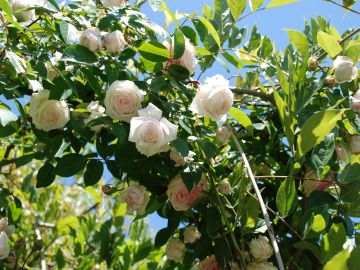
Souvenir de la Malmaison

Souvenir de la Malmaison

The middle ground is centered on a lovely Maya lemon. This was on the property when we arrived but has been nursed back to health and clipped into a good strong form. This is one of two lemon trees and as it borders the lane it is the one that supplies of the lane dwellers more than it does us.

This is all backed with a tall wall of clipped leaves – made up of Titoki trees, a Prunus cerasfera Nigra and other assorted hedge materials – all of which lie on the neighbours side of the lane. Although it can get a bit shaggy, this wall of trees blocks their house from my view and provides a backdrop to my composition. I am as they say ‘well pleased.’

The other day, for no apparent reason, the neighbor decided to cut a big whole in this wall of leaves crudely exposing a corrugated iron fence of which I had no previous consciousness. It might be an attempt to let light into the space surrounding their front door – futile though it will be due to the orientation of the house. Although I’d like to think that this sudden hole in my composition is to do with a broadly considered plan on the neighbour’s behalf – but I suspect it is a result of angry gardening.

Hitherto unseen splendours

Hitherto unseen splendours

Angry Gardening comes in 3 Categories – all very popular among New Zealand men.

Category 1: occurs when they first take possession of a new property and usually involves a chainsaw, with which they angrily remove all planted presence of the previous owner.

Category 2: occurs when men are sent out into the garden against their will usually during televised sports events. This usually involves angry use of a lawn mower or leaf blower to drown out the person who evicted them.

Category 3: occurs in those small parcels of land that while on their property sit outside the zone on habitation – aka the little spaces on the other side of the fence, the back of a shed or the unseen side of a garage – these spaces are resented and get angrilly attacked about once every six months.

Although all categories come with a big dose of resentment, Category 3 is the worst – because it seems such a waste of time – gardening you can’t see. Confronted with this realization – massacre is usually considered the best approach.

It is the approach my neighbor has taken to this part of his strip before – a mature flax disappeared one day for no obvious reason – weeds now grow in its place.

Another example of borrowed landscape - this vine originates two houses away in an overgrown back yard - but for how long?

Another example of borrowed landscape – this vine originates two houses away in an overgrown back yard – but for how long?

Borrowed landscape is a tricky proposition because you rely on the owner of the landscape in question – and most times you are totally in their hands. You need to know that they have the ability to see a wider view – to see landscape and gardening holistically as part of a series of interlinked properties – such relationships are rare.

The strange thing is should the neighbor come to me and ask me to take over this strip he can’t see but I look at daily,  I’d be glad do it.

DLJ
Posted in Uncategorized | 1 Comment

silver and sunshine

b4

the tea set soon after it arrived home

I am thrilled with this week’s auction haul. Maidens & Foster had a good estate showing this week and I left a long list of absentee bids. Although I didn’t get my number 1 item – a lovely big Winchcombe pottery jug – I did get numbers 2 and 3 on the list, so the going was good.

The evasive Winchcombe jug

The elusive Winchcombe jug

Number 3 on the list was a lovely almost pair of early Nineteenth century rummers in a large box lot of glasses in which there were few other surprises – a couple of thumb nail cut sherry glasses I don’t need, I’ve kept but the rest has gone off to charity.

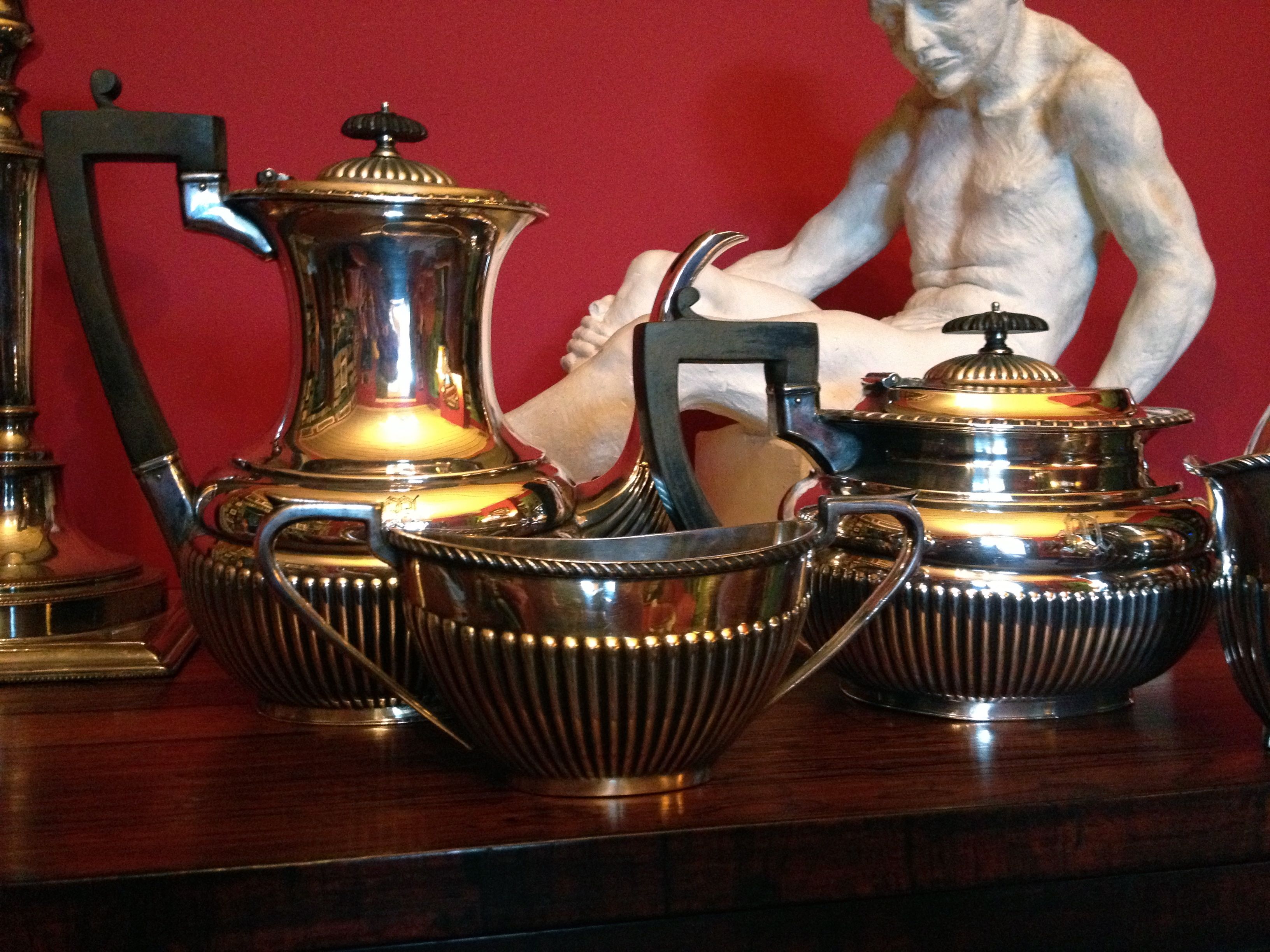
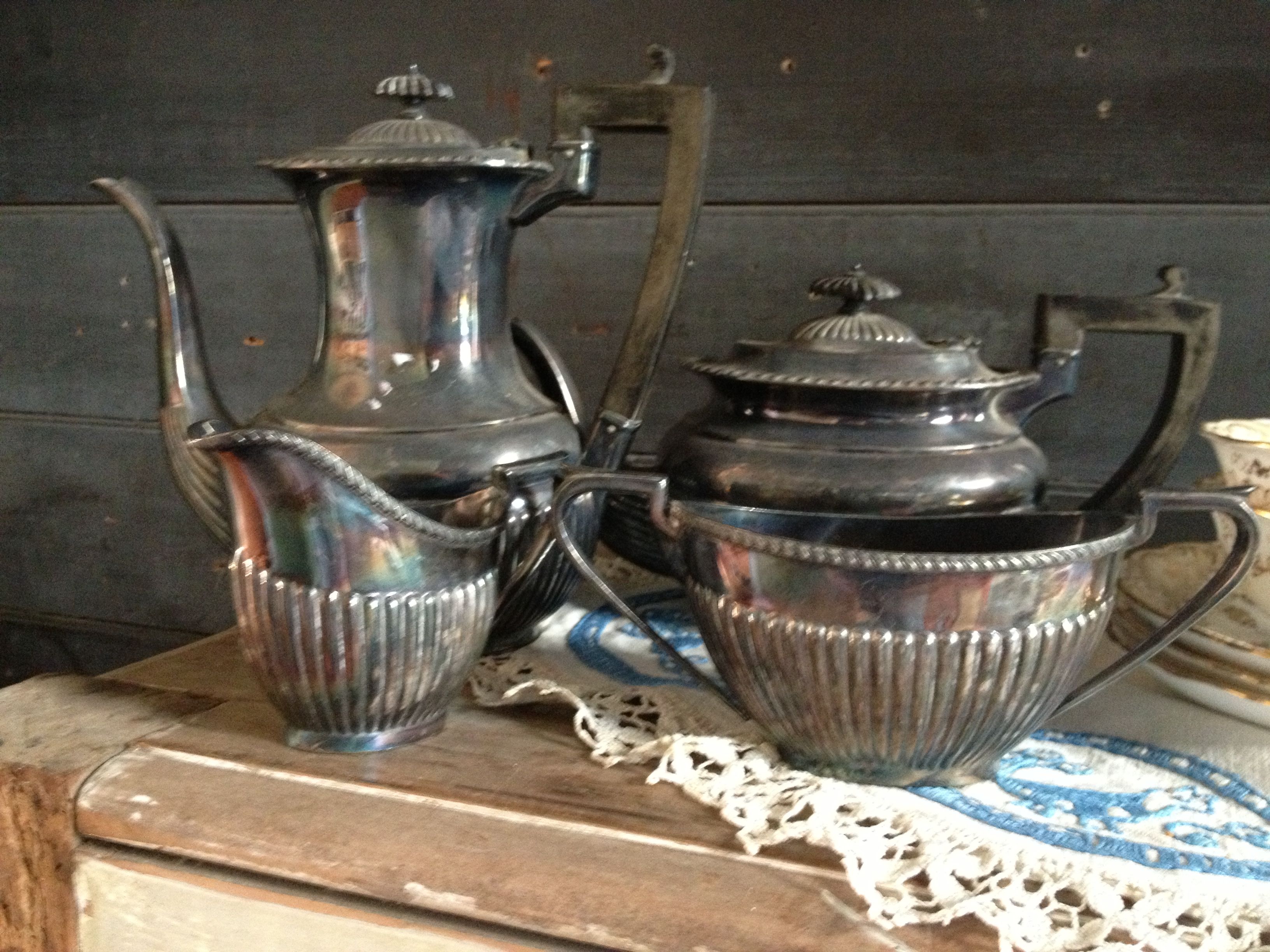
Number 2 on the list was a very black looking tea set, consisting on a handsomely proportioned tea pot, a matching tall coffee pot and milk and sugar.

Now there is old worn out plate to be found in any sale. Silver, electroplated silver, is not much sought after because no one wants to polish it and it has gone from vogue as a dinner table item. The other problem is most of what you see are cheaply plated, or even one time quality items, that have been over polished and aren’t worth replating. Tradition says worn Sheffield plate, where copper shows through, is ok – but ordinary plating just looks worn and tired if there is a view through to a patch of nickel.

What was interesting about the items on the tea set is that they were totally black. This is a good sign that they were either solid silver or that the surface of the plate was intact. Infuriatingly there were no markings of any description to indicate the origin of the pieces or the material from which they were made.

I don’t need a tea service but I told myself it would go very cheap (it did) and that polished up it would make a great expensive looking present (it would).

Two hours later - a superb silver tea service.

Two hours later – a superb silver tea service.

When I got it home I sat out on the back step with some old pieces of toweling and a tin of Brasso. If you’re polishing from black there is no point starting with a silver polish – shift the black with a good brass polish and finesse it later with a proper silver polish or silver cloth. Rinse the whole lot in hot soapy water and buff it up with a clean cloth.

The tea pot did not disappoint, the silver came up solid and intact over the whole surface and even revealed an elegant engraved letter ‘M’. One by one the other pieces proved themselves as in superb condition and sat glinting in the late sun.  I thought to myself how pleasant polishing silver really is, how satisfying the results were, how nice these will look on the dinner table.  How many nice silver pieces sit out there unloved – awaiting someone with an hour or so to spare to bring them back to life?

DLJ


Posted in auction finds etc., practical matters | 1 Comment

Operation Yellow Sofa

couch

We have a yellow sofa. It is a Victorian piece picked up at a Cordy’s sale. When we saw it we were bowled over by its rugged attractions and amused to hear that it had passed unloved through a least one-sale prior. So we got it for a good price and carted, or had it carted, to Napier.

It is a hearty colonial piece and soon after we found another, slightly more refined, version of it in William Cotterall’s Furniture of the New Zealand Colonial Era. This version reminded us that ours is missing its castors but all in all we prefer ours, with its wonderful ebonised black finish over, what I suspect is, a red cedar frame.

The sofa took up residency under the large southern facing windows of the Studio where it has stayed. It has never been recovered and to date the castors remain missing. However, a recent cull of the furniture in the Studio has brought the sofa to the top of the list for attention. So this posting is about the dilemmas of fabric choice and an inherent battle between two styles.

1.

I don’t know if everyone’s life is quite as connected to the world of fabric as is mine – I suspect not. I will happily browse fabrics all day long. I love the down-home charms of Spotlight, were surprisingly good fabrics lurk for those who know their materials. We adore ABFAB the Auckland off cut and remnants store and it has been a source for many a curtaining fabric and even some upholstery that as yet remain unused.  Yes there is a fabric bank of yet to be used dress, curtain and upholstery fabrics – but that doesn’t stop me looking for more.

It didn’t take long to realize that we weren’t going to find the fabric we needed for our sofa at either of the usual sources.  For one reason – later explained to us – New Zealanders hate yellow! I could of course say a few things about New Zealanders and their taste but negative generalisations regarding my fellow Kiwis get me in hot water – so let me say a word or two about the non plus ultra of Hawke’s Bay decorating instead.

Hutchinson’s – a surprising casual name for an old prestige firm – is one of those rarities – a decorating and furnishing business that has been in operation since 1885 and in the building it now occupies since the 1950s.  Now throughout the regional centres there are old firms like this, but most are trading on borrowed time and look it. Hutchinson’s, has probably never looked better and from a fabric point of view it’s something close to heaven. It was here amongst the Morris prints and the Sanderson linens that the ‘yellow line’ had been delivered.

2.

As we are want to do, we had been making clandestine calls on Hutchinson’s fabric department on occasional Saturday mornings for weeks, until one morning a wary assistant asked the pertinent question – ‘what exactly is it you’re looking for?’  Guilty we glanced at each other and offered up ‘yellow brocade.’  He looked at us intensely and said the secret decorating words – ‘chrome yellow?’ We sensed a co-conspirator and said ‘exactly! It was then that he delivered his line – Sorry, New Zealanders hate yellow – I don’t know why?

Hutchinson's - operating in Hastings since 18885

Hutchinson’s – operating in Hastings since 18885

A lesser fellow would have sent us on our way but a connection had been made and instead he offered to call some of his suppliers and haul in a few yellows that might be lingering in the sample books on English manufacturers were yellow is not treated with the same suspicion.

This he did and each Saturday morning since we have picked up a new collection of books of samples only to return them to Hutchinson’s the following Saturday.

We have our own language for rejecting the samples for being to; modern, busy, muted, bright, banana, mustard (none are really chrome yellow), Jacqueline Kennedy, French, (those two are different), New York decorator, grandmotherly, old-fashioned, or Havelock North.

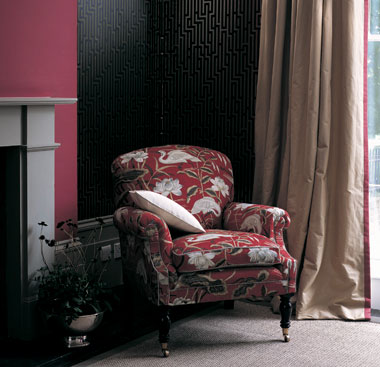
Half of the problem is that Hutchinson’s has a lovely red couch placed seductively in their fabric department covered in  Heron and Lotus Flower a GP and J Baker print and it keeps playing on my mind.

mi0e0VRT5IWhNrmyAd5v6Ag

Heron and Lotus Flower

We haven’t been sticking to brocades but have been considering the possibility of a dynamic pattern as long its yellow. Yellow works because the room is essentially blue and yellow. A very large banquette takes up almost the width of the room and this is covered in yellow velvet (it came that way).

The framework of the couch is black and it works well with yellow – as the current covering attests. Now of course GP and J Baker could oblige my supplying Heron and Lotus Flower in a yellow.

Bakers 06

GP and J Baker’s setting of Heron and Lotus Flower

3.
Today we picked up the book and there is barely a yellow to be seen in any of their patterns.   I now start asking myself does the yellow couch have to stay yellow? The yellow we’re replacing is certainly not original covering.

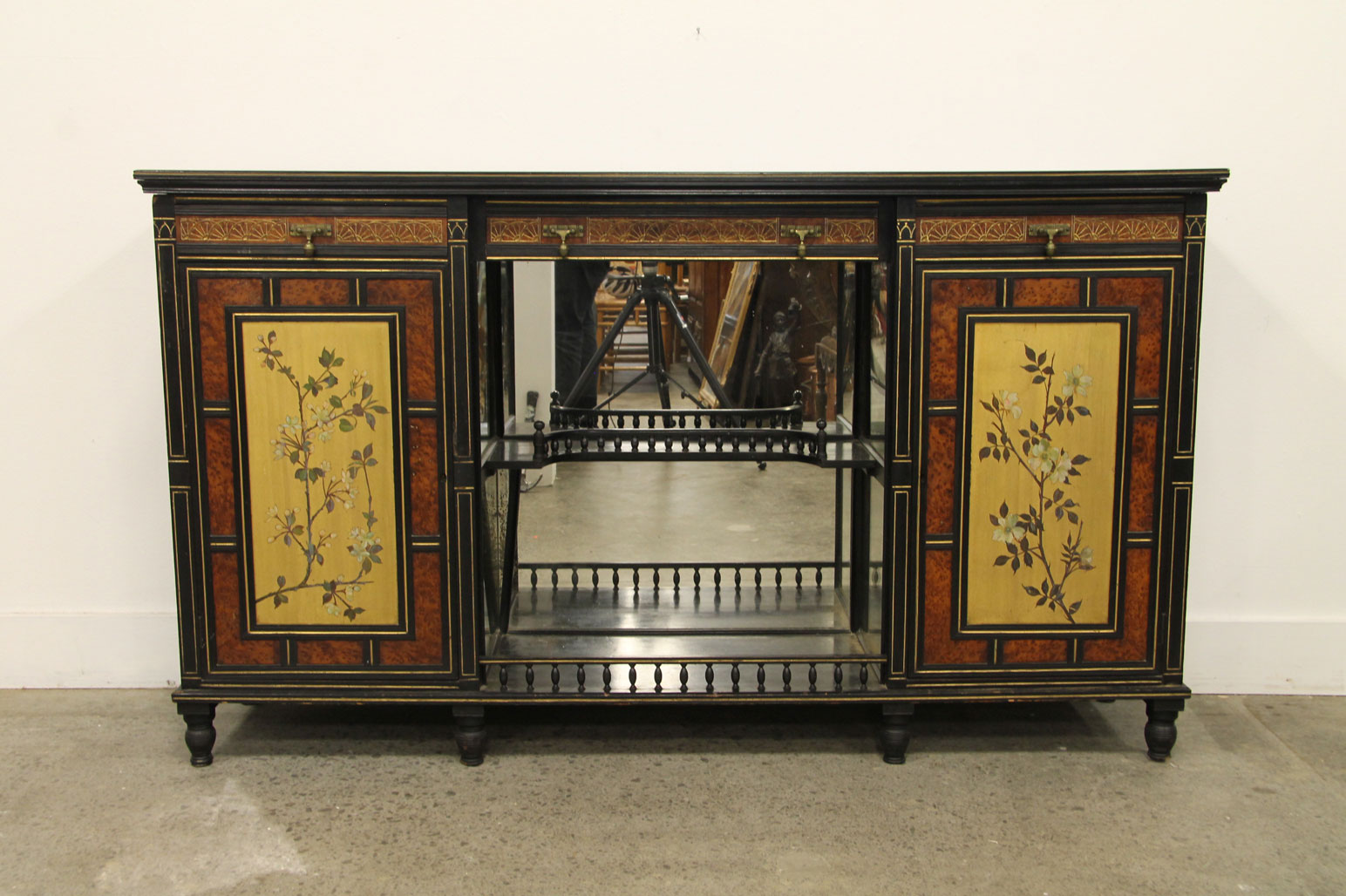
What I like about Heron and Lotus flower is its nod to Aesthetic movement. The Aesthetic movement is a constant presence here. I love its sheer originality. Although inspired by Japanese Art it is madly original and one of the wonders of the Victorian designer’s imagination.  We have any number of Aesthetic movement dinner plates and serving dishes but I particularly love Aesthetic movement furniture with its black ebonised finished – highlighted with panels of painted gold. An overmantle in this style hangs over the black painted library fireplace.

An Aesthetic movement sideboard

An Aesthetic movement sideboard

In essence the Studio is always something of a tug of war between two different styles. The Studio is largely furnished with early Victorian furniture with nod to the classical style – volutes and pediments – including the yellow couch – itself crowned with a heraldic motif (or is that strictly speaking gothic?). We have toyed with Aesthetic pieces in the studio before and there are still two mock bamboo chairs. As it happens we are once again have our eyes on an Aesthetic movement sideboard for the Studio – so once again Aestheticism is on the rise at Finnis house.

It takes me a while is getting my head around is the blend of Aesthetic furniture with other styles. Aesthetic rooms were always completely contemporary – all of one aesthetic style. Pushing the classical styled yellow couch in an Aesthetic direction with a patterned fabric may help to knit the components together. After all the library overmantle sits comfortably amongst William IV furniture.  This option is helped by the observation that Heron and Lotus flower comes in blue the other main colour in the room.

blue

As luck would have it this weekend’s haul as also turned up a good Zoffany fabric more like the one we intended to use in the first place and a promise of even more new samples from a new and enthusiastic participant in Operation Yellow Sofa – ‘if she can understand exactly what were looking for’ – oh dear, I wish I knew but I’ll know when we find it.

In the mean time the yellow sofa sits quietly in the Studio unaware that it is the subject of such attention and I get to spend my weekend with fabric sample books and speculating on the possible arrival of an Aesthetic sideboard and how that might change our favorite room yet again.

DLJ

Posted in auction finds etc., furniture | 1 Comment

Mortimer – a friend of Oscar’s.

Some time back I blogged about a small collection of artworks I have accumulated relating to Oscar Wilde – https://decorextremus.wordpress.com/2011/08/13/in-oscars-corner/ – and which hang in the library here.

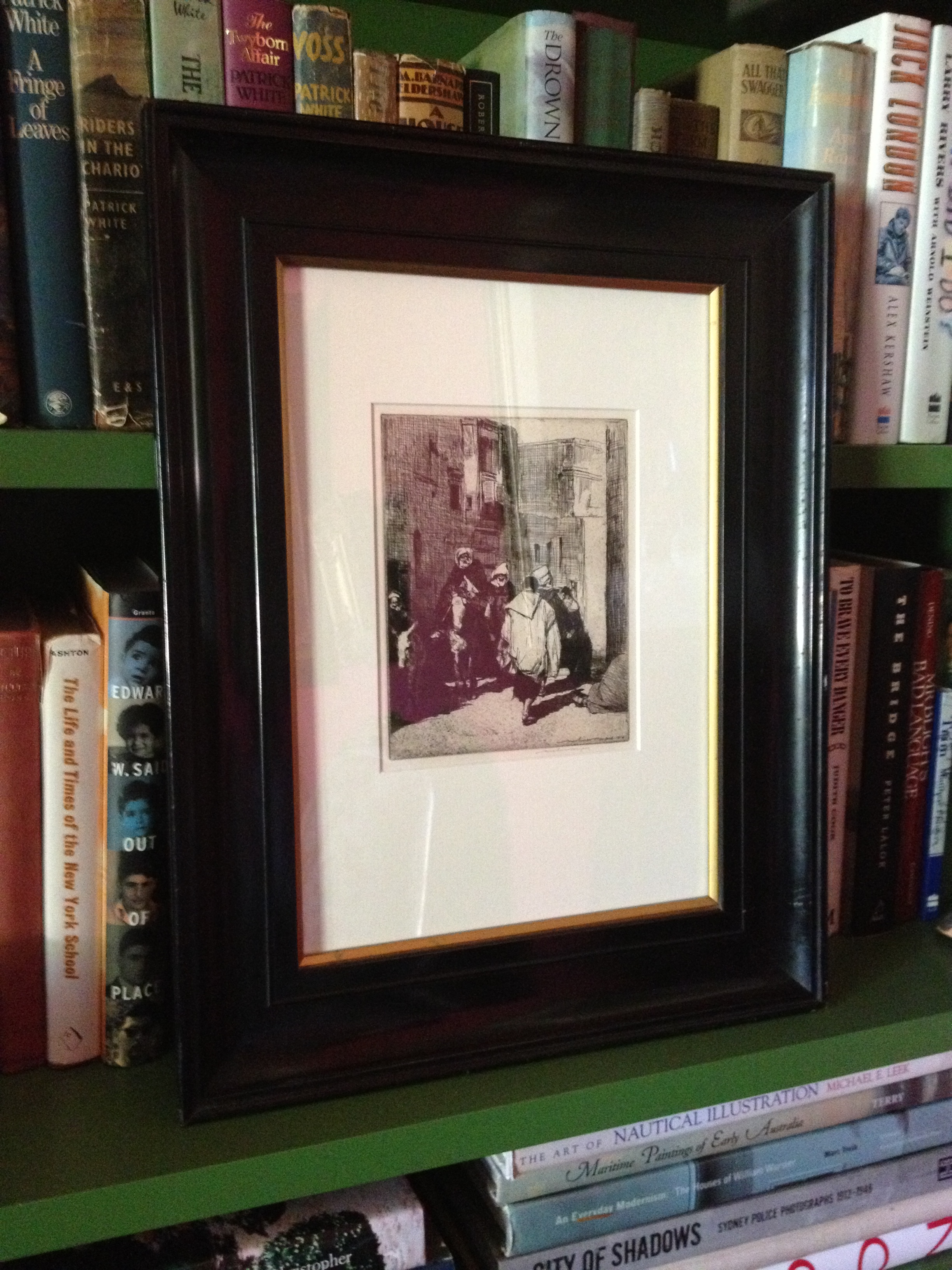
Today the collection was joined by a Mortimer Menpes etching of Cairo acquired – again locally – some years back but which first had to under go a clean and has only today returned from the framers  – installed in a nice old black lacquer frame of some age.

2013-01-31 16.08.04

Menpes (1885-1938) was an Australian born artist who went to London where he became a student and close friend and assistant of Whistler’s. Menpes was an excellent etcher and his views of Venice are stunning and accordingly famous in etching circles.

However he and the American painter fell out (most people did with Whistler) after Menpes decided to travel to Japan and see Japanese art firsthand – something Whistler had essentially forbidden him to do. When he returned he had a large and successful exhibition but refused Whistler insistence that he sign his work – ‘pupil of Whistler.’

Another version of the falling out (favored by Wikipedia) is that ‘Whistler and Menpes quarreled over the interior design of Menpes new house, which Whistler felt was a brazen copying of his own ideas – nice vision two straight men falling out over décor.

I’ve always liked the Menpes works encountered in Australian galleries and so when this turned up in Napier I nabbed it. A second nice discovery was to find a Menpes oil in the collection of Andrew McIntosh Patrick a collector and decorator of consummately infallible taste whom I admire immensely (note to self: a Andrew McIntosh Patrick posting is required).

It wasn’t until later that I discovered that Wilde and Menpes were friends and that the Australian was godfather to Oscar’s second son Vyvyan.  Vyvyan later wrote ‘I still possess some of his etchings which he bestowed upon me in lieu of a christening mug’ sadly (the ungrateful wretch) continued ‘the etchings are not very good.’

Having seen many Victorian christening mugs – I think Vyvyan did rather well.

DLJ


Posted in Uncategorized | Leave a comment

Third lustreous time around

I’ve been fascinated by recent television programmes around antiques on which dealers say of an item ‘they used to get hundreds of pounds, but now you can expect to get about thirty.’ I think of copper bed warming pans and balloon back chairs, once much sought after in auction houses but which can now quite literally sell for – thirty dollars a piece. However there are a lot of other items out there due a second, or is that a third, moment in the limelight.

Rather like achieving a new victory in a long forgotten war, there is something nice about collecting objects that were once fought over but no longer get much notice. For a start there is usually plenty of information lying around in old abandoned textbooks but there is also a nice intersection between the authentic antique and reproductions – designed to meet the collector market in those first moments of revived fashion.  1 lustre

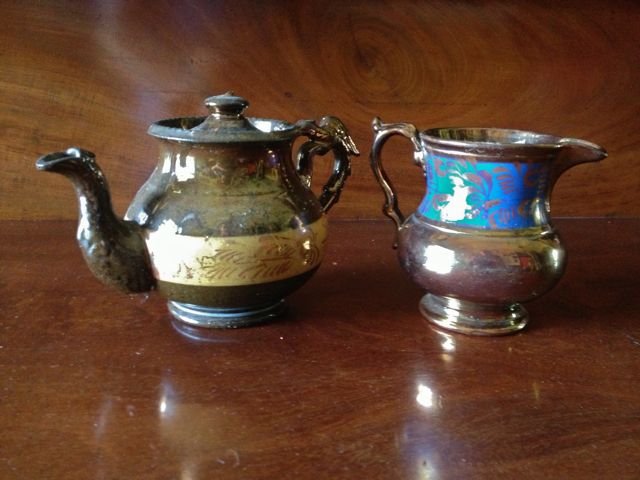
Lusterware is one of those materials desirable for its ability to deceive. The entire point of silver lusterware was to allow earthenware to simulate old English pewter or plate. Thus an earthenware body carrying fluted or beaded design with a coat of silver lustre might transform a brown earthenware teapot – suitable only for the kitchen – into an object worthy of the drawing room.

These pieces were intended for a middle class to whom silver plated items had not yet come down sufficiently in price. Of course silver plate did eventually come down in price and the highly breakable lustrewares became rare and therefore eventually collectable.

This was the story of silver lustre but I think the story of copper is a little different. Copper lustre pieces date from the same technological moment – in the later eighteenth century. Except that 100 years later in the late nineteenth century, when collecting silver lustre was probably an esoteric pastime, copper lusters were becoming mainstream again as decorative pieces in Arts & Crafts style homes.

2 lutre

Today I’m not sure it matters whether a lustre piece is original – probably over a brown earthenware body – or later reproduction – probably from the same factory that made the original. They do what they always did and that is – gleam in the half-light of an interior and add a little resonant richness to the patina of a room.

DLJ

Posted in collecting, original surfaces | 1 Comment

The Old Safe (1)

We have for some time been looking to add extra storage to the little china pantry we have created. The room has a large sideboard already overflowing with china and a small bookcase stacked with recipe books. However at the rate we acquire both china and recipe books, more storage was clearly going to be  needed.

We were looking for a butler’s stand. The logical thing would be to move the old beaten up one from the studio and to buy a nicer looking one for the big room. However that piece seems so right in the position that it’s in we decided instead to find another for the china pantry.

The local auction house failed to oblige and those in far-flung destinations didn’t seem quite right. So when M&F offered up a large painted safe which we thought might do the job.

safe

Described as a Kauri (a local version of pine) safe, it was painted in a thick dark chocolate-brown – but some of the original blue paint could be seen underneath.  While it looked like it had come from a shed on a farm somewhere, I suspect that someone had purchased it in order to do it up but simply run out of puff because there was a strong reserve. This happened to be our top bid and it came our way.

Taking a good look at it  – it was solid and in good shape. There was no sign of rot or any other real decay, just an annoyingly unstable looking paint surface.  The wire weave sides were distressed. I had initially intended to replace. However closer inspection revealed that each was held into place on four sides in what were nine separate panels of wire. This was my first clue to what revealed itself to be a quality – well made – piece of furniture and not the country item I first thought.

Given a chance Peter will paint anything green, especially anything destined for the kitchen. So I wanted to have an alternative ready for the eventual suggestion that we might paint the safe green.  There is a little shelf on the wall of the china store and on it an assortment of small vases – most of which are in constant use for flowers plucked from the garden.

vaseMy favorite is a blue vase with splashes of pink and yellow with a real fire-licked quality in which the colours are fused together. I love these early twentieth century Japanese vases (never deemed very collectible) because of their excellent glazes and color ranges. There are about half a dozen of them scattered about the house. So I decided to use this one  as an inspirational starting point.

lowers plucked from the garden. My favorite is a blue vase with splashes of pink and yellow with a real fire-licked quality in which the colours are fused together. I love these early twentieth century Japanese vases (never deemed very collectible) because of their excellent glazes and color ranges. There are about half a dozen of them scattered about the house. So I decided to use this one  as an inspirational starting point.

The safe had been blue in its early life but that seemed too close to green and the room itself is yellowish, so another yellow seemed an unwise choice. So this left pink. Except that pink is about the hardest colour in the world to get right – most new-pinks end up looking – vulgar. The best pinks are old faded pinks.  When I got the vase, the paint charts and the safe together in the full light of day I released it wasn’t going to work. After some discussion we moved on to another old piece of china, this time the border of an early nineteenth century Irish dinner service somewhere in a colour range best thought of as something-berry.

plateI am not one to attack old furniture with an orbital sander – but in this case I realised that there weren’t too many other options. The loose paint needed to be removed for a new coat to have any hope of sticking.  It took only a few minutes to remove the first of the paint and a few more to realize that the safe wasn’t Kauri but a hardwood. I am even less the type likely to attack a piece of mahogany furniture with an orbital sander and so the whole dilemma whether to paint or strip reared its head.

The idea of an old mahogany safe glowing with rich colour in the corner of the room was rather appealing but the sheer labour required to get it to that point (in the 32 degree heat) was not.  I fantasized for a while about stripping and varnishing. I then considered a two-tone effect with mahogany details picked out – but in the end I decided to be staunch and went back to the sander.

To be continued …

Posted in Uncategorized | 1 Comment

What a little moisturiser can do …

Sometime back I bought a little portrait at Dunbar Sloane in Wellington. Well as it happened I bought two on the same night but this is the story of one.  I discovered it among a number of small paintings in one of their antique sales. So the painting, by an unknown artist, was considered decorative rather than anything special art wise.

Lot 100

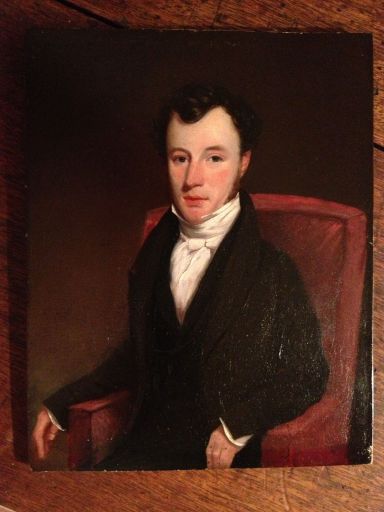
This is not a story about discovering a lost masterpiece. I liked the painting because, although a little naïve, it represented a kind and gentle-looking younger man.  He was dressed in a severe black coat and a crisply tied white cravat and was seated on a little red chair. This painting was a nice depiction of men’s costume in the early 19th century but it’s no great shakes as art.

Most portraits that come up for sale seem to be of garrulous balding ruddy-faced types and so I decided that this sweet-faced young man could come home with me. The other portrait purchased that night was of a young bearded Renaissance scholar (with something slightly Brad Pitt about him) so you get the theme of my portrait collection – attractive young men in need of a home.

The little portrait has been hanging in the library for some time now and in an archaic yet modern version of identity theft I’ve used him as my digital avatar on a number of occasions and I’ve become very fond of him – as I have of each of my small collection of portrait paintings.

After a while it became apparent that, even in the red hued gloom of the library, that the man in my picture was getting a bit stressed and tired around the edges. The big gilded frame is tatty but the painting itself (on wooden panel) is solid but crazed and dirty. So I decided that this young proto-metrosexual needed a little work done and sent him off to the oil painting version of a day spa.

Earlier this week I collected the painting from the painting conservator Nel Rol – who a little while back cleaned and re-stretched the large Joseph Gaut that now hangs in the studio. I am on a little bit of a conservation spree at the moment. I think we hesitate to get works cleaned in part because there are horror stories and part because of the imagined cost. However each newly returned work from Nel is a joyous revelation and I highly recommend getting a little work done where and when it needed.

after

Not only has my little chap come back freshly barbered with his face clean and smooth, but also his linen has been freshly ironed and his coat brushed. Even the little red chair he sits on has been spring cleaned.

He’ll be popped back in his frame and again take his place on the library wall – a lesson to us all that we need to moisturise a least once every one hundred and eighty years.

DLJ

Posted in Uncategorized | 1 Comment

Grandmother’s couch

Sometime ago Douglas and I began to think we probably needed a couch in our bedroom. We wanted to read in more comfort than we could sitting on a chair and wanted something on which you could also slump, in couch potato way, in front of the TV. Let’s face it: if you’re going to do something mindless you at least want to be comfortable.

We kept an eye out at the redoubtable local auction. Endless couches turned up, whole armadas of them in fact – the sad, the abused, the once proud, the still almost-alright-if-you-ignored-that-stain. Some of them, designed to seat two people, were so mean in their proportions that they were little bigger than a chair. Then something really good turned up (a few weeks back there was a Danish-modern couch) but it was too large for the room.

Douglas’ edict was that the couch should have bare legs, so it went with the vaguely modernist look of the room. If our front bedroom is where my early 19th century neoclassical furniture had washed up, our bedroom is where Douglas’ modernist pieces reside. This includes his Curvesse’ Chair, the beautiful to look at but uncomfortable to sit on, Garth Chester masterpiece.

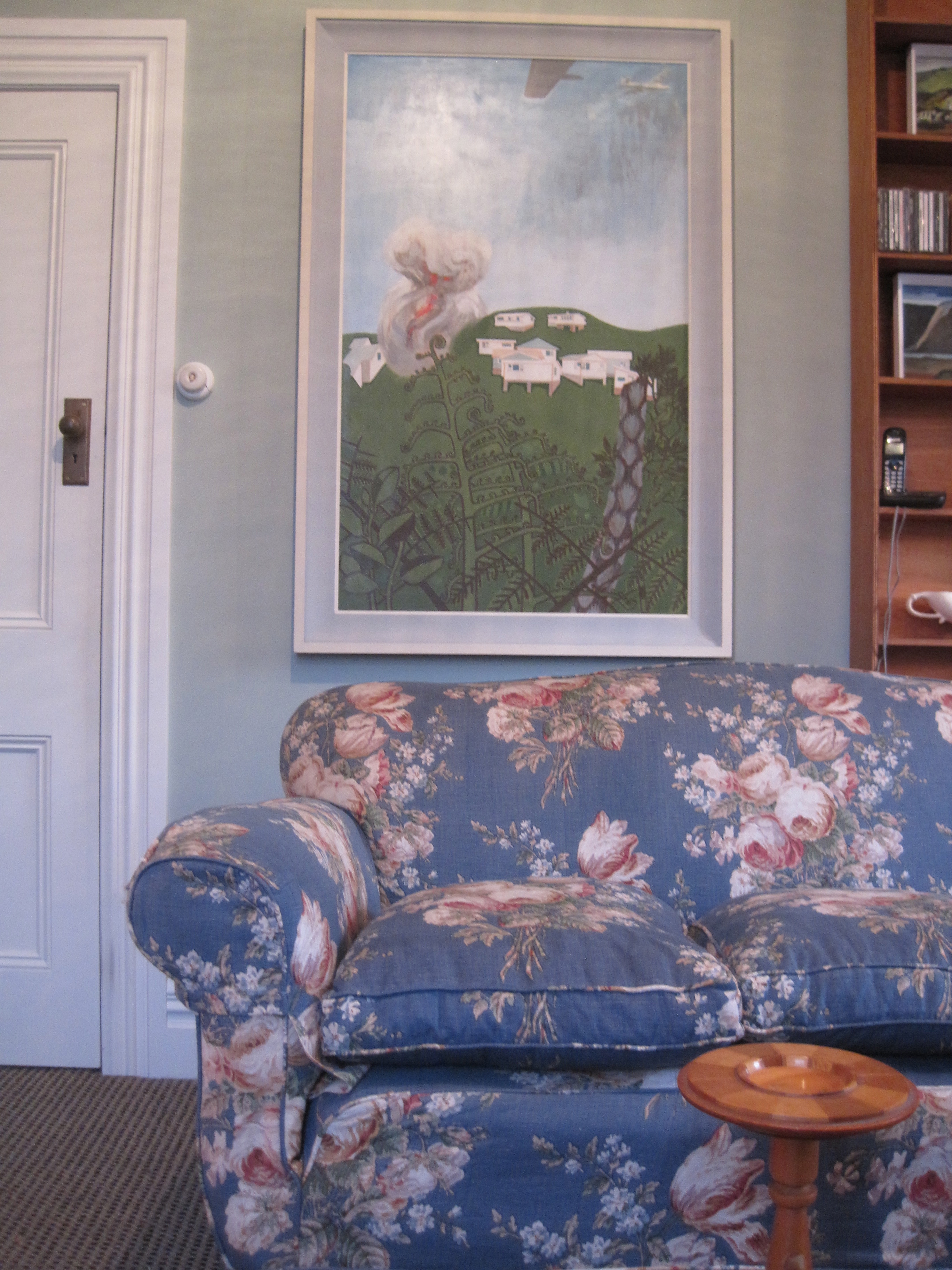
Then, a semi-fabulous couch and two chairs turned up at the auction, covered in blue Sanderson floral linen.  It was clearly a couch that had come from an estate sale – something well preserved from a grandmother’s not too often used front room somewhere.  The legs were not bare but it had a plump, come-and-sit-on-me, come hither look and enough space for two and the inevitable cat.

We would be away at the wonderfully weird Putaruru Hotel (about which Douglas will be writing in the magazine Home) when the auction was happening and so he left a relatively high book bid of $320. (Anyone who has bought a couch brand new will be rolling on the floor laughing till tears come out of their eyes at the thought this could be a ‘high bid’ for what is a three piece suite).

Amazingly we didn’t get the usual heart-warming text saying we were victorious. The plot grew thicker. Douglas enquired and was told it had gone for the astounding price of $800 – the sort of price which leads to pin-drop silence down the road. Douglas found out that two sides of the ‘estate’ family had bid against each other without the other side knowing.

This little vignette of inter family dynamics conjured an interesting picture that had a certain amusement value – and we knew that another couch would come along so we didn’t worry too much.

As it happens the couch found its way back into the next week’s sale. This time we were bidding in the room, and we got it for $300. I’m still confused why, if the family wanted it, they didn’t bid for it a second time – embarrassment perhaps.

It was delivered the next day.

The couch is an excellent fit for the room and very comfortable indeed. The strange grandmotherly covering with its blue background and cozy floral bouquets goes well with the slightly icy green walls and even with the somewhat strange Juliet Peter painting – My Thoughts on Vietnam – in front of which it sits. (This is one of Douglas’s recent modernist purchases – and décor-wise it is all right to match couch and painting as long as you buy the painting first).

We were never intending to keep the two armchairs but got them brought up to the house because if the couch was too big, then we would experiment with two chairs positioned next to each other. However the couch fits so the chairs are superfluous.

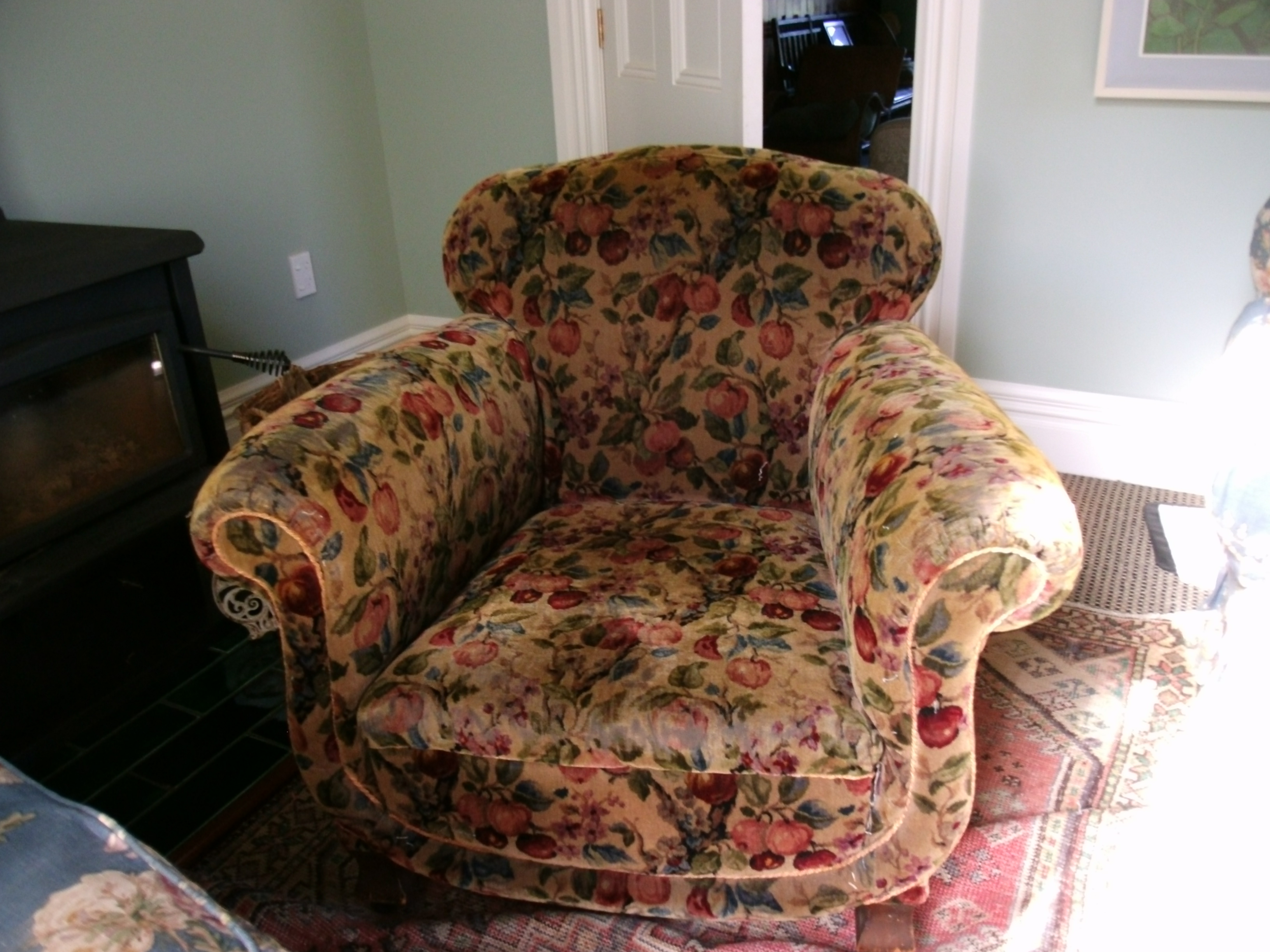
Douglas, ever inquisitive when it comes to items of furniture, had even at the auction house looked under the seemingly very expensive oh-so-Hawke’s Bay Sanderson linen covers – and what could be seen of the original moquette coverings seemed pretty good. We decide to take off one of the slipcovers and expose the entire chair.

This in itself was a lesson – the covers had been made pre the invention of Velcro and were put together with little hooks and eyes – beautifully done. Usually slipcovers are used to hide crimes – the crime in this case was not excessive wear but décor crime. The original covering were intact and in very good shape but had simply fallen from fashion sometime in the 1950s or 1960s and the suite been revamped with the linen covers.

I wonder if this original couch might have been great grandmothers and the blue version grandmothers – this might explain the family’s interest.

Fashions being cyclical – to our eyes the original coverings were rather beautiful; especially as a more 1920s shape of the chair itself was also revealed. Better still, they have been out of the light and the colours although more muted than they would have been new were quite spectacular. The plan is to send these two chairs – now fresh to the market – back to the auction houses as ‘two art deco chairs’ – watch this space.

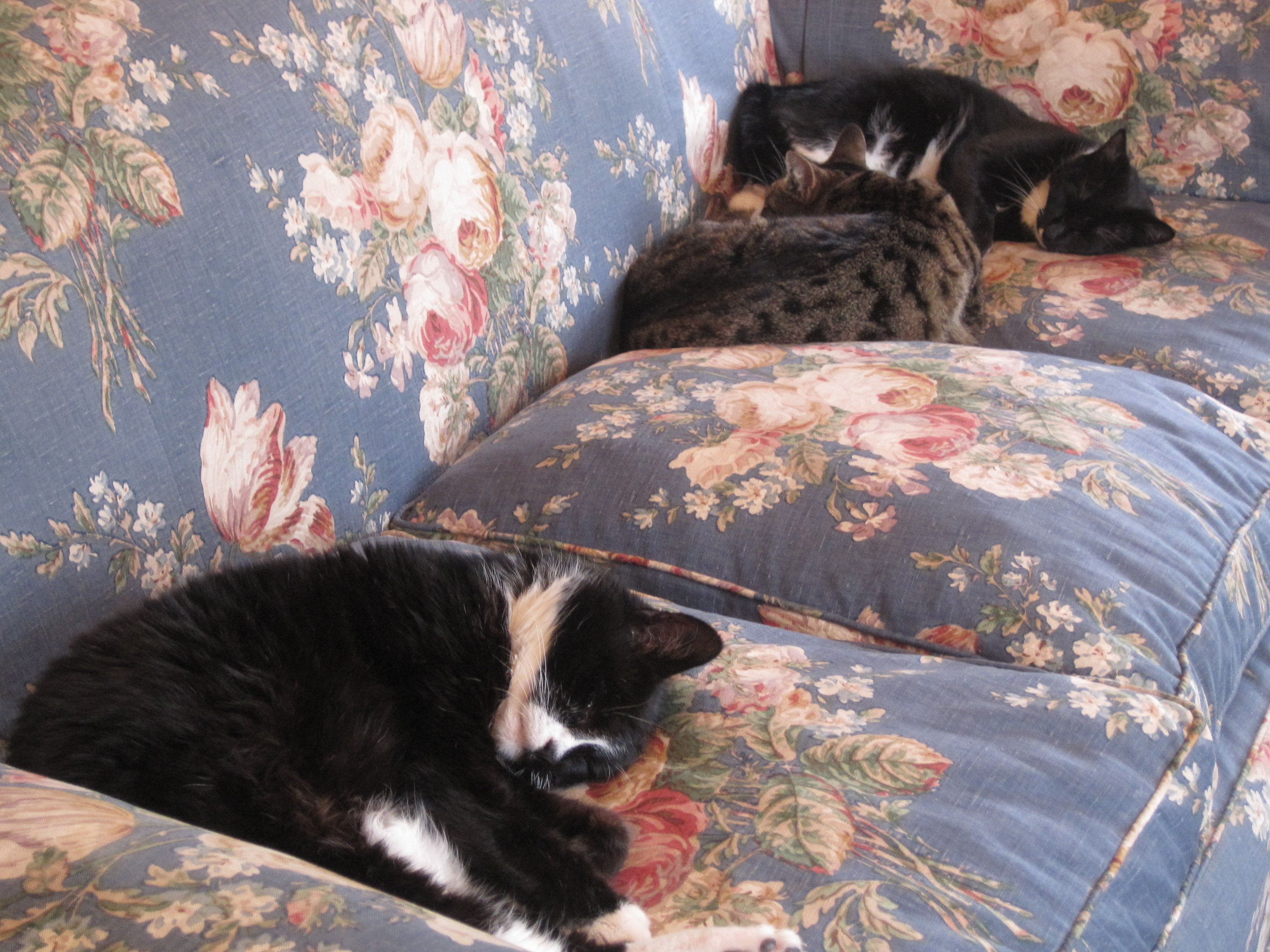
There is a little postscript here. The arms of these chairs have those protective linen coverings which grandparents like. The linen had a little soiled where the hands rest. I asked my close friend Shonagh Koea who is the oracle of household tips and she told me the best way to wash Sanderson linen is in cold water with sunlight soap. As I write this they are drying in the Hawke’s Bay sun – inside out of course to prevent fading – and the cats are curled up asleep on their new couch.

PW

Posted in auction finds etc., original surfaces, Uncategorized | Tagged , , , , | 1 Comment

Epergne fever

An epergne is an Edwardian or Victorian vase-like arrangement for the centre of the dining table. It usually has several stems and allows for a kind of mass effect – utterly decorative and of no practical use.

Of course as decor extremists we needed to have one.

I had been searching for one over the past few years.

I inherited a rather plain simple EPNS one from my mother but Douglas decreed this was too simple to have the desired panache.

We kept an eye on epergnes at auctions and in fact passed up on a milk-glass one, dimpled all over in the way your flesh goes when you have a cold swim.

Note: many epergnes are just plug-ugly. The Victorian and Edwardian era – pre modernism – was a riot of invention, you might almost say over-invention. Modernism brought back strict rules (and hence those yawnsomely stereotyped ‘Modernist’ inspired contemporary homes that fill design magazines.)

Before the iron curtain came down, the only law was invention: and epergnes, like flower buds floating on a stream, came into their own.

Often they were made of spun glass, and can have the same slightly sickening colours – yellow-green is a fave, as is pink-purple. They can be highly elaborate, multi-tiered or more basic.

Because of their delicacy the glass ones are often broken.

They seem surprisingly popular – surprising because they completely go against the convention of casual dining.

It is all about entering a room and inwardly gasping at ‘the look’.

You could put flowers in the epergne or, even better, fruit like grapes, mandarins – anything which implied a sense of careless excess.

In the end in the junk sale down the road this silver model came up. It was very basic, tarnished and we got it for not very much money at all.

One of the flower buds seemed slightly in the wrong place. When I cleaned the silver it suddenly came to life. The flower buds had been yellow and dirty but with a careful wash in sudsy water they came up clear. Then – disaster. In trying to twist the one flower back into shape I exerted too much pressure and the silver snapped at the base.

Suddenly the epergne which is made to be side 360 degrees lost one whole ‘side’.

I felt – well, not devastated – but disappointed.

Nevertheless for our midwinter dinner last night I decided to premiere the new (slightly wrecked) epergne. I ran out into the winter garden and picked winter roses. I tried them out first, without putting water in the glass flowers, to see what they would look like.

They looked fabulous.

Gorgeousness, in a word. The very motto of that curious tribe known as…decor extremists.

PW

Posted in Uncategorized | Leave a comment

Omega Workshops – Down on the Farm

Today is the first day of a short holiday I’ve cooked up for myself, in order to sit in front of the fire and do nothing. Surprise, surprise then if I wasn’t at Maidens & Foster at 9.30am this morning placing a bid on a pair of old rag rugs.

It was too cold and miserable a day to stay for the sale and so I headed back to the fire and awaited M&F’s ‘you’ve had a successful bid’ text which arrived at about 3.00pm just as I’d got fairly sick of doing nothing much at all.

As per always one pays fairly highly for the absence but the rug is a fairly nice one dating from the 1930s (that’s my guess). I’d hoped it would lay unnoticed at the sale in part because the second rug that it was rolled up inside is a not-so-pretty 1950s number featuring roses. That, and the observation that the preferred rug is pretty filthy, was supposed to have caused people to pass it by as something of a hopeless case.  However the rug is mine now.

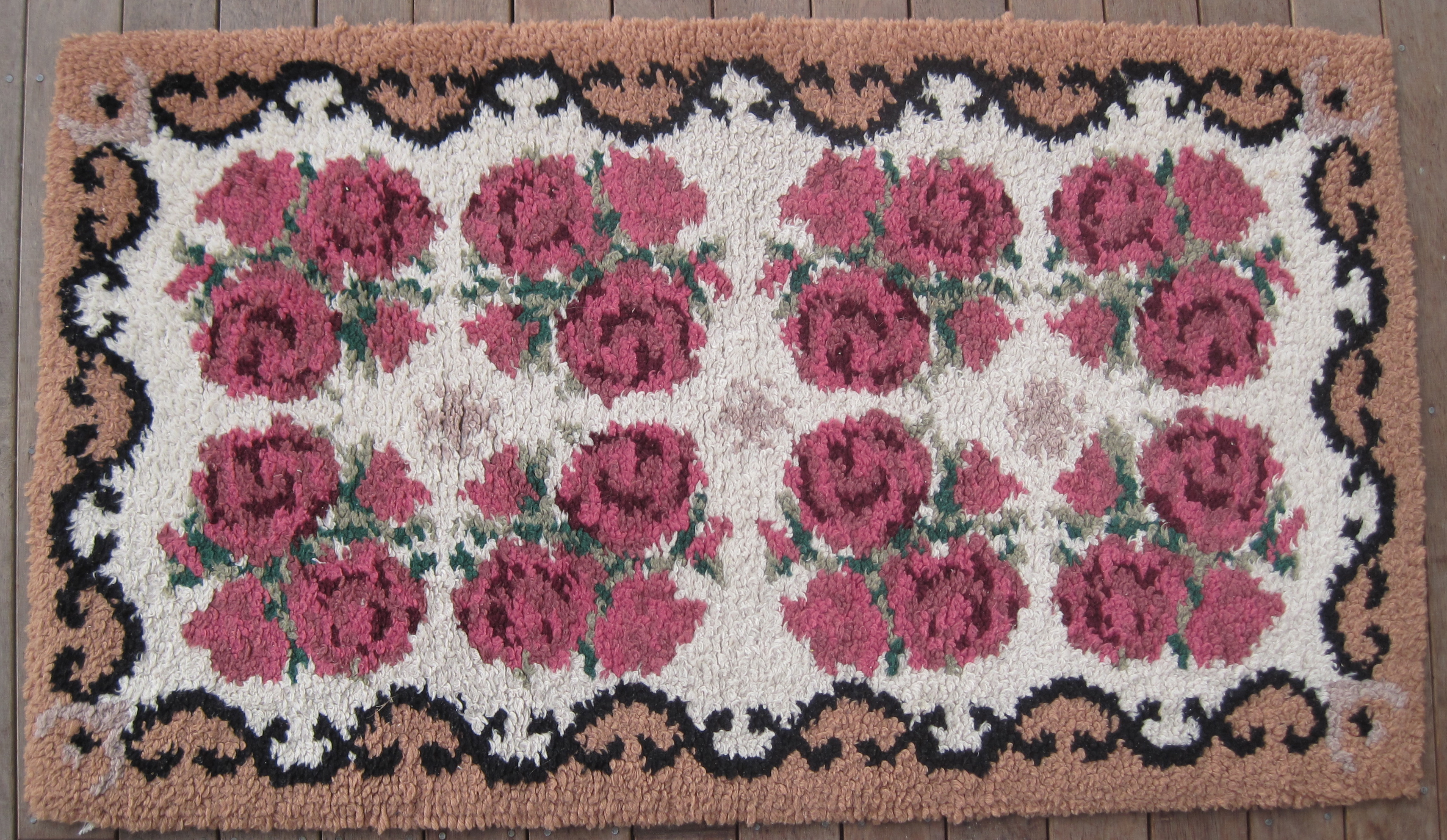
The rose rug – for the moment just a little too postwar baroque

This leads me on to think about how to clean an old rag rug.

Now some people are a little blasé about this topic and I’ve have been told to just chuck them in the washing machine. I did this once with two modernist style hand-hooked wool rugs and they certainly came up clean and fluffed up, but one of them seemed to suffer some sort of abrasion from the paddles of the washer which meant the pile never seemed to sit properly again.  It was passed on to someone else so as not to remind me of my textile crime.

Rag rugs were of course the art form of poorer people. They were made at home and usually occupied kitchen or laundry or bathroom floors. Even if they didn’t start out in those locations they certainly ended up there (or worse in garages or garden sheds). This means that they got engrained with all sorts of muck. At the same time they were tough – and probably did get chucked into laundry tubs and then hung out on the line. however these days rugs like this a reaching retirement age and looking to take things more gently.

However having spent last week with the country’s leading textile experts for a conference on matters that included the care and importance of textiles, I thought that I should perhaps approach this one more carefully.

Faced with something like this I think the safest starting point is a gently vacuum or brush. I’ve noticed in museums that they vacuum through gauze or a light weight piece of fabric. The alternative, brushing, gets overlooked for cleaning textiles but it can do an amazingly efficient job.

A good source of advice on these matters is The Art of Keeping House, by the Historic Houses Trust of New South Wales and available in Australia and New Zealand. It advises pretty much a vacuum or brush and then to leave the rest to experts. So for once I am going to play by the rules and do nothing more – well perhaps a little damp sponging here and there – recommended by a number of online experts.

Omega Workshops Signboard (1915), somewhere a kiwi house wife probably turned this into a rag rug.

Turning the rug over I notice that some of the original backing needs to be stitched back into place – this I can handle. This side as always gives a glimpse of the colour and tones of the original carpet – and indeed gives a better sense of the pattern. One of the nice things about this generation of rugs is how so very Omega Workshops they seem to be. I rather like that the whole aesthetic of the Omega workshop produced by bored London aristocrats and middle class intellectuals at play – ended up on the farm-house floors of back woods New Zealand.

The rug will join 3 others of the Neo-Omega school scattered round the house. One of which has even been elevated from floor carpet to table top decoration – a sure sign of old age and a suitable rag rug retirement plan.

DLJ 

Posted in auction finds etc., original surfaces, practical matters, Uncategorized | Tagged , , , , , , | 1 Comment