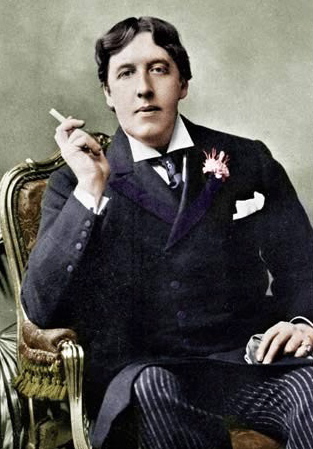
In Oscar’s Corner

I was recently asked just how much the townsfolk of Napier would have really know about Oscar Wilde in his own time. I answered pretty quickly that I felt some had very real understanding of Wilde and some perhaps some even had a direct connection.

This not at all scholarly response was entirely based upon two local discoveries that now make up my Oscar Wilde corner.

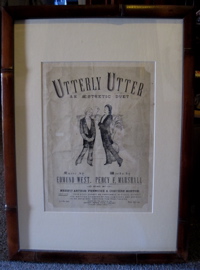
The first is a piece of sheet music found in a pile of old and largely indifferent offerings in a local charity shop. Called Utterly Utter: An Aesthetic duet, it is a long forgotten satirical ditty from the pen of Edmund West and Percy E Marshall whose reputation as a composer/lyricist duo seems to have lasted no better than has their duet.

What’s wonderful about it, is the cover illustrating two aesthetic gentlemen, elegantly dressed in evening suits – in angular poses – one offering the other a lily. It brings to mind other aesthetic parodies most famously Gilbert & Sullivan’s Patience – itself in danger of slipping from the repertoire.

Using the rationale that Oscar Wilde was sent to the United States in advance of Patience so that audiences would know who and what was being parodied, I figure that for Utterly Utter to be performed in a nineteenth century Napier drawing-room the same rule had to apply – or else it would have been a very unfunny evening around the piano.
I can understand how a piece of sheet music might have been bought in London or sent out – the latest thing – to the colonies but my next discovery seemed both more of a find and more of a mystery.

This was a small pencil drawing by Frank Miles, titled ‘I’ve been Roaming,’ it is a rather lovely pencil drawing of a woman with flowers and leaves collected in her hair. This work turned up at the local auctioneer Maidens & Foster. It is no bigger than a cigarette packet and was close framed in a small narrow gold frame and so it was hardly attention-getting. Yet worst (or best) of all, some one had attached a note to it reading “Frank Miles was Oscar Wilde’s first boy friend.” Now I don’t want to disparage the locals – but with a note like that no red-blooded Kiwi bloke was gong to be bidding on the piece – and thus it was mine for a song.
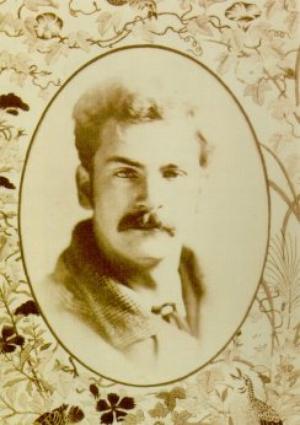
Frank Miles (1852-1891)

Was Frank Miles really Oscar Wilde’s first boyfriend. Well most biographers say yes (there are a few still in denial). The two met in the spring of 1876 with Frank described as a dashing good-looking blond-haired young man. The two men lived together for a period and Wilde certainly introduced Miles to the society beauties he specialised in depicting, as well as a host of other delights.

What I like most about Frank Miles, is that he was a good Victorian romantic – troubled and talented. Not only was Frank sexually adventurous, he was colour-blind and this meant he struggled as a painter – and therefore almost specialised in pencil sketches. There’s that and then the fact that he went insane and died in a mental hospital just before his fortieth birthday. It’s a sad picture but an engaging one and it makes me like ‘I’ve been Roaming,’ in a way I wouldn’t if it were an ordinary portrait of a Victorian society beauty.

How did this work get to Napier – that we’ll never know. However, like Frank Miles, I’ve been Roaming needed help. It sat for more than a year on the mantelpiece of my study where it looked insignificant, until I found a substantially larger frame at a local antique shop. Taking it down to the framers I had one of those moments where you find yourself doing what you despise in others and directing what was essentially an exercise in pretentious framing ­– small pencil sketch in large gilt frame – but it worked and the end result gives Frank Miles and I’ve been Roaming  the gravitas they deserve.
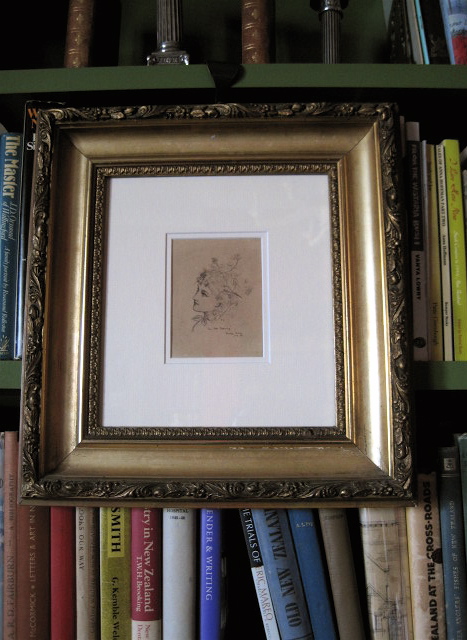
With Utterly Utter organised into an old bamboo frame (that we’ve carried around unused for years) the two works now make a little Oscar Wilde moment on our wall and should any one ask – they’re local icons – reminders of a particular moment in Napier’s long forgotten history – which in their own way tell a romantic story.

DLJ

Posted in art | 1 Comment

Family Secrets

The original kitchen revealed: the fireplace once housed a range. What was once the serving hatch to the dining room can be seen to the right of the door.

Recently on Kim Hill’s morning radio show, it was revealed that her great-grandparents had been servants in England. There is nothing unusual about this. In the 19th century a vast percentage of the population was employed ‘in service’. It was a respectable way to earn a living, and highly intelligent people, who simply lacked capital, made a living looking after often less intelligent people who simply had the advantage of capital.

I’m speaking of this because recently I became more aware of the servant who lived and worked in Finnis House.

rimu tongue and groove

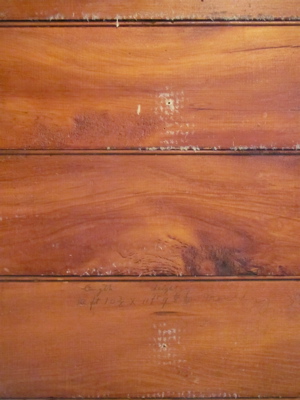
It came about like this. When we took off the horrible 1950s Pinex wall covering of Flat B  and revealed the beautiful rimu tongue-in-groove of the original kitchen. Douglas and I had hoped this would extend into the servant’s bedroom which, typically, was just off the kitchen and hence probably one of the warmest rooms in the house, because if it did it could provide the wall cladding for a new master bedroom.

However once we took off the Pinex in the servant’s bedroom we struck an unsuspected gentility: wallpaper. The servant, female, was given wallpaper, a dado – although it should be noted this wallpaper was very utilitarian. In contrast to the lovely garlanded wallpaper in the dining room, it was kind of like ground down muesli – ‘a servant should know her place.’

The thing which amazes me is, we know a little about the other inhabitants of the house, but we know nothing at all about this phantom servant. No name, no age, no background. Yet if one could only access her consciousness what a picture one would have had of the Finnis’: a servant would always be privy to family secrets.

... and wallpaper for the maid.

As we pulled away the coverings of the kitchen wall we found the actual size of the kitchen range which was much bigger than the existing fireplace (probably put in post 1931 earthquake. There was also the curious kitchen servery, a kind of sliding door through which the servant would have pushed the food, so the family could eat in privacy – but also without – tiresomely having to do anything for themselves, except serve the meal.

The Finnis’ had two daughters at home and it was not unusual for unmarried daughters to become unpaid servants, but I think in the Finnis house this unknown servant did all the work.

Strange, then, that we will be occupying her quarters. I have always liked servants’ quarters and in fact in the last house I lived in, I ended up occupying the servants’ wing perfectly happily. (Something about the domestic scale is pleasing. It’s nook and cranny stuff instead of big broad show off rooms).

Ironically too, in the politics of the villa, the servant’s quarters at Finnis House ended up being those closest to the sun. They were literally the warmest rooms in the house whereas the formal rooms all faced south, presenting a ‘suitable face’ to the enquiring road.

What was the name of the servant? What was her later life?

By the 1930s and the depression servants had pretty much disappeared from New Zealand.We’ll probably never know – even though we know other enticing things about the house – like how the studio was a dance studio during the 1940s; and how Flat A housed the mistress of the farmer who owned the property in the 1950s. Put this down to the secrets of the house. After all, every house has its secrets. It’s why we fall in love with houses, I think. In every house lies an untold story. These rooms of an unnamed servant are just one of them.

PW

Posted in Uncategorized | Leave a comment

Searching for Jasper Green

I have, over the years, got into the habit of buying myself little tokens, (paintings, expensive books, nice watches), to mark a special occasion, especially those that come with a cheque attached – an advance or a nice award. This week I have extended this habit into one that marks those small occasions that come without cheques and in this case with not winning literary prizes.

The prize in question went to a well-deserving friend and so any associated melancholy was short-lived – intense enough only to drive me to my favourite Wellington antiquarian bookshop (Quilter’s) and to one of a near-by second-hand shop (Abel Traders).

Among the host of things that caught my eye (but not sufficiently to pick-up this time)  at Abel’s were – a framed photograph of an old steamer off Gravesend, a couple of nice Victorian plates in the Chinese manner, a painted fire screen, some lithographs of Scotsmen in traditional garb and small collection of Jasperware.

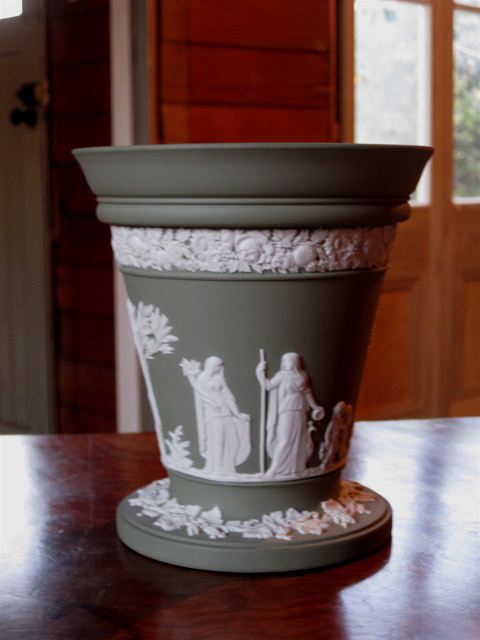
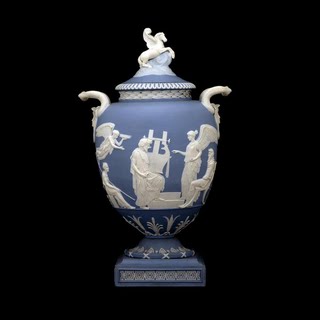
I may well have been able to resist the jasperware (I always have in the past) had it not been green. Jasperware, popular collectible of grandmothers, is a difficult area in which to collect because ninety-nine percent of what you see around you – is essentially valueless late twentieth century homeware – in disguise as something authentically Georgian/Victorian. In addition, most items you encounter are tiny – as is want to happen to items intended as ‘collectables.’ In the case of Wedgewood Jasperware this means an endless onslaught of pin dishes, ash-trays and commemorative plates.

Green however is something that is always on our minds. It would be easy enough for every room in the house to end up green if we didn’t occasionally take stock of our plans and have a bit of a rethink. Having said that we’re planing another green room and are keen to get the colour right – and when it comes to greens and blues, Wedgwood tones are good starting point.

Amongst the items of offer was a small jug and two conical vases, one tiny the other of decent size. The larger one caught by eye – it had a pastoral scene involving heavily armed cherubs set amongst a couple of nicely articulated trees against a solidly turned body and seemed in good condition. Underneath a couple of scattered mark and impressed numbers – easily to make out Wedgwood and Made in England and the rest could wait. After a bit of indecision, knowing that either Peter or I knew anything at all about Jasperware he purchase (wholly reasonably priced) was made the item wrapped and flown home.

When it comes to collector’s books – I like the old ones – in this case Chats on Wedgwood (1924) by Harry Barnard. It’s one of a series be found in almost antiquarian bookseller – including Quilter’s. These old books are under illustrated and tend to tell you how to identify things that you’re more likely to find in the V&A than you are in the Sallies but they have a certain charm that you imagine you might get talking to an old antique dealer  – although old antique dealers seem in reality to be rather less conversational that you might imagine.

Long story short the basic key to understanding the marks on the bottom of Wedgwood Jasperware is that if the words are Wedgwood and England and they appear in different places on the bottom (not next to each other) then it’s probably older. If in the case of the vase I bought, the words are Wedgwood and Made in England, then it is twentieth century. Had I looked more closely at the additional miscellaneous marks underneath this would have been confirmed by a date – 1955.

Placed on a little biedermeier table of Peter’s, standing in the debris of what will be the new green room, I like the vase. It is nothing like the sample of green paint we’d pre-chosen for the room and so we will probably get the paint charts out once again and having noted the essential difference in marking between old and new jasperware – I shall adopt a new approach to any further purchases.

DLJ

Posted in inspiration | Leave a comment

In Praise of Small Kitchens

The builders are at last in residence and we have squeezed into the remainder of the house. The Studio is piled high with furniture and paintings and the Hallway is choked with even more paintings and even more furniture.

The builders will be wrenching off the back end of the house, which consists of ancient wash house, an old bathroom and a carport and sunroom that date from the 1950s. We are doing, what we all end up doing to villas – opening up the back end of the house to the sun and adding a deck.

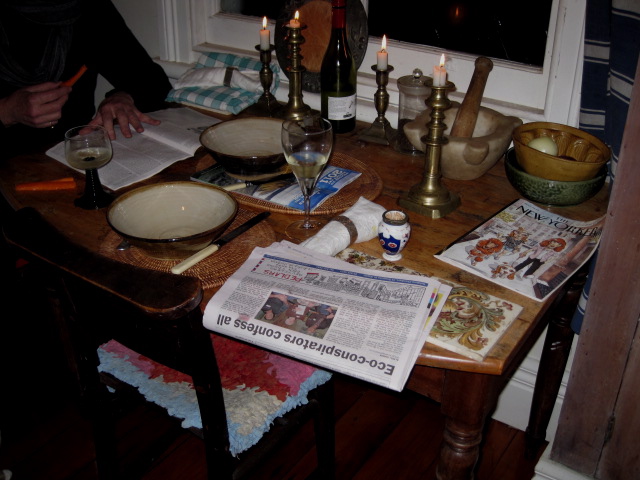
This means we’re sort of camped out in our own house and in terms of eating it means that we are squeezed into a tiny kitchen only a few metres square for the next eight weeks.

Ours is a small kitchen, a very small kitchen by contemporary standards, but it’s made minute by its new dual use as a dining room and kitchen. There is however something appealing about the intensity of our new cooking/eating arrangement.

The view from the dining table is now so full-on. Familiar items are now seen anew. The whole space conjours a persistent memory of an earlier eat-in kitchen and brings with it an intense sense of warmth and coziness. Everything butts against something else. Every movement requires a certain degree of co-ordination.

At the same time that it’s intense the room seems lofty. One of the nice things about the villa is that even the most modest rooms have a certain grandness of proportion via their ceiling heights. This room, once a minor bedroom, has that very characteristic emphasised by a tall sash window. Sitting at the little table now positioned under that window gives the room a new sense of height that compensates for the intensity of the floor plan.

Two days in to the alterations and this all seems fun. The cats have slowly adjusted to the rearrangement – though not yet to the builders and our little kitchen seems a perfect bolt hole as winter really starts to kick-in.

DLJ

Posted in Uncategorized | Leave a comment

A portable print room

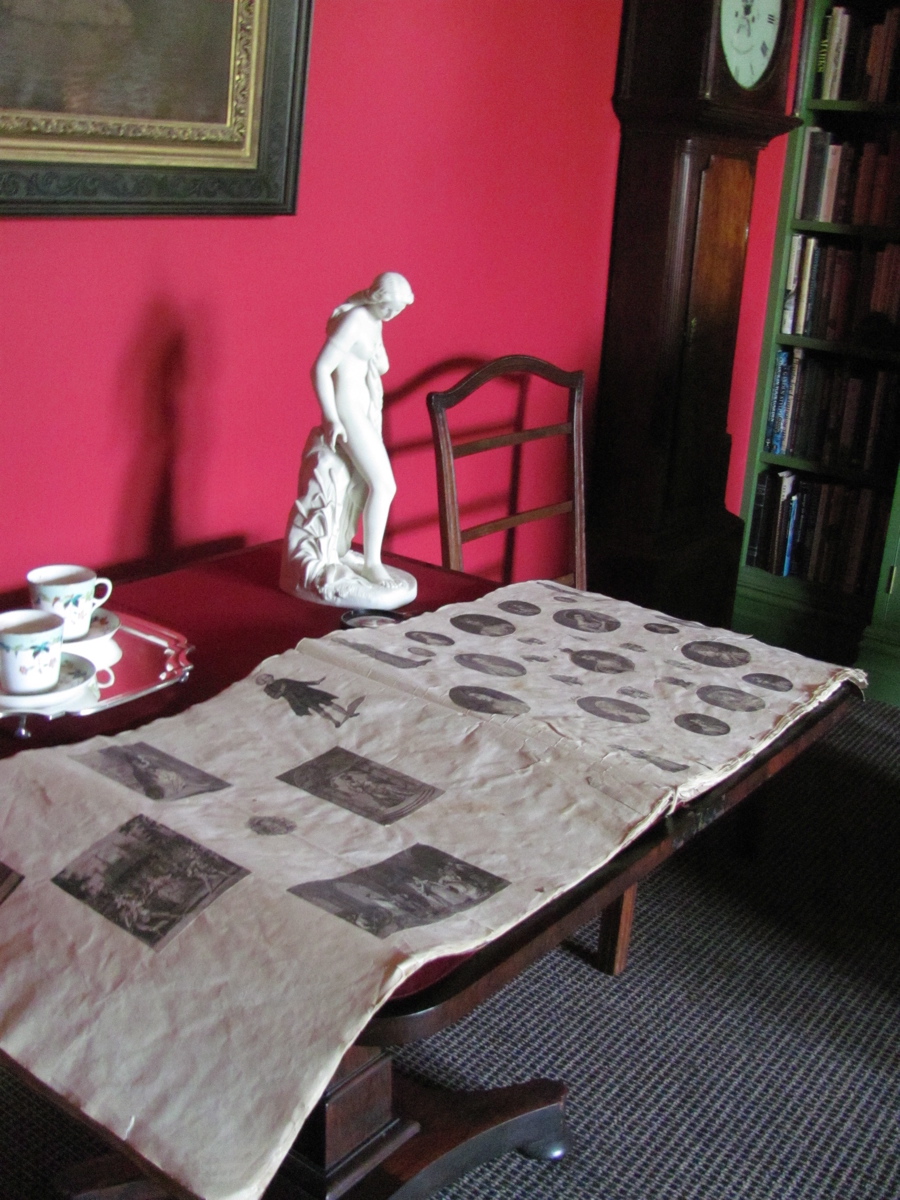
A while back at a Bethune’s book auction in Auckland I bid on and got an 18th century scrapbook. I was the only bidder for what would have appeared a slightly tatty one-off and the price was correspondingly low. It was a large (470 x 580mm) leather covered album in which someone in the late 18th century had carefully cut out all sorts of images and made up a composite view of the world.

This was a favourite thing for women, in particular, to do: that is, leisured women, those who weren’t lighting fires, washing, cleaning and doing all the work the leisured classes required to keep up maximum levels of decorative idleness (it’s an art of purdah, I guess). So on the long wet and cold winter afternoons English women who needed a break from a feverish attack of embroidery would cut out things and paste them into books – and also onto walls.

This was the time of the print room – when carefully cut out steel engravings check were pasted onto walls. Some of these rooms still survive, odd leftovers from a different time.

Having bought the album it sat closed for over a year. Probably it was awaiting its proper surroundings. Then one night recently, Douglas and I had a fire in the library and I got out a magnifying glass and spent a very enjoyable evening scrutinising the engravings in detail.

In a way it was like being taken inside the head of someone for a voyage into a different time and space. The most accurate dating for the album is after 1789. There is a whole page devoted to ‘Hair styles of 1789’ – all elaborate coiffures.

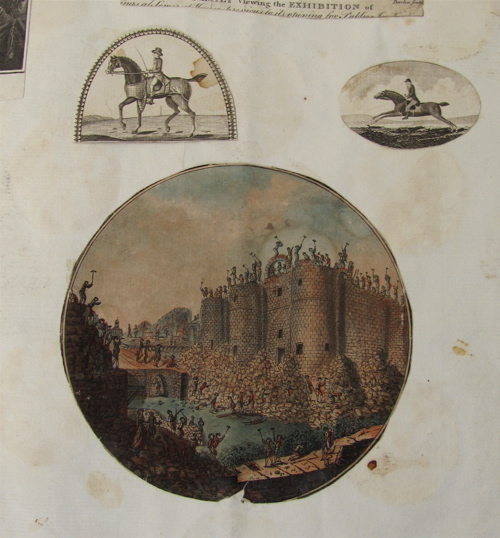
This places the book during that momentous period of the French Revolution. In fact I found a picture, hand tinted, which is of the storming of the Bastille (more accurately it’s demolition by the mob.)

What I love about scrapbooks are the accidental placements. Right above the busy action of a mob in full flight are two little pictures of elegant racehorses streaming along. To the person cutting out the pictures, both are of equal interest or curiosity: both are facets of 18th century human nature.

Discovery was another motif. There was a picture of Capt Cook (alongside other notable King Edward the Confessor) . There is even a picture of a war canoe in New Zealand based on Sydney Parkinson’s etchings, I think.

I also noted that among the ‘Hair styles of 1789’ was a picture of a tattoed woman or man. I couldn’t work out where the person was meant to come from – the Pacific Islands maybe? There was also a picture of black boy gesturing emphatically alongside Justice Denning.

So the book, which seems to depict a static fixed world, in fact, is all about change.

I could understand why these engravings were so sensational. They have a lovely graphic quality, very intense and precise. Shadows are delivered by extra lines. The graphic quality is both stilted and oddly moving. For example the portraits actually did give quite an individual sense of a face.

I spent several hours looking at the pictures in detail. (A magnifying glass has the effect of changing the still picture into a kind of movie by varying the depth and what area of the engraving you are actually scrutinising … so it rushes into close-up).

In time these engravings would have gone completely out of fashion, surpassed by the changes in technology. I guess this is what makes Print Rooms and this album so touching: it is like a slice of time frozen perfectly and delivered into the present.

I have left the album open on a table in the library. Of course accidents happen … the curious cat-kitten landed on it pretty much immediately and insisted she have a kind of bathing beauty snap taken of her. Soon I’ll close the album and then it will be shut away like a magic box till the next time someone looks at it in detail.

PNW

Posted in auction finds etc. | Leave a comment

HOME invasion

a Brian Culy photograph

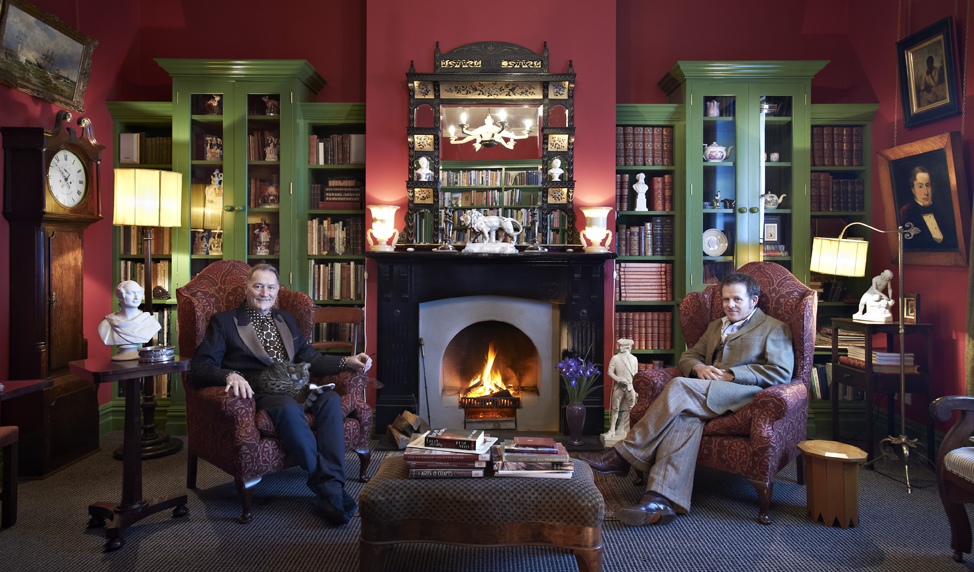
This is Peter and I snapped in the library by photographer Brian Culy. You can read all about it in the June/July issue of Home NZ out now. Then, once you’ve all got your own copy in front of you, I’ll spill the beans on a home invasion of the very nicest sort.

DLJ

Posted in Uncategorized | Leave a comment

Building the Titanic [Bathroom].

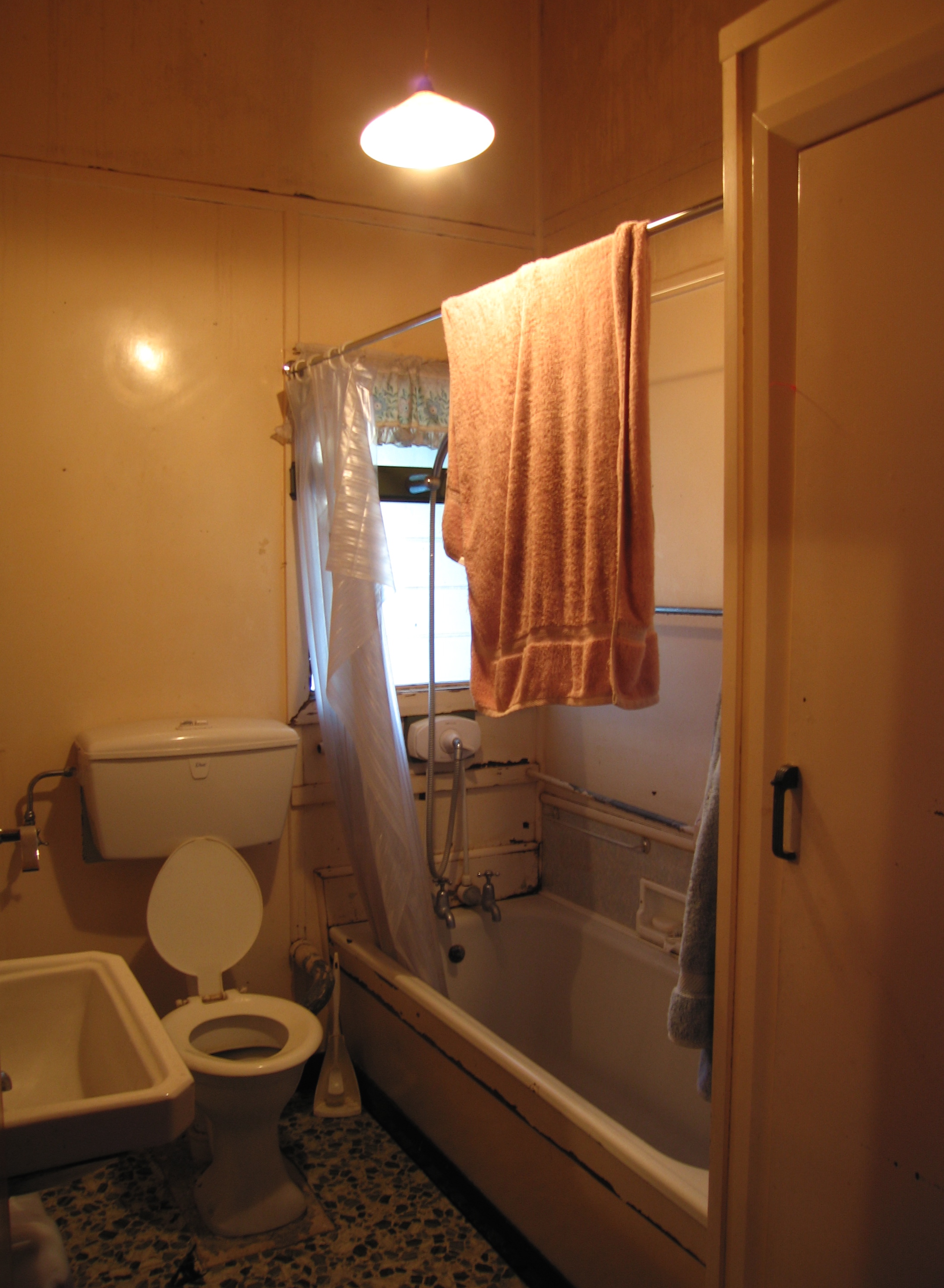
Without a doubt the most unattractive (aka revolting) room in the those when we acquired it, was the bathroom in what we referred to as the second flat. This was the nicest of the three flats and the bathroom had once been new, but it was – needless to say – past its best.

The bathroom as we discovered it.

When we took possession of the second flat we suddenly found ourselves with two bathrooms and two kitchens. The first job on the books was converting the obsolete kitchen into an office (see Original Surfaces). Both this and the bathroom had been carved out of the house’s original dining room and although the bathroom was small, the arrangement of the two rooms worked well. It was decided to progress to the bathroom room next.

The nicest thing about this old version of the bathroom was that we never once had to use it.

With not much thought to the eventual design. I began by simply tearing out the bathroom, stripping it down to the timber framing. This gave me a good view of the proportions of the room which although only 2.4m x 1.8m is 3.5 m high. So in essence I had a grandly proportioned but tiny room.

I don’t really recall now how we settled on the theme for the decoration of the bathroom. What we wanted was something masculine, luxurious, woody and with essentially Edwardian overtones. This came to be referred to as the ‘first class men’s bathroom on the Titanic.’

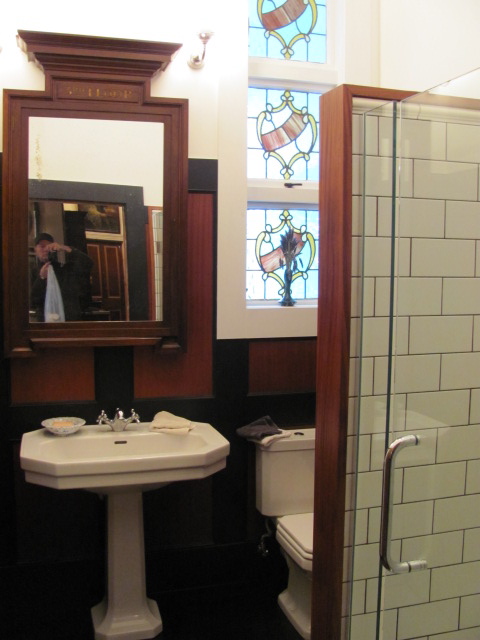
It seems to me that the world is full of what people think are luxurious bathrooms – it usually comes down to a gold-plated tap or some insanely expensive vanity top. I started with a mahogany framed Beaux Arts mirror and a set of 3 heraldic stained glass windows that had turned up in the local auction house. The windows were reset by Adam Morrison, our joiner, and replaced the original pokey little louver in the corner of the room. Suddenly we were on our way.

Window in, room lined and shower cubicle tiled.

Heraldic windows seemed to need an aristocratic ceiling. I decided to try fibrous plaster for the first time. I’d read in World of Interiors  years ago, someone recommending that a small room requires large pieces of furniture and emphatically scaled details. So I went straight to Cararra ceilings – whose moulds date from the Titanic period and were used in big commercial buildings (At the same time I purchased the largest pedestal basin in Duravit’s 1930 range).

I chose a classical molding and an enormous ceiling rose. This turned out to be a problem in that the first plasterers we engaged had never handled anything of this scale. Ever trusting, it wasn’t until I realised that the moldings were being put-on upside down that I had to toughen up and get a more experienced craftsman to finish the job.

Edwardian meant tiles and panelling. We tiled the shower and the space behind what was to be a heated towel rail in simple rectangular white tiles, laid brick style. We asked the tiler for a black grout at which he shook his head. We persevered. When he later came back to do another job, he told us he’d been pushing the white tile/black grout all over town – with no take-up.

My original intension had been to partially panel the walls with teak which seemed ship-like. I gulped a little bit at the cost (remember luxury is much more affordable in a very small room than it is in a large one) but was prepared to dive in when Peter intervened. We’d been talking about teak over and over, but I suspect that Peter, like any number of people, thought of teak as a darker richer mahogany – on seeing a teak sample he said – I HATE THAT!

Remembering the big mahogany mirror, I went instead of mahogany plywood with a pine overlay which I decided to paint – initially green but eventually black.  We discovered Michael O’Dwyer, a builder who understood immediately what was needed and could interpret my rough drawings and he set about panelling the room.

the pedantic approach to masking tape

With Michael’s job done, it was up to me to paint the panelling. Never in my life have I been so pedantic about masking tape. Each mahogany panel was carefully masked off and then a sheet of newspaper taped over that and the edge sealed again.

We’d decided on black – because the top half of the room was pure white. My understanding, having grown up amongst ancient craftsmen, was that with a dark colour you use an undercoat that has been tinted to a dark grey. This gives you better coverage and a deeper colour. Not so, said the man at Resene paints. There are no dark undercoats and their undercoat cannot be tinted He tells me, there is no problem using black over an ordinary undercoat!

After days of careful painting, I was devastated to find, on lifting the masking tape, that the bright white undercoat had penetrated the seal and now edged my mahogany panels like a lace frill. A dark undercoat would have partially alleviated this problem and even after carefull removal of the excess paint with a razor blade, there remains a thin white line that glows sandwiched between the mahogany and the black paint at the edge of each panel.

the lace frill

With the onset of the rare disorder decor depression syndrome,  I admit to having abandoned the project for months (and months). I could never face the painstaking job of addressing almost every panel with a scraper and a paint brush. Peter eventually started talking about ‘getting  a project manager’ to complete  the bathroom’ and I rallied.

We finished the bathroom. The black panelling properly repaired was matched with a black stained floor and then the whole room began to knit together. The Duravit bathroom suite came from Trademe, the lights, pendant and wall, from the local auction. The end result is luxurious and masculine.


the finished bathroom - still tiny but grander

However, like its predecessor, I’ve never used it. On completion I passed it on to Peter as his bathroom. An ideal solution to the problem of who cleans what and when. He lives with the maintenance of the glossy black floor he chose and I get to conjure my own bathroom in a planned extension (along with the fabled girl’s bathroom). At the moment I’m thinking something involving gold-plated taps and marble vanity tops (I jest).

One more thing, in writing this piece I googled ‘First Class Bathroom Titanic,’ something I’m glad I didn’t do at the beginning – imagination is sometimes so much more satisfying that reality.

DLJ

Posted in inspiration, practical matters | 2 Comments

Cleaning up your act

You know that moment you walk into the door after being away. For me it’s like a snapshot of your own life. How does the house look (house being a reality of its own but also a metaphor for how you live life, what you think about your own life.) For this reason I like to clean up the house and have it looking kind of pleasant and ordered when I step inside the house after being away.

This goes into a strange area, which is how inanimate things can seem quite animate: they become enfused with your own wairua, or life spirit. This ebbs and flows in intensity: at times objects can become very full of spirit and actually seem to represent another person fully. This is most obvious when someone you love dies and the things they touched, or the objects closest to them, become full of their fragrance. You keep them, touch them, look at them. In this way you connect with someone who isn’t there.

Houses become full of these (unseen) fragrances: quite unwittingly rooms and houses become the scene settings for our lives. We ‘read’ the story into the setting. This is what makes breaking up a family home so cathartic. You are literally breaking apart the shell of an identity. This is also why people cart away an object from a family home: like a shard, reminding the person of the whole.

This has taken me a long way from the snapshot you take when you enter your own house or flat or bedroom after being away. It goes beyond: does it look tidy? It’s more like: am I happy where I live? Am I happy where I am in my own life?

A pleasantly ordered environment is key to my own stability. I like to think, no matter how effectless I might be in the larger questions of life, to do with how the world is ordered (or more correctly disordered) I can have a small space which is coherent and pleasing. It has to do with order, peace, coherence for me.

So before I go away I get out the hoover and duster. I clean the surfaces. Then I sort of edge out of the scene setting until that moment the key turns in the lock.

And then the house is left to that magical sway of time in which it lives on its own momentum – the house becomes silent, or rather the only sounds are the scraping of bird’s feet as they land on the tin roof, or the creaks of boards as they expand and contract in heat– the house seems enthralled – awaiting that sound of a key rattling in a lock, and then a stranger enters the house again, animating everything – Hello house!’ I call out gladly, as I walk in the door -’ I’m home!’

PW

Posted in Uncategorized | Leave a comment

Colonial Idol: and the contestants are …

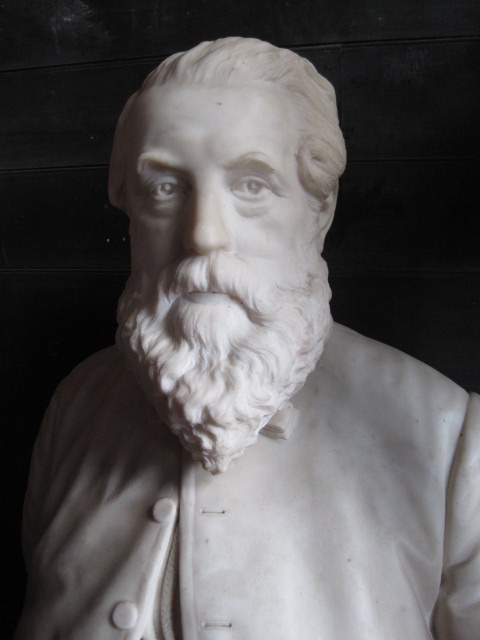
If this man seems familiar it might be that you have spent too long in the pub. For decades he lived on a shelf above the bar of the Birdcage tavern, in Auckland. I acquired him in the sale of contents after that establishment closed.

That diversion aside, I’d like to know who he might be, as he has now wandered into the corner of the Studio, and should he prove worthy enough (i.e. literary or scholarly), he will eventually take up a position on a suitable pedistal in the library.

What do we know? He was carved in Rome in 1883 by Orazio Andreaoni, an Italian sculptor who specialised in producing busts from photographs – particularly popular in the colonies.  Indeed in 1883 – a New Zealander writing under the name of ‘Old Colonist’ in the Southland Times described a visit to Andreoni’s studio in Rome –

‘On another occasion I visited the studio of Andreoni, a sculptor, who, if I am not mistaken in my judgment, will achieve for himself a position of eminence. His skill in producing life-like busts astonished me. And what is more remarkable, he succeeds without the presence of the living subject. Give him a faithful photograph and he manipulates a model in clay so like the person that unless you saw him at work you would scarcely believe that he had not the living individual before him.’

There is a sneaking suspicion Old Colonist may our subject. He writes

I had the opportunity of watching his method with a living subject, from the commencement of the process.  A gentleman who had commissioned Andreoni to sculpture his bust, was seated in an armchair upon a platform, a few feet above the floor in the centre, of the studio. An assistant brought in a pedestal stand on which was a shapeless lump of clay. Signor Andreoni placed this in front of the platform at some little distance from the gentleman in the chair, whose likeness he was about to attempt. The artist’s first aim seemed to be to familiarise his eye with the general appearance of his subject He walked from side to side, occasionally standing a few moments in silent, and earnest contemplation of the gentleman’s features, and the normal expression of his face.

Could this simply be false modesty? Was Old Colonist there to sit for a bust?

The other thing we know is that on the pedistal underneath is written ‘Auckland & Dunedin Centenery.’ Of course the wooden pedistal may have been borrowed from another source but it is worth considering who might have been included in both those events – a politican, a Premier or Prime Minister?

Thus far we’ve eliminated the most common guess, Dick Seddon – (too young in 1883)
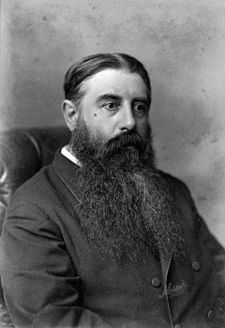
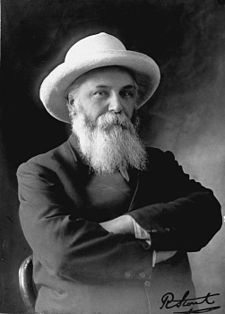
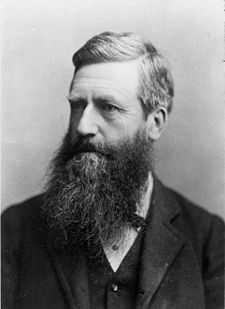
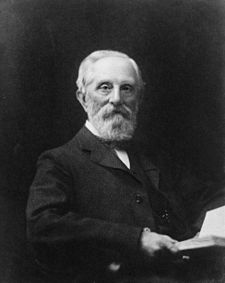
and a few others mostly on the grounds of their beardlessness – John Balance seems only to have had a goatee. The problem is that 1883 is crowded with Prime Ministers  past, current and future all whom were ripe for busts and all of whom sported beards. Here’s a number of possibilites – left to right Vogel, Stout, Atkinson and Hall.


Atkinson seems close however in that case, as with the others, the match doesn’t seem right for a sculptor renowned for an excellent likeness. Then there’s been other suggestions. William Larnach (egotistical enough), Joseph Godfrey Holdsworth (too obscure?) or William Sefton Moorhouse (Christchurch rather than Auckland or Dunedin) have all been suggested. Generally we’ve discounted the possibility of the clergy, soldiers (as they’d be in uniform) and Governors (as they are sure to be wearing their decorations).

At the moment he’s just the (very heavy) guy in the corner but we’d love to identify him, if only so we can greet him properly over breakfast. Any thoughts?

DLJ

Posted in art | 2 Comments

How to decorate your hotel room

On a Tuesday night, I find myself at Dunbar’s in Auckland. The catalogue for this sale hadn’t been particularly spectacular and I wasn’t going to go. Dunbar’s Auckland sales are never as strong as their Wellington ones – in part because they are forever having to offer works in sun-damaged Georgian and borer-riddled Victorian that have been wrenched from the estates of sub-tropical Auckland.

It had been a long drive from Napier and lounging around in my room waiting the first episode of Downton Abbey seemed a tempting alternative to venturing out. However there were a small group of daguerreotypes of departed Nineteenth century gentlemen, complete with lustrous gold frames and velvet-lined cases, at Dunbar’s and  so I went.

The temperature in the room was flat – with almost every lot selling well under the low end of its  range. This of course is dangerous territory, as things you haven’t viewed properly becomes a very tempting – all potential bargains. The mood was sullen, almost morose, despite the porter’s best efforts to add some humour into the proceedings. As so often happens at antique sales these days everyone seemed to get what they want after a bid or two. Except of course when it’s me – a lovely majolica teapot had caught my eye at the viewing and so I bid – but the other bidder held on tenaciously and now has a lovely Wedgewood majolica teapot for her efforts.

damaged goods

The scenario on the daguerreotypes is similar. I came away with one, the one I most wanted but that too most eyes was the least attractive (being damaged and not pristine) and a small miniature – not on my original list but something I’d seen pre- auction. It is of a sailor, Andrew Macredie, drowned at sea 1804. He is rugged rather than handsome but I’m happy to have rescued him from a neglectful family whose whole history, in miniatures, silhouettes and daguerreotypes was on the block tonight.

Most of the night was spent texting friends and reading forward in the catalogue. A friend who figures out where I am, suggests “perhaps you have a problem” and offers to find me “a counsellor.”

The Oriental part of the sale seem stronger. I mark a few things and decide it’s worth staying. I end up with two blue and white late 19th century Japanese chargers. They cost me $40 the lower estimate was $200 and so they seem a bargain – for something I didn’t look at closely. However this time it turns out they are – rather lovely and of good scale. I’m already thinking about how I might use them at home.

As the sale only has 30 or 40 lots to go and one of the last is one of those tempting unloved dinner services – this time Hamilton by Burgess & Leigh’s Middleport Pottery, Burslem. Created in what they called ‘semi-porcelain’ it is in a glittering sub nouveau pattern edged with gold and  … well lets just say I add this to my auction cart and proceed to checkout.

Back in my hotel room I’m watching the second half of Downton Abbey, wallowing in its decor.  I realise how particularly bland my hotel room is this time. The hotel is full – I can tell this from the car park, and they’ve put me in a ground floor room obviously specially designed for the disabled – I can tell this from the bathroom. It is rather a disheartening thought, as the room is less than less than charming.  There are, I notice, no pictures on the walls a weird omission that somehow feels a little unfair to the disabled.

Andrew Macredie - drowned at sea 1804

I have been known to take pictures down from the walls of motels and put them in the cupboard, if looking at any length of stay. Particularly ones with religious or new age overtones of which motelliers seem to have a ready supply.  This time I’m doing the opposite – I arrange my Japanese chargers against the wall of the kitchenette – next to the plastic jug and the free sachets of tea. I prop my daguerreotype against the  bedside table and then I look to hang my miniature. Without a picture hook to hang it on I am stumped.

How here’s a McGyver-style tip – when looking for a drawing pin in a crisis – check the soles of your shoes – it just so happens my boots have picked up a bright red headed map pin.  With my rescued sailor on the wall – my dinner service awaiting a wash and my blue and white chargers propped up behind it, I have turned a bland hotel room into a home away from home, a little Downton Abbey in Ponsonby and I can at last relax.

Posted in art | Leave a comment